funics

Author Archive

Grover Washington, Jr – Winelight

In Album, Make Me a Memory on March 30, 2012 at 10:56 am

Grover_Washington,_Jr._-_WinelightWinelight, featuring the track “Just The Two Of Us,” went platinum and garnered two Grammy awards. Winelight is probably one of Grover Washington’s best-loved albums. It includes Bill Withers’ Grammy Award winning song “Just the Two of Us,” and other well-executed smooth jazz compositions. Washington has long been one of the leaders in R&B-influenced jazz, and this album consolidates his claim to fame as one of the fathers of this often misunderstood sub-genre. Steve Gadd’s smart drumming gives each song a relaxed, infectious groove. The saxophonist really unwinds on tunes such as “Let it Flow (for “Dr. J.)” and “Make Me a Memory (Sad Samba),” improvising over a soulful blend of blues, jazz, and pop, a combination both accessible to mainstream pop listeners and musically compelling to jazz fans. Recorded in June and July 1980. Also available with Come Morning on 1 cassette. Live Recording Personnel: Grover Washington, Jr. (soprano, alto & tenor saxophones); Bill Withers (vocals); Paul Griffin, Richard Tee (Fender Rhodes); Raymond Chew (Clavinet); Bill Eaton, Ed Walsh (synthesizer); Eric Gale (guitar); Marcus Miller (bass); Steve Gadd (drums); Robert Greenidge (steel drums); Ralph MacDonald (percussion); Hilda Harris, Yvonne Lewis, Ullanda McCullough (background vocals). Producers: Grover Washington, Jr, Ralph MacDonald. Personnel: Grover Washington, Jr. (saxophone, soprano saxophone, alto saxophone, tenor saxophone); Bill Withers (vocals); Eric Gale (guitar); Paul Griffin (Fender Rhodes piano, Clavinet, keyboards); Richard Tee (Fender Rhodes piano); Ray Chew (Clavinet); Bill Eaton (Oberheim synthesizer); Steve Gadd (drums); Ralph MacDonald (congas, percussion); Robert Greenidge (steel drum); Ullanda McCullough, Yvonne Lewis, Hilda Harris (background vocals). Audio Remixer: Elliot Scheiner. Liner Note Author: David Nathan.

Recording information: Rosebud Recording Studio (06/1980-07/1980).gw

Photographers: Don Hunstein; Tom Copi; Jim Shea; Robin Kaplan; Scott Weiner.

Arranger: Bill Eaton.

tracks

  1. Winelight
  2. Let It Flow (For Dr. J)
  3. In the Name of Love
  4. Take Me There
  5. Just The Two Of Us cd
  6. Make Me a Memory (Sad Samba) 6:32

Soirée Ethiopienne Grar-Acacia, le 12 Mai, à St Nom la Bretèche, avec funics

In Concert on March 19, 2012 at 6:25 pm

Image

Soirée Grar Acacia, le 12 mai 2012

à Saint Nom la Bretèche

Espace Jacques Kosciusko-Morizet

1 Place Henri Hamel

78860 Saint Nom la Bretèche

plan d’accès

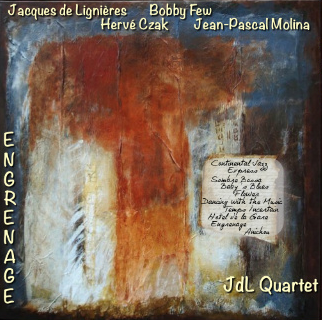
JDL Quartet – New Noomiz site, new album

In Album, Concert, Events on February 20, 2012 at 10:48 pm

Jacques de Lignières (Sax), Hervé Czak (Contrebasse),

Jean Pascal Molina (Batterie) , Bobby Few (Piano)

new Album in preparation! Stay tuned :

“Engrenage”

JDL Quartet Noomiz   (new web site)

La playlist complete de ce nouvel album, et des extraits sonores

  • Jazz continental Express
  • Sombre bossa jdl…
  • Baby’s blues jdl
  • Flower bf

This slideshow requires JavaScript.

JDL Quartet new album “Engrenage”

In Concert, Events on February 19, 2012 at 10:33 pm

Jacques de Lignières (Sax), Hervé Czak (Contrebasse),

Jean Pascal Molina (Batterie) , Bobby Few (Piano)

new Album in preparation!

Stay tuned :

“Engrenage”

jdl quartet engrenage

Peinture de Marie Barbé "Fragments d'écrits"

Chicago Song (A Change of Heart) David Sanborn

In Chicago Song on February 18, 2012 at 3:59 pm

A Change of Heart (1987) Warner Bros

By the mid 1980s saxophonist David Sanborn’s sound was dominated by the synthetic tinge of keyboards and synthesizers, falling in line with the slick, crossover jazz style of the era. 1987’s Change of Heart is emblematic of Sanborn’s direction at the time, and its eight tracks alternate between funky, danceable numbers and smooth ballads, all with a highly polished commercial veneer. Sanborn seldom gets adventurous; but that’s not what his listeners expect. Rather, Change of Heart shows off the saxophonist’s bright, groovy sound and plenty of his patented high-register playing.

Engineers include: Michael Hutchinson, Eric Calvi, Keith Seppanen.

Personnel includes: David Sanborn (alto saxophone); Mac Rebennack (piano); Don Grolnick (electric piano); Philippe Saisse (keyboards, synthesizers, programming); Michael Colina, Ronnie Foster (synthesizers, programming); John Mahoney (Synclavier); Michael Brecker (EWI); Carlos Rios (acoustic & electric guitars); Marcus Miller (guitar, keyboards, bass); Hugh McCracken, Nicky Moroch, Hiram Bullock (guitar); Anthony Jackson (bass); Steve Ferrone, Micky Curry, John Robinson, Steve Gadd (drums); Mino Cinelu (percussion, electronic drums); Paulinho Da Costa (percussion); Jason Miles (synthesizer programming).

Producers: Marcus Miller, Ronnie Foster, Philippe Saisse, Micheal Colina.

Tracks:

  1. Chicago Song (6:26)
  2. Imogene (5:26)
  3. High Roller (4:39)
  4. Tintin (4:05)
  5. Breaking Point (4:26)
  6. A Change of Heart (5:07)
  7. Summer (5:45)
  8. The Dream (4:58)

01 – Chicago Song (Marcus Miller)

  • David Sanborn: Saxophone Alto
  • Jason Miles: Programmation (Synthétiseurs)
  • Bernard Wright: Synthétiseurs additionnels
  • Marcus Miller: Claviers, Basse, Guitare rythmique
  • Hiram Bullock: Guitare
  • Steve Ferrone: Batterie
  • Mark Stevens: Choeurs

Marcus Miller Biography

In Bio, Chicago Song on February 18, 2012 at 12:16 am

Marcus Miller (born William Henry Marcus Miller Jr., June 14, 1959, Brooklyn, New York) is an American jazz composer, producer, and multi-instrumentalist. Miller is best known as a bassist, working with trumpeter Miles Davis, pianist Herbie Hancock, singer Luther Vandross, and saxophonist David Sanborn, as well as maintaining a prolific solo career. Miller is classically trained as a clarinetist and also plays keyboards, saxophone and guitar.

Life and career

Early life

Miller was born in 1959 and raised in a musical family that includes his father, William Miller (a church organist and choir director) and jazz pianist Wynton Kelly. By 13, Marcus was proficient on clarinet, piano and bass guitar, and already writing songs. Two years later he was working regularly inNew York City, eventually playing bass and writing music for jazz flautist Bobbi Humphrey and keyboardist Lonnie Liston Smith. Miller soon became a first call session musician, gracing well over 500 albums, a short list of which includes Michael Jackson, Herbie Hancock, Mariah Carey, Wayne Shorter, McCoy Tyner, Frank Sinatra, Dr. John, Aretha Franklin, Elton John, Grover Washington Jr., Donald Fagen, Bill Withers, Chaka Khan, LL Cool J, Me’shell Ndegé Ocello and Flavio Sala.

Professional career

Miller at the Paradiso in Amsterdam, 2007

Miller spent approximately 15 years performing as a sideman or session musician, observing how band leaders operated. During that time he also did a lot of arranging and producing. He was a member of the Saturday Night Live band 1978-1979. He wrote the intro to Aretha Franklin’s ‘I Wanna Make It Up To You’. He has played bass on over 500 recordings including those of Luther Vandross, Grover Washington Jr., Roberta Flack, Carly Simon, McCoy Tyner, Bryan Ferry andBilly Idol. He won the “Most Valuable Player” award, (awarded by NARAS to recognize studio musicians) three years in a row and was subsequently awarded “player emeritus” status and retired from eligibility. In the nineties, Miller began to make his own records, putting a band together to take advantage of touring opportunities.

Miller’s proficiency on his main instrument, the bass guitar, is generally well-regarded. Not only has Miller been involved in the continuing development of the technique known as “slapping”, particularly his “thumb” technique, but his fretless bass technique has also served as an inspiration to many, and he has taken the fretless bass into musical contexts and genres previously unexplored. The influences of some of the previous generation of electric bass players, such as Larry Graham, Stanley Clarke, and Jaco Pastorius, are audible in Miller’s playing. Early in his career, Miller was accused of being simply imitative of Pastorius, but has since more fully integrated the latter’s methodology into his own sound.

Miller has an extensive discography, and tours frequently and widely in Europe and Japan.

Between 1988 and 1990 he appeared in the first season and again toward the end as both the musical director and also as the house band bass player in the Sunday Night Band during the two seasons of the acclaimed music performance program Sunday Night on NBC late-night television.

As a composer, Miller wrote “Tutu” for Miles Davis, a piece that defined Davis’s career in the late 1980s, and was the title track of Davis’s album Tutu, upon which Miller wrote all the songs with only two exceptions, and one of those was co-written with Davis. He also composed “Chicago Song” for David Sanborn and co-wrote “‘Til My Baby Comes Home”, “It’s Over Now”, “For You to Love”, and “Power of Love” forLuther Vandross. Miller also wrote “Da Butt”, which was featured in Spike Lee’s School Daze.

Personal life

Miller has a wife and four children: two daughters and two sons, one of whom, Jon, recently graduated from Columbia Universityand now works for radio and television host Glenn Beck.

Grammy Awards

Miller has won numerous Grammy Awards as a producer for Miles Davis, Luther Vandross, David Sanborn, Bob James, Chaka Khan andWayne Shorter. He won a Grammy Award for Best R&B Song in 1992, for Luther Vandross’ “Power of Love” and in 2001 he won for Best Contemporary Jazz Album for his fourth solo instrumental album, M2.

Miller currently has his own band. In 1997 he played bass and bass clarinet in a band called Legends, featuring Eric Clapton (guitars and vocals), Joe Sample (piano), David Sanborn (alto sax) and Steve Gadd (drums). It was an 11-date tour of major jazz festivals inEurope.

In addition to his recording and performance career, Miller has established a parallel career as a film score composer. He has written numerous scores for films featuring Eddie Murphy, L.L. Cool J, Chris Rock, Matthew Perry, Samuel L. Jackson and others. He composed the musical score for the Chris Rock-created sit-com, Everybody Hates Chris, now in syndication on Nick-At Nite.

Instruments and gear

He plays a 1977 Fender Jazz Bass that was modified by Roger Sadowsky with the addition of a Bartolini preamp so he could control his sound in the studio. Fender currently produces a Marcus Miller signature Fender Jazz Bass in four- (made in Japan) and five-string (made in U.S) versions.

Discography

Solo period (1982–present)

  • 1983: Suddenly
  • 1984: Marcus Miller
  • 1993: The Sun Don’t Lie
  • 1995: Tales
  • 1998: Live & More
  • 2000: Best of ’82-’96
  • 2001:  (2002 Grammy Award for Best Contemporary Jazz Album)
  • 2002: The Ozell Tapes – Live 2001
  • 2005: Silver Rain
  • 2007: Free
  • 2008: Marcus[4]
  • 2008: Thunder (as SMV, with Stanley Clarke and Victor Wooten)
  • 2010: A Night in Monte Carlo – Live 2009
  • 2011: Tutu Revisited – Live 2010
  • 2012: tba

Luther Vandross period

  • 1983: “Busy Body”
  • 1985: “The Night I Fell In Love”
  • 1985: “‘Til My Baby Comes Home”
  • 1985: “It’s Over Now”
  • 1986: “I Really Didn’t Mean It”
  • 1986: “Never Too Much”
  • 1986: “She Won’t Talk To Me”
  • 1986: “Give Me the Reason”
  • 1987: “Stop to Love”
  • 1987: “See Me”
  • 1988: “Luther In Love – Megamix”
  • 1988: “Any Love”
  • 1989: “The Best of Love”
  • 1989: “Come Back”
  • 1991: “The Rush”
  • 1991: “Power of Love / Love Power (Uno Clio & Colin and Carl Remix)”
  • 1991: “Power of Love / Love Power”
  • 1991: “Power of Love”
  • 1993: “Never Let Me Go”
  • 1993: “Heaven Knows”
  • 1995: “This Is Christmas”
  • 1995: “Power of Love / Love Power (The Frankie Knuckles Mixes)”
  • 1996: “Your Secret Love”
  • 1996: “I Can Make It Better”
  • 1998: “I Know”
  • 2001: “Luther Vandross”
  • 2003: “Dance With My Father”
  • 2007: “Love, Luther”

Grover Washington jr period

  • 1984: Inside Moves

David Sanborn period (1975–2000)

  • 1977: Lovesongs
  • 1980: Hideaway
  • 1981: Voyeur
  • 1981: As We Speak
  • 1982: Backstreet
  • 1984: Straight to the Heart
  • 1987: Change of Heart
  • 1988: Close-Up
  • 1991: Another Hand
  • 1992: Upfront
  • 1994: Hearsay
  • 1995: Pearls
  • 1996: Songs from the Night Before
  • 1999: Inside

Miles Davis period (1980–1990)

  • 1981: The Man with the Horn
  • 1982: We Want Miles
  • 1983: Star People
  • 1986: Tutu
  • 1987: Music From Siesta
  • 1989: Amandla
  • 2002: The Complete Miles Davis at Montreux

The Jamaica Boys period (1986–1990)

  • 1987: The Jamaica Boys
  • 1989: The Jamaica Boys II: J. Boys

Film scores

  • 1990: “House Party” (featuring Kid & Play)
  • 1992: “Boomerang” (featuring Eddie Murphy)
  • 1994: “Above the Rim” (featuring Tupac Shakur)
  • 1994: “A Low Down Dirty Shame” (featuring Keenan Ivory Wayans)
  • 1996: “The Great White Hype” (featuring Samuel L. Jackson)
  • 1997: “The Sixth Man” (featuring Marlon Wayans)
  • 1999: “An American Love Story”
  • 2000: “The Ladies Man” (featuring Tim Meadows)
  • 2001: “The Trumpet of the Swan” (featuring Reese Witherspoon)
  • 2001: “The Brothers” (featuring Morris Chestnut)
  • 2001: “Two Can Play That Game” (featuring Vivaca Fox)
  • 2002: “Serving Sara” (featuring Matthew Perry)
  • 2003: “Deliver Us from Eva” (featuring L.L. Cool J)
  • 2003: “Head of State” (featuring Chris Rock)
  • 2004: “Breakin’ All the Rules” (featuring Jamie Foxx)
  • 2005: “King’s Ransom” (featuring Anthony Anderson)
  • 2006: “Save the Last Dance 2” (featuring Izabella Miko)
  • 2007: “I Think I Love My Wife” (featuring Chris Rock)
  • 2007: “This Christmas” (featuring Idris Elba)
  • 2008: “Thunder” (featuring Stanley Clark and Victor Wooten)
  • 2009: “Good Hair” (featuring Chris Rock as SMV)
  • 2009: “Obsessed” (featuring Beyoncé Knowles)

David Sanborn Biography

In Bio, Chicago Song on February 17, 2012 at 11:42 pm

David Sanborn (born July 30, 1945) is an American alto saxophonist. David SanbornThough Sanborn has worked in many genres, his solo recordings typically blend jazz with instrumental pop and R&B. He released his first solo album Taking Off in 1975, but has been playing the saxophone since before he was in high school. Sanborn has also worked extensively as a session musician, notably on David Bowie’s Young Americans (1975).

One of the most commercially successful American saxophonists to earn prominence since the 1980s, Sanborn is described by critic Scott Yannow as “the most influential saxophonist on pop, R&B, and crossover players of the past 20 years.” Sanborn is often identified with radio-friendly smooth jazz However, Sanborn has expressed a disinclination for both the genre itself and his association with it.

Biography

Early years

Sanborn was born in Tampa, Florida, and grew up in Kirkwood, Missouri. He suffered from polio in his youth, and began playing the saxophone on a physician’s advice to strengthen his weakened chest muscles and improve his breathing. Alto saxophonist Hank Crawford, at the time a member of Ray Charles’ band, was an early and lasting influence on Sanborn. Sanborn performed with blues musicians Albert King and Little Milton at the age of 14, and continued playing blues when he joined Paul Butterfield’s band in 1967, after attending the University of Iowa.

Although Sanborn is most associated with smooth jazz, he explored the edges of free jazz in his youth, studying with saxophonists Roscoe Mitchell and Julius Hemphill. In 1993, he revisited this genre when he appeared on Tim Berne’s Diminutive Mysteries, dedicated to Hemphill. Sanborn’s album Another Hand also featured leading avant garde musicians.

In his three and-a-half decade career, Sanborn has released 24 albums, won six Grammy awards and has had eight gold albums and one platinum album. He continues to be one of the most highly active musicians of his genre, with 2010 tour dates exceeding 150.

Recordings

He has been a highly regarded session player since the late 1960s, playing with an array of well-known artists, such as James Brown, Bryan Ferry, Michael Stanley, Eric Clapton, Bobby Charles, Cat Stevens, Roger Daltrey, Stevie Wonder, Paul Simon, Jaco Pastorius, the Brecker Brothers, Michael Franks, Kenny Loggins, Casiopea, Players Association, David Bowie, Todd Rundgren, Bruce Springsteen, Little Feat, Tommy Bolin, Bob James, James Taylor, Al Jarreau, Pure Prairie League, Kenny G, George Benson, Joe Beck, Donny Hathaway, Elton John, Gil Evans, Carly Simon, Guru, Linda Ronstadt, Billy Joel, Kenny Garrett, Roger Waters, Steely Dan, Ween, the Eagles, The Grateful Dead, the German group Nena, and Japanese pop star Utada Hikaru.

Sanborn has won numerous awards including Grammy Awards for Voyeur (1981), Double Vision (1986), a Change of Heart (Chicago Song) (1987) and the instrumental album Close Up (1988). In television, Sanborn is well known for his sax solo in the theme song for the NBC hit drama L.A. Law. He has also done some film scoring for films such as Lethal Weapon and Scrooged. In 1991 Sanborn recorded Another Hand, which the All Music Guide to Jazz described as a “return by Sanborn to his real, true love: unadorned (or only partly adorned) jazz” that “balanced the scales” against his smooth jazz material. The album, produced by Hal Willner, featured musicians from outside the smooth jazz scene, such as Charlie Haden, Jack DeJohnette, Bill Frisell, and Marc Ribot. His more recent albums include Closer.

In 1994 Sanborn appeared in A Celebration: The Music of Pete Townshend and The Who, also known as Daltrey Sings Townshend. This was a two-night concert at Carnegie Hall produced by Roger Daltrey of English rock band The Who in celebration of his fiftieth birthday. In 1994 a CD and a VHS video were issued, and in 1998 a DVD was released.

In 1995 he performed in The Wizard of Oz in Concert: Dreams Come True a musical performance of the popular story at Lincoln Center to benefit the Children’s Defense Fund. The performance was originally broadcast on Turner Network Television (TNT), and issued on CD and video in 1996.

Broadcasting activities

Sanborn has performed on both radio and television broadcasts; he has also acted as a host. Since the late 1980s he has been a regular guest member of Paul Shaffer’s band on Late Night with David Letterman. From 1988-89, he co-hosted Night Music, a late-night music show on NBC television with Jools Holland. Following producer Hal Willner’s eclectic approach, the show positioned Sanborn with many famed musicians, such as Miles Davis, Dizzy Gillespie, Pharoah Sanders, Eric Clapton, Robert Cray, Lou Reed, Jean-Luc Ponty, Santana, Todd Rundgren, Youssou N’dour, Pere Ubu, Loudon Wainwright III, Mary Margaret O’Hara, Screamin’ Jay Hawkins, and Curtis Mayfield. During the 1980s and 1990s, Sanborn hosted a syndicated radio program, The Jazz Show with David Sanborn. Sanborn has recorded many shows’ theme songs as well as several other songs for The Late Late Show with Tom Snyder.

More recent activities

In 2004, Sanborn was inducted into the St. Louis Walk of Fame. In 2006, he was featured in Gordon Goodwin’s Big Phat Band’s album The Phat Pack on the track “Play That Funky Music”, a remake of the Wild Cherry’ hit in a big band style. Sanborn often performs at Japan’s Blue Note venues in Nagoya, Osaka, and Tokyo. He plays on the song “Your Party” on Ween’s 2007 release La Cucaracha. On April 8, 2007, Sanborn sat in with the Allman Brothers Band during their annual run at the Beacon Theatre in New York City.

In 2010, Sanborn toured primarily with a trio featuring jazz organist Joey DeFrancesco where they played the combination of blues and jazz found in his latest album. “Only Everything”. In 2011, Sanborn will tour with keyboardist George Duke and bassist Marcus Miller as the group “DMS”.

Discography

Albums

As leader

  • Taking Off (1975)
  • Beck & Sanborn, with Joe Beck (1975)
  • David Sanborn (1976)
  • Promise Me the Moon (1977)
  • Heart to Heart (1978)
  • Hideaway (1979)
  • Voyeur (1981)
  • As We Speak (1981)
  • Backstreet (1982)
  • Straight to the Heart (1984)
  • Double Vision, with Bob James (1986)
  • A Change of Heart (1987)
  • Close Up (1988)
  • Another Hand (1991)
  • Upfront (1992)
  • Hearsay (1994)
  • The Best of David Sanborn (1994)
  • Pearls (1995)
  • Love Songs (1995)
  • Songs from the Night Before (1996)
  • Inside (1999)
  • The Essentials (2002)
  • Time Again (2003)
  • Closer (2005)
  • Original Album Classics (5 CD box set of 5 albums reissued in replica LP covers)
  • Here and Gone (2008)
  • Only Everything (2010)

As sideman

With Hubert Laws

  • The Chicago Theme (CTI, 1974)

DVDs

  • Legends: Live at Montreux 1997 (Released: 2005)
  • The Legends of Jazz: Showcase (Released: 2006)

Filmography

Actor/Host

  • The Wizard of Oz in Concert: Dreams Come True (1995)
    Cast member in the TV musical
  • Scrooged (1988)
    Played a street musician
  • Sunday Night (1988)
    Was the host of this music show (later known as Michelob Presents Night Music)
  • Magnum P.I. (1986)
    Was guest saxophonist in the episode L.A.
  • Stelle Sulla Citta (1983)

Himself

  • Eric Clapton & Friends in Concert (1999)
  • Burt Bacharach: One Amazing Night (1995)
  • The Kennedy Center Honors: A Celebration of the Performing Arts (1996)
  • Forget Paris (1995)
  • Celebration: The Music of Pete Townshend and The Who (1994)
  • Michael Kamen: Concert for Saxophone (1991)
  • Benny Carter: Symphony in Riffs (1989)
  • The 2nd Annual Soul Train Music Awards (1988)
  • The 1st Annual Soul Train Music Awards (1987)
  • One Trick Pony (1980)
  • Late Night with David Letterman / The David Letterman Show (occasionally, 1986)
  • Saturday Night Live (15 March 1980)
  • Lethal Weapon 4 (1998)
  • Lethal Weapon 3 (1992)
  • Lethal Weapon 2 (1989)
  • Psycho III (1986)
  • Finnegan Begin Again (1985)
  • Stelle Sulla Citta (1983)
  • Moment to Moment (1975)
  • Forget Paris (1995)
  • Tequila Sunrise (1988)
  • Lethal Weapon (1987)
  • Psycho III (1986)
  • Murphy’s Romance (1985)
  • Saturday Night Live (1975)

Gear List

  • Saxophone
    Selmer Mark VI Alto Saxophone
    Manufacturer: Selmer
    Location: Paris, France
    Retail Value (approx): $6,000 (US)
  • Reeds
    Vandoren V16 reeds
    Each reed lasts David roughly a week.
  • Mouthpiece
    A modified Dukoff D8 Metal Alto Sax Mouthpiece
  • Ligature
    A Harrison Ligature
  • Bell Jar
    To keep his reeds humidified without over-soaking them, David soaks the reeds in water in a bell jar. First he soaks them for a couple of hours in the jar, and then empties out most of the water so that the reeds won’t get wet, but will still stay humid. He finds this technique extremely valuable.
  • References
  1. a b Cook, Richard; Brian Morton (1996) [1992]. The Penguin Guide to Jazz on CD (Third ed.). London: Penguin Group. pp. 1148–1149.ISBN 0-14-051368-X.
  2. ^ “Biography”. Official Community of David Sanborn. Retrieved 2008-05-15.
  3. ^ Yannow, Scott “David Sanborn — Biography” from Allmusic.com, URL accessed 21 May 2011
  4. a b c Balfany, Greg (January/February 1989). “David Sanborn”. Saxophone Journal 13 (4): pp. 28–31
  5. ^ “Sessions”. Official Community of David Sanborn. Retrieved 2008-05-15
  6. ^ Wynn, Ron (1994). All Music Guide to Jazz. San Francisco: Miller Freeman. p. 567. ISBN 0879303085
  7. a b “Discography”. Official Community of David Sanborn. Retrieved 2008-05-16.
  8. a b c d “Filmography”. Official Community of David Sanborn. Retrieved 2008-05-16.
  9. ^ “Lethal Weapon (1987) Full cast and crew”. IMDB. Retrieved 27 November 2011.
  10. ^ “Gear List”. Official Community of David Sanborn. Retrieved 2008-05-16.

Chicago Song Bass line

In Chicago Song on February 17, 2012 at 4:08 pm

Marcus Miller’s anthem, Chicago Song, the addictive and groovy bass line


from: http://www.lucaspickford.com

Jazz Slang

In Others on February 12, 2012 at 3:46 pm

From just about its inception, Jazz has had a (spoken) language all its own.
Though most words haven’t seen the light of day outside of a jazz club, quite a few have found their way into the mainstream American lexicon, and are still bandied about today. Words like, hipcat and daddy-o have helped contribute to Jazz’s “cool” mystique.

18 Karat — All the way, full out.
The Duke is a classy guy, his heart is “18 karat.”

Air-check — A recording of a radio or television performance.
Did you hear the “air-check” of Billie Holiday with Gerry Mulligan?

The Apple — New York city. This is now common usage.
We got a gig up in “The Apple” at Minton’s with Diz and Bird.

Axe — An instrument.
Hey, Jack, bring your “axe” over tomorrow and we’ll jam.

Baby — A term of endearment.
Hey, “baby,” I got some bread, lets paint the town.

Bad — Good.
Thar dude Wynton Marsalis does some “bad” ass playin’.

Bag — A person’s particular interest.
I’d like to play with your combo, dude, but your sound just ain’t my “bag.”.

Balloon lungs — A brass man with plenty of wind.
That cat must have “balloon lungs,” Stix said he held that note for three and half minutes!”

Barn Burner — Originally in Sinatra slang this was a stylish, classy woman, but today, it can even be applied to a good football game.
Hey, Quincy, did you see Stella over at the diner? Man, she is one amazing “barn burner.”

Barrelhouse — Barrelhouse was the colloquial term for a cabaret in New Orleans where liquor was served. Barrelhouse music is the type of music played in one of these cabarets.
Hey, Man, I dig this “barrelhouse” music. It flows free.

Beat — Exhausted or tired.
Man, we been blowin’ all night. I’m really “beat.”

Birdbrain — A Charlie Parker imitator.
It’s 1957 already. We need something new. I’m gettin’ tired of all of the “Birdbrains” around these days..

Blow — A jazzman’s term for playing any instrument.
That European guy, Django Reinhardt, can really “blow.”

Blow your top — A phrase which expresses enthusiasm or exasperation.
Hey man, I know it’s tough, but don’t “blow your top.”

The Bomb — Very cool.
The Crusader’s new CD, “Louisiana Hot Sauce” is “the bomb.”

Boogie Man — In the jazz slanguage of 1935, this was a critic.
Roscoe just waxed a great disc and the “boogie man” gave it a bad review.

Boogie Woogie — An early piano blues form that was popularized in Chicago. The term has sexual overtones.
Hey, Lester, dig that “boogie woogie” that Yancy is layin’ down.

Bose Bouncing — To play notes so low as to bounce a Bose speaker from its foundation.
I’m sorry, my bass player was just “Bose bouncing.

Bread — A jazzman’s word for money.
Alright, Jack, if ya want me to play, ya gotta come up with some “bread.”

Break it down — Get hot!! Go to town.

Bring Down or Bringdown — As a verb – to depress. As a noun – one who depresses.
Hey, man, don’t “bring me down” with all of this crazy talk.
Hey, let’s get out of here, that guy is a real “bringdown.”

Bug — To annoy or bewilder.
Man, don’t “bug” me with that jive about cleanin’ up my act.

Burnin — Used to describe a particularly emotional or technically excellent solo.
Hey, man, did you hear that solo by Lee? It was “burnin.”

Cans — Headphones.
That last take was really kickin’, put on the “cans” and lets record the final take.

Cats — Folks who play jazz music.
I used to partake in late-night jam sessions with the “cats” over at Sid’s.

Changes — Chord progression.
Hey, Pops, dig those “changes” that the Hawk is playin’.

Character — An interesting, out of the ordinary person.
Sonny is certainly a “character.”

Chick — A young and pretty girl.
Hey, Buster, leave it alone. That “chick” is outta your league.

Chill ‘ya — When an unusual “hot” passion gives you goose pimples.
Gee, Jody, doesn’t it “chill ‘ya” the way Benny plays the clarinet?

Chops — The ability to play an instrument, a highly refined technique. Also refers to a brass players facial muscles.
“He played the hell out of that Gershwin; he’s sure got chops.” and “My chops are still achin’ from last nights gig.”

Clams — Mistakes while playing music.
Charlie is really layin’ down some “clams” tonight.

Clinker — A bad note or one that is fluffed.
Hey, Charlie, that was some “clinker” that you just hit.

Combo — Combination of musicians that varies in size from 3 to 10.
Here me talkin’ to ya Lester. Did you see that supreme “combo” that the Hawk put together?

Cool — A restrained approach to music. A superlative which has gained wide acceptance outside of jazz.
That cat Miles Davis plays some “cool” jazz. That cat Miles, is “cool.”

Corny, Cornball — A jazz man’s term for trite, sweet or stale.
Man, Guy Lombardo is one “corny” cat. Man, Guy Lombardo plays some “cornball” music.

Crazy — Another jazz superlative.
Count Basie’s band sure lays down a “crazy” beat.

Crib — Same as pad.
Hey, baby, come on up to my crib awhile and relax.

Crumb — Someone for whom it is impossible to show respect.
Sleazy Eddie is a real “crumb.”

Cut — To leave or depart. Also to completely outdo another person or group in a battle of the bands.
Hey, man, did you see the way that two-bit band “cut” when Basie “cut” them last night.

Dad, Daddy-o — A hipster’s way of addressing another guy.
Hey, “daddy-o”, what’s cookin’.

Dark — Angry or upset (used in the Midwest).
Joe was in a real “dark” mood after Jaco showed up 30 minutes late for the gig.

Dig — To know or understand completely.
Hey, dad, I been listenin’ to what you been doin’ and I “dig” that crazy music.

DeeJay, Disk Jockey — An announcer of records on radio.
Man, he is one crazy “deejay”. He spins some cool disks.

Down by law — is to have paid dues; that is, to have earned respect for your talent or ability to “get down.”
Charlie Parker spent years on the road working a lot of dives to fine-tune his craft. He earned every bit of success and recognition he later received. He was “down by law.”

Drag — As a verb – to depress or bring down a person’s spirits or, as a noun – a person or thing which depresses.
Let’s get outta here, that guy is a real “drag.”

The End — Superlative that is used interchangeably with “too much” or “crazy.”
The way Benny blows the clarinet is “the end.”

Finger Zinger — Someone who plays very fast.
Ignasio the new guitarist is a finger zinger on the guitar. Damn, that boy is incredible!

Flip — A verb meaning to go crazy or a noun meaning an eccentric.
That dude is really cooking, I think he’s going to “flip.”

Flip your lid — Same as “Blow your top.”
That cat looks crazy. I think he’s gonna “flip his lid.”

Fly — Smooth or slick.
Hey, Eddie, did you see the hat-check girl Bernice? Man, she is “fly.”.

Fracture — To inspire or move someone.
You are the funniest guy I know. When you start to tell a joke, it “fractures” me.

Freak Lip — A pair of kissers that wear like leather; one who can hit high C’s all night and play a concert the next day.
Ol’ Satchmo, …now he had a pair of “freak lips!”

Funky — Earthy or down-to-earth.
That George Clinton is one “funky” cat.

Gas — As a noun – something that moves you. As a verb – to stir up feelings.
The way that guy beats the skins is a real “gas.”

Gate — Early term for a Jazz musician.
Armstrong is the original Swing Jazz player that’s why they call used to call him “Gate.”

Get Down — To play or dance superlatively with abandon.
Jaco can really “get down” on the 4-string.

Gig — A paying job.
I’m playing a gig in the city tonight.

Gone — Yet another Jazz superlative.
Lester is a real “gone” cat.

Goof — Fail to carry out a responsibility or wander in attention.
Hey, Leroy, stop “goofin'” when I’m talkin’ to ya.

Got your glasses on — you are ritzy or snooty, you fail to recognize your friends, you are up-stage.

Groovy — Used in the fifties to denote music that swings or is funky. For a short while in the sixties, groovy was synonymous with cool. The word has been used little since the seventies.
Hey, Jack, dig that “groovy” beat.

Gutbucket —Gutbucket refers to something to store liquor in and to the type of music associated with heavy drinking. An early term for lowdown or earthy music.
That cat Satchmo started out playing some real “gutbucket” in the houses down in New Orleans.

Hand me that skin (later modified to Hand me some skin) — A big expression for “shake, pal.”
Hey, whaddya say Rufus, “hand me some skin.”

Head or Head Arrangement — An arrangement of a song that is not written, but remembered by the band members (the tune and progression to improvise on).
Man, Basie’s band uses a lot of “heads”, not those written arrangements. That’s why his band really cooks.

Heat — Solo space.
Yo, man, I want some “heat” on ‘Giant Steps’!

Hep — A term once used to describe someone who knows or understands. Replaced by “hip” about the same time that cool replaced hot. Some sources believe that “Hep” was the surname of a Chicago gangster of the 1890’s.
Dipper Mouth Armstrong is a “hep” cat.

Hide hitter – drummer.
The hide hitter didn’t show, so we had to make it a duo.

Hip — A term used to describe someone who knows or understands. Originally “hep” until the 40’s or 50’s.
Yardbird Parker is really “hip”.

Hipster — A follower of the various genres of bop jazz in the 50’s. These were the precursors of hippies in the 60’s.
Those “hipsters” that hang out at Shelly’s Manne-Hole are really diggin’ the West Coast sound.

Horn — Any instrument (not necessarily a brass or reed instrument).
That dude can sure blow his “horn.”.

Hot — A term once used to describe “real” jazz. Replaced as a superlative by “cool” in the late 40’s or early 50’s.
Satchel Mouth Armstrong played some really “hot” jazz in the 20’s.

A Hot Plate — A hot recording.
Boys, I think we got ourselves a “hot plate.”

I’m Booted — I’m hip or I understand.
It’s cool, man, I know just what you mean, “I’m booted.”

In the Mix — Put it together, make it happen.
Put that cat “in the mix,” we need a drummer for our upcoming tour.

In the Pocket — Refers to the rhythm section being really together as in…
Those guys are really in the pocket, tonight.

Jack — Jazz man’s term for another person. Often used in a negative manner.
Please don’t dominate the rap, “Jack.” Hit the road, “Jack.”

Jake — Okay.
Even though nobody seems to like him, that guy is “jake” with me.

Jam — To improvise.
The band is “jammin'” inside right now.

Jam Session — A group of jazz players improvising.
You might want go downstairs, Duke’s boys are having a “jam session.”

Jazz — The music which is discussed here. May have come from the French jaser – to chatter. May have come from Jasbo Brown – a dancer.
The 1920’s was declared the Age of “Jazz.”

Jazz Box — a jazz guitar.
The Ibanez PM model was developed in conjunction with Pat Metheny to meet his demand for a true “jazz box”

Jitterbug — A jumpy, jittery energetic dance or one who danced this dance during the swing period.
Artie Shaw is a hot clarinet player. He sure has all of the “jitterbugs” jumpin’.

Jive — A versatile word which can be used as a noun, verb or adjective. Noun – an odd form of speech. Verb – to fool someone. Adjective – phoney or fake.
Old Satchmo can lay down some crazy “jive.” Don’t “jive”me man, I wasn’t born yesterday. That cat is one “jive” dude.

JAMF – Jive A– Mother F—-R. Someone who is not thought highly of.

Joe Below — A musician who plays under-scale.
How can you expect to make a buck when “Joe Below” almost plays for free?

Jump — To swing.
Let’s check out that bar over there. It sounds like the joint is “jumpin’.”

Junk — Heroin.
“Junk” and booze have laid a heavy toll on Jazz.

Kill — To fracture or delight.
You “kill” me, man, the way you’re always clowning around.

Lame — Something that doesn’t quite cut it.
Some of the cats that claim to be playin’ Jazz these days are layin’ down some “lame” music.

Licks, hot licks — An early term for phrase or solo.
Louie can really lay down some “hot licks.”

Licorice Stick — Clarinet
Gee, Jody, doesn’t it “chill ‘ya” the way Benny plays that “licorice stick”?

Lid — Hat.
Hey man, nice lid.
“Lid” has also entered the world of hip-hop slang via a company called Ultimate Lids that makes hats.

Moldy Fig — During the Bop era, fans and players of the new music used this term to discribe fans and players of the earlier New Orleans Jazz.
What do you expect, Eddie is a “moldy fig” and he’ll never dig the new sounds.

Muggles — One nickname for marijuana used by early Jazzmen (Armstrong has a song by this title).
Hey, Louis, I need to calm down. You got any “muggles?”

My Chops is beat — When a brass man’s lips give out.
Too many high C’s tonight, man, “my chops is beat!!”

Noodlin’ — To just play notes that have no particular meaning to a tune or solo.
Quit “noodlin” cat, let’s start working the tune.

Out of this world — A superlative which is no longer in common use.
I’m tellin’ ya, man, the way Benny Goodman blows is “out of this world.”

Out to Lunch — Same as lame.
That guy is “out to lunch,” I can’t stand the way he plays.

Pad — House, home, apartment or bed.
Hey, Lester, c’mon up to my “pad” you look like you need to cool down.

Popsicle Stick — A sax player’s reed.
I’m playing a great popsicle stick.

Rock — To swing or jump (as in Jump bands – the fore-runners of Rock and Roll bands).
Louis Jordan’s band really “rocks.”

Rock and Roll — Of course the new music of the 50’s, but originally slang for sex.
Hey, baby, you’re drivin’ me crazy, let’s “rock and roll.”

Rusty Gate — Someone who can’t play.
That cat swings like a rusty gate.

Sackbut — The Sackbut was a 16th century instrument, similar to the trombone.
The History of the Sackbut

Scat — Improvise lyrics as nonsense syllables. Said to have originated on the “Hot Five” song “Heebie Jeebies” when Louis Armstrong dropped his lyrics.
I can really dig Dizzy’s new way of singing “scat.”

Scene — A place or atmosphere.
In the late twenties, Armstrong was the man on the New York “scene.”

Schmaltz it — Play it “long-haired.”

Schmaltz or Schmalz — It’s the Yiddish word for chicken fat, and has been a slang term in the U.S. since the ’20s for anything sickeningly sweet or “greasy”, especially music or poetry.
That Lombardo guy is popular, but he sure plays a lot of “schmaltz.”

Scratch — (see Bread)
I need to get my axe fixed, but I got no “scratch.”

Screwin’ the Pooch — Really bad mistakes while playing music.
Roscoe must’ve had a bad day, cause he’s really “screwin’ the pooch.”

Send — to move or to stimulate.
Roscoe, you really “send” me.

Sharp — Fashionable.
Hey, Rufus, that’s one “sharp” looking suit of clothes you’re sportin’ there.

Sides — Records.
We sat around and dug “sides.” Or, as George Crater (or was it Ira Gitler?) once put it, “I sat around with another musician and Doug Sides.” ~ Bob Blumenthal

Skins player — The drummer. (Skins comes from the days when cowhide or other dried animal skin was used to make drum heads.)
Man, we were all ready to have a little improv jam session but our “skins player” skipped out on us. There’s one cat that I’m gonna skin!

Smokin’ — Playing your ass off.
I can already tell from outside that Jimmy is “smokin'” tonight.

Snap your cap — Same as “Blow your top.”
Hey, Buddy, calm down. Don’t “snap your cap.”

Solid — A swing-era superlative which is little used today.
Little Jazz can blow up a storm, he’s really “solid.”

Split — To leave.
Sorry I can’t stick around Slick, I gotta “split.”

Square — A somewhat outmoded term meaning unknowing which can be a noun or a verb.
That cat is a real “square”

Sugar band — A sweet band; lots of vibrato and glissando.

Supermurgitroid — really cool.
That club was supermurgitroid!

Swing — to get a rocking or swaying beat.
Ellington’s band “swings” like no other. It’s elegant.

Sraw Boss — From Dan Nicora: The term was explained to me by Richard Davis, bass player with Thad & Mel, and many NY groups. It refers to the lead alto player in a big band, being the dude who leads all the other saxophones, knows all of the answers and takes care of the crew.

Tag — Used to end the tune, repeating the last phrase three times.

Take five — A way of telling someone to take a five minute break or to take a five minute break.
Hey, Cleanhead, this is a cool tune and we’re blowin’ too hot. We oughta “take five.”

Too much — Just one more jazz superlative. Originally something so good, that it is hard to take.
Art Blakey is a fantastic drummer. His playing is “too much.”

Torch — Used occasionally as a description of a song that expresses unrequited love.
Nobody could sing “torch” songs like Peggy Lee.

Train Wreck — Event during the playing of a tune when the musicians “disagree” on where they are in the form (i.e. someone gets lost), so the chord changes and the melody may get confused for several bars, but depending on the abilities of the musicians (it happens to the best of them), there are usually no fatalities and the journey continues.

Tubs — Set of drums.
Jo is really hot tonight. Listen to him pound those “tubs.”.

Two beat — Four-four time with a steady two beat ground beat on the bass drum. New Orleans Jazz.
I can’t dig this “two beat” jazz. My boys got to have four even beats to the measure.

Wail — To play a tune extremely well.
Count Basie did a tune called “Prince of Wails” — a clever play on words. Damn, Basie’s band can really “wail.”

Walking bass or walking rhythm — an energetic four-beat rhythm pattern.
I really dig the way Earl plays the 88’s. He plays the tune with his left hand and a “walking bass” with his right.

Wax a disc — Cut a record.
I just “waxed a disc” up at Rudy Van Gelder’s studio with Jimmy Smith.

Wig, Wig out — To flip out. Also to think precisely.
I don’t know what happened, man, we were just sittin’ there and Louie just “wigged out.”

Wild — Astonishing or amazing.
It’s really “wild” the way Lee plays the trumpet.

Witch Doctor — A member of the clergy.
Have you heard, Margie’s brother is a “witch doctor.”

Woodshed (or Shed) — To practice.
Duke was up all night shedin’ that untouchable lick.

Zoot — Used in the thirties and forties to describe exaggerated clothes, especially a zoot suit.
Look at that cat’s “zoot” suit. It’s crazy, man.

Bill Frizell Bio & Discography

In Bio on January 25, 2012 at 10:13 pm

Bill Frisell est un guitariste de jazz américain né le 18 mars 1951 à Baltimore (Maryland)

Il est considéré, avec John Scofield et Pat Metheny, comme l’un des plus célèbres et des plus admirés guitaristes de jazz de ces dernières années. Une particularité est l’extrême diversité des styles qu’il aborde (folk, bop, expérimental…).

Biographie

Frisell est né à Baltimore. Il a passé la majeure partie de sa jeunesse aux alentours de Denver, Colorado et a étudié la musique à l’université du Nord Colorado. Son professeur était Dale Bruning, qui continue encore aujourd’hui a enseigner, et avec qui Frisell a même enregistré un album en duo. Frisell est ensuite allé étudier au Berklee College of Music à Boston où il reçoit l’enseignement de Jim Hall ce qui a énormément influencé son jeu et sa sonorité.

La carrière de Frisell a véritablement démarré lorsque Pat Metheny, indisponible pour un enregistrement, le recommanda à Manfred Eicher du label ECM. Frisell enregistre alors plusieurs albums pour le label et participa notamment aux albums Paths, Prints et Wayfarer, de Jan Garbarek. Ce dernier est particulièrement séduit par l’imagination et les véritables paysages sonores que déploie Frisell1. Son premier album sous son nom fut In Line, album solo, avec toutefois la participation du bassiste Arild Andersen sur quelques pistes.

Son premier groupe, constitué de Kermit Driscoll à la basse, Joey Baron à la batterie, et Hank Roberts au violoncelle, reçut un accueil très chaleureux. Assez rapidement le groupe fut réduit à un trio (Frisell/Baron/Driscoll) qui connut un véritable succès. Ce trio forme aussi l’ossature de groupes plus étoffés.

Dans les années 80, il habite New York et participe activement à la foisonnante scène musicale de la ville. Il collabore en particulier avec John Zorn, et fait partie de son groupe Naked City, groupe avant-gardiste où il se frotte à une approche bruitiste, composée de collages à successions rapides, tout en conservant son son si particulier et la touche d’ironie qui signe son jeu. Il se fit connaître aussi de par sa collaboration avec Paul Motian, qui déboucha sur la formation du trio Motian/Frisell/Lovano qui connut un grand succès.

Les années 90 virent la création de deux de ses albums les plus importants :

  • Have a Little Faith un recueil de musiques américaines, de Charles Ives et Aaron Copland à Bob Dylan et Madonna
  • This Land un recueil bariolé de compositions originales mais très influencées par le folklore américain.

Il s’implique ensuite dans l’illustration sonore des films de Buster Keaton, avec son trio. Au milieu des années 90, il s’installe àBainbridge Island près de Seattle et continue d’explorer la piste initiée avec Have a Little Faith en incorporant explicitement des éléments de musique bluegrass et musique country.

Bill Frisell a reçu en 2005 un Grammy Award du meilleur album contemporain pour Unspeakable

Discographie

Disques personnels

  • 1982 : In Line, Edition of Contemporary Music (ECM)
  • 1984 : …Theoretically, avec Tim Berne, Empire Productions
  • 1985 : Is That You?, Nonesuch Records.
  • 1985 : Rambler, (ECM)
  • 1988 : Lookout for Hope, (ECM)
  • 1988 : Works, (ECM)
  • 1989 : Before We Were Born, Nonesuch Records.
  • 1990 : Is That You?, Elektra Musician
  • 1991 : Where in the World? , Nonesuch Records.
  • 1993 : Have a Little Faith, Nonesuch Records.
  • 1994 : This Land, Nonesuch Records.
  • 1995 : Music for the Films of Buster Keaton, Nonesuch Records.
  • 1996 : Quartet, Nonesuch Reocrds.
  • 1997 : Nashville, Nonesuch Records.
  • 1998 : Gone, Just Like a Train, Nonesuch Records.
  • 1999 : Good Dog, Happy Man, Nonesuch Records, avec Ry Cooder, Jim Keltner et Wayne Horvitz
  • 1999 : The Sweetest Punch, Polygram, avec Elvis Costello et Burt Bacharach
  • 2000 : Ghost Town, Nonesuch Records
  • 2001 : Blues Dream, Nonesuch Records.
  • 2001 : Bill Frisell – Dave Holland – Elvin Jones, Nonesuch Records.
  • 2002 : The Willies, Nonesuch Records
  • 2002 : Selected Recordings, (ECM)
  • 2003 : The Intercontinentals, Nonesuch Records.
  • 2004 : Unspeakable, Nonesuch Records.
  • 2004 : Petra Haden and Bill Frisell, Sovereign Artists Records.
  • 2005 : East/West, Live, Nonesuch Records.
  • 2005 : Richter 858, Songlines
  • 2005 : Bill Frisell – Ron Carter – Paul Motian, Nonesuch Records.
  • 2006 : Live, avec Driscoll and Baron
  • 2008 : History, Mistery, Nonesuch Records.
  • 2009 : Disfarmer, Nonesuch Records.
  • 2010 : Beautiful Dreamers, Savoy Jazz
  • 2010 : Lágrimas Mexicanas, avec Vinicius Cantuária
  • 2011 : Sign Of Life, Music For 858 Quartet,Savoy Jazz
  • 2011 : All We Are Saying…,Savoy Jazz
  • 1979 : Fluid Rustle, Eberhard Weber (ECM)
  • 1979 : Live at Chapati Winter 78, Triode
  • 1981 : Atmosphere, Chris Massey Group
  • 1981 : Psalm, Paul Motian (ECM)
  • 1981 : A Molde Concert, Arild Andersen (ECM)
  • 1982 : Paths, Prints, Jan Garbarek (ECM)
  • 1982 : Later That Evening, Eberhard Weber (ECM)
  • 1982 : Blue Jay Sessions, Mike Metheny
  • 1983 : Wayfarer, Jan Garbarek (ECM)
  • 1984 : The Story of Maryam, Paul Motian
  • 1984 : Almost Blue, Chet Baker
  • 1984 : Introspection, Jukkis Uotila
  • 1985 : Transparency, Herb Robertson
  • 1985 : Jack of Clubs, Paul Motian
  • 1985 : It Should’ve Happened a Long Time Ago, Paul Motian Trio (ECM)
  • 1985 : Bass Desires, Marc Johnson (ECM)
  • 1986 : Lyle Mays, Lyle Mays
  • 1986 : Fragments, Paul Bley Quartet (ECM)
  • 1987 : Strange Meeting, Power Tools (avec Ronald S. Jackson, Melvin Gibbs)
  • 1987 : Second Sight, Marc Johnson (avec John Scofield, Peter Erskine) (ECM)
  • 1987 : Paul Bley Quartet, Paul Bley Quartet (ECM)
  • 1987 : Black Pastels, Hank Roberts
  • 1987 : Cobra, John Zorn
  • 1987 : Misterioso, Paul Motian
  • 1987 : Fullton Street Maul, Tim Berne
  • 1988 : Rah, Billy Hart
  • 1988 : Big Band, Julius Hemphill
  • 1988 : Monk in Motian, Paul Motian
  • 1988 : Street Dreams, Lyle Mays
  • 1988 : Cynical Hysterie Hour, John Zorn
  • 1989 : More News for Lulu, John Zorn
  • 1989 : Lush Life Vol. 1, Tony Scott
  • 1989 : Lush Life Vol. 2, Tony Scott
  • 1990 : News for Lulu, John Zorn
  • 1990 : Bill Evans, Paul Motian
  • 1990 : Naked City, Naked City
  • 1990 : Torture Garden, Naked City
  • 1990 : After the Requiem, Gavin Bryars (ECM)
  • 1991 : Another Hand, David Sanborn
  • 1992 : Grand Guignol, Naked City
  • 1992 : Tuskegee Experiments, Don Byron
  • 1993 : Absinthe, Naked City
  • 1993 : Radio, Naked City
  • 1993 : Rhapsody, Lee Konitz
  • 1994 : Just So Happens, Gary Peacock
  • 1994 : Going Back Home, Ginger Baker
  • 1994 : Fascination, Michael Shrieve
  • 1995 : Oshumare, Billy Hart
  • 1995 : Dialogues, Jim Hall
  • 1997 : Angel Song, Kenny Wheeler (ECM)
  • 1997 : Down Home, Joey Baron
  • 1997 : Woman’s Day, Ron Miles
  • 1997 : Sound of Love, Paul Motian Trio
  • 1998 : Songs We Know, Fred Hersch
  • 1999 : Orfeu, Ron Carter
  • 2000 : We’ll Soon Find Out, Joey Baron
  • 2000 : B.O. The Million Dollar Hotel, Bono
  • 2002 : Heaven, Ron Miles
  • 2004 : Motian in Tokyo, Paul Motian
  • 2005 : It’s More Residual, Cuong Vu
  • 2005 : Triorism, Paul Motian Trio
  • 2005 : The Complete Studio Recordings, Naked City
  • 2005 : I Have the Room Above Her, Paul Motian Trio
  • 2005 : Fusion for Miles: A Tribute in Guitar – A Bitchin’ Brew, Various Artists
  • 2006 : Two Doors, Michael Shrieve
  • 2006 : The Elephant Sleeps but Still Remembers, Jack DeJohnette
  • 2006 : Spooked, Marly’s Ghost
  • 2008 : Guitars, McCoy Tyner