funics

Author Archive

Premier Show le 13 Mars au festival Jazz en Ville de Conflans Ste Honorine!

In Events on March 14, 2009 at 8:44 am


6ème JAZZENVILLE

DE CONFLANS SAINTE HONORINE


Du vendredi 06 mars au samedi 14 mars 2009


Marraine du festival : Elisabeth Caumont

MJC – LES TERRASSES

Avenue du Pont – Conflans sainte Honorine


° Vendredi 13 mars 2009

Lieu : MJC de Conflans

°  20h30 – Concert (Entrée gratuite)

Atelier SOUL / JAZZ de La Clef à Saint Germain en Laye

°  21h30 – Concert (Entrée gratuite)

H’R BLUES SEXTET

°  22h30 – Concert (Entrée gratuite)

Atelier JAZZ de La Clef à Saint Germain en Laye

concertsprog


la plaquette du festival Jazz en Ville: jazz-au-confluant-edito

100 Best Hardbop Recordings

In Album on March 10, 2009 at 9:22 pm

A collection of  what is known to be the best Hardbop recordings:


  • Wardell Gray – Los Angeles All-Stars – Jan. 21, 1952 Prestige2
  • J.J. Johnson – The Eminent J.J., Vol. 1 – June 22, 1953 Blue Note3
  • Miles Davis Walkin’ – April 29, 1954 Prestige4
  • Elmo Hope – Elmo Hope Quintet – May 9, 1954 Blue Note5
  • Art Farmer – When Farmer Met Gryce – May 19, 1954 Prestige6
  • Sonny Rollins – Movin’ Out Aug. – 18, 1954 Prestige7
  • Horace Silver – The Jazz Messengers – Dec. 13, 1954 Blue Note8
  • Clifford Brown – Study In Brown – Feb. 23, 1955 EmArcy9
  • Kenny Dorham – The Jazz Prophets – April 4, 1956 Chess10
  • Art Blakey – The Jazz Messengers – April 6, 1956 Columbia11
  • Johnny Griffin – Introducing Johnny Griffin – April 17, 1956 Blue Note12
  • Max Roach – Max Roach Plus Four – Sept. 17, 1956 EmArcy13
  • The Lighthouse All-Stars – Music For Lighthouse keeping – Oct. 2, 1956 Contemporary14
  • J.R. Monterose – J.R. Monterose – Oct. 21, 1956 Blue Note15
  • Clifford Jordan – Blowing In From Chicago – March 3, 1957 Blue Note16
  • Clark Terry – Serenayde To A Bus Seat – April 1, 1957 Riverside17
  • Ray Bryant – Ray Bryant Trio – April 5, 1957 Prestige18
  • John Coltrane – Blue Train – Sept. 15, 1957 Blue Note19
  • Lee Morgan – The Cooker – Sept. 29, 1957 Blue Note20
  • Ornette Coleman – Something Else – Feb. 10, 1958 Contemporary21
  • Jimmy Smith – The Sermon – Feb. 25, 1958 Blue Note22
  • Cannonball Adderley – Portrait of Cannonball – July 1, 1958 Riverside23
  • Lou Donaldson -The Blues Walk – July 28, 1958 Blue Note24
  • Thelonious Monk – Misterioso – Aug. 1, 1958 Riverside25
  • Dizzy Reece – Blues In Trinity – Aug. 24, 1958 Blue Note26
  • Jerome Richardson – Midnight Oil – Oct. 10, 1958 Prestige27
  • Art Blakey – Moanin’ – Oct. 30, 1958 Blue Note28
  • Frank Rosolino – Free For All – Dec. 22, 1958 Specialty29
  • Horace Silver – Finger Poppin’ – Jan. 31, 1959 Blue Note30
  • Art Blakey – At The Jazz Corner of the World – April 15, 1959 Blue Note31
  • John Coltrane – Giant Steps – May 4, 1959 Atlantic32
  • Charles Mingus – Mingus Ah Um – May 5, 1959 Columbia33
  • Curtis Fuller – Blues-ette – May 21, 1959 Savoy34
  • Donald Byrd – Byrd In Hand – May 31, 1959 Blue Note35
  • Harold Land – The Fox – Aug. 1, 1959 Contemporary36
  • Walter Davis, Jr. – Davis Cup – Aug. 2, 1959 Blue Note37
  • Benny Golson – Groovin’ With Golson – Aug. 28, 1959 Prestige38
  • Jimmy Heath – The Thumper   – Sept. 1, 1959 Riverside39
  • Bobby Timmons – This Here is Bobby Timmons – -Jan. 13, 1960 Riverside40
  • The Jazztet – Meet The Jazztet – Feb. 6, 1960 Chess41
  • Hank Mobley – Soul Station – Feb. 7, 1960 Blue Note42
  • Art Blakey – The Big Beat – March 6, 1960 Blue Note43
  • Barry Harris – At The Jazz Workshop – May 15, 1960 Riverside44
  • Freddie Redd   – The Connection – June 13, 1960 Felsted45
  • Tina Brooks – True Blue – June 25, 1960 Blue Note46
  • Teddy Edwards – Teddy’s Ready – Aug. 17, 1960 Contemporary47
  • Jackie McLean – Jackie’s Bag – Sept. 1, 1960 Blue Note48
  • Booker Ervin – Cookin’ – Nov. 26, 1960 Savoy49
  • Kenny Drew – Undercurrent   -Dec. 11, 1960 Blue Note50
  • Stanley Turrentine – The Blue Hour – Dec. 16, 1960 Blue Note51
  • Freddie Hubbard – Hub Cap – April 9, 1961 Blue Note52
  • The Jazz Crusaders – Best of the Jazz Crusaders – May 1, 1961 Pacific Jazz53
  • Dexter Gordon – Doin’ Allright – May 6, 1961 Blue Note54
  • Horace Silver – Doin’ The Thing – May 20, 1961 Blue Note55
  • Gene Ammons – Boss Tenors – Aug. 27, 1961 Verve56
  • Sonny Clark – Leapin’ & Lopin’ – Nov. 13,   Note57
  • Don Byas – Tribute To Cannonball – Dec. 15, 1961 Columbia58
  • Herbie Hancock – Takin’ Off – May 28, 1962 Blue Note59
  • Wes Montgomery – Full House – June 25, 1962 Riverside60
  • Blue Mitchell – The Cup Bearers – Aug. 28, 1962 Riverside61
  • Kenny Burrell – Midnight Blue – Jan. 7, 196 3Blue Note62
  • Joe Henderson – Page One – June 3, 1963 Blue Note63
  • Lee Morgan – The Sidewinder – Dec. 21, 1963 Blue Note64
  • Grant Green – Solid – June 12, 1964 Blue Note65
  • Wayne Shorter   – Speak No Evil – Dec. 24, 1964 Blue Note66
  • Hank Mobley – Dippin’ – June 18, 1965 Blue Note67
  • Lee Morgan – Cornbread – Sept. 18, 1965 Blue Note68
  • Horace Silver – Cape Verdean Blues – Oct. 1, 1965 Blue Note69
  • Larry Young – Unity – Nov. 10, 1965 Blue Note70
  • Joe Henderson – Mode For Joe – Jan. 27, 1966 Blue Note71
  • George Benson – George Benson Cookbook – Aug. 1, 1966 Columbia72
  • Sonny Criss – This Is Criss!  – Oct. 21, 1966 Prestige73
  • Lee Morgan – The Procrastinator – July 14, 1967 Blue Note74
  • Duke Pearson – The Right Touch – Sept. 13, 1967 Blue Note75
  • Lonnie Smith – Think!  -July 23, 1968 Blue Note76
  • Rusty Bryant – Rusty Bryant Returns – Feb. 17, 1969 Prestige77
  • Les McCann   –   Swiss Movement – June 22, 1969 Atlantic78
  • Houston Person – Goodness!  – Aug. 25, 1969 Prestige79
  • Louis Hayes – Ichi-Ban – May 5, 1976 Timeless80
  • Nick Brignola – L.A. Bound – Oct. 17, 1979 Night Life81
  • Art Blakey – Straight Ahead – June 1, 1981 Concord82
  • David “Fathead” Newman – Still Hard Times April 14, 1982 Muse83
  • Joanne Brackeen – Fi-Fi Goes To Heaven – Oct. 1, 1986 Concord84
  • Marvin “Smitty” Smith – Keeper Of The Drums – March 1, 1987 Concord85
  • Bobby Hutcherson – Cruisin’ The ‘Bird – April 15, 1988 Landmark86
  • Ray Brown – Bam Bam Bam – Dec. 1, 1988 Concord87
  • Ricky Ford – Hard Groovin’ – Feb. 24, 1989 Muse88
  • Erica Lindsay – Dreamer – March 3, 1989 Candid89
  • Roy Hargrove – Diamond In The Rough – Dec. 1, 1989 Novus90
  • Benny Green – Lineage – Jan. 30, 1990 Blue Note91
  • Ralph Moore – Furthermore- March 3, 1990 Landmark92
  • Ray Brown – Moore Makes Four – May 22, 1990 Concord93
  • Mike Smith – On A Cool Night – Jan. 1, 1991 Delmark94
  • T.S. Monk – Take One – Oct. 16, 1991 Blue Note95
  • Tom Scott – Born Again – March 1, 1992 GRP96
  • Travis Shook – Travis Shook – Jan. 1, 1993 Columbia97
  • Kenny Barron – Other Places – Feb. 1, 1993 Verve98
  • Jimmy Smith – Damn! – Jan. 24, 1995 Verve99
  • Horace Silver – The Hardbop Grandpop – Feb. 29, 1996 Impulse! 100
  • Jake Langley  – Doug’s Garage – Nov. 10, 1999 Radioland


A courtesy of Hardbop Homepage (http://hardbop.tripod.com/index.html

If you feel like patting your feet, pat your feet

In Others on March 5, 2009 at 12:44 am

“We’d like to have you all join in with us on this one and help us find the groove by patting your feet, or popping your fingers, or clapping your hands, or shaking your heads . . . or shaking whatever else you want to shake.”

–Horace Silver
Doin’ the Thing, Blue Note, 1959.

“If you feel like patting your feet, pat your feet. If you feel like clapping your hands, clap your hands. And if you feel like taking off your shoes, take off your shoes. We are here to have a ball. So we want you to leave your worldly troubles outside and come in here and swing.”

–Art Blakey
At the Jazz Corner of the World,
Blue Note, 1959.

Joe Henderson – Bio

In Bio on March 4, 2009 at 11:15 pm
Joe Henderson

Joe Henderson


Joe Henderson

Tenor Saxophone
April 24, 1937 — June 30, 2001

“Joe Henderson is always in the middle of a great solo.”

–Richard Cook & Brian Morton

Joe Henderson was born in Lima, Ohio, on April 24, 1937. Lima is fifty miles south of Toledo, Ohio, sixty miles north of Dayton, Ohio, sixty miles east of Ft. Wayne, Indiana, and about a hundred and twenty miles from Detroit–which is probably the reason why Joe went to Detroit to live and study.

He finished high school in Lima, and gives credit to a home town drummer, John Jarette, who advised him to listen to Charlie Parker, among others. Getz was the one who got through to him first because of his sound, taste and simplicity; however, later, Charlie Parker became his great inspiration.

There were a couple of piano players around Lima who gave him a working knowledge of the piano, namely Richard Patterson and Don Hurless. They were older fellows who went to school with his older brothers and sisters. Incidentally, there were fifteen brothers and sisters, and there being no night baseball or T.V., this might have possibly accounted for such a large family.

Joe’s first saxophone teacher, Herbert Murphy, was responsible for his embryonic understanding of the instrument. Joe was still in high school, and he did quite a bit of writing for the school concert band and also for various “rock” groups that came through Lima.

“My older brother James T. encouraged me to go to college to cultivate the talent he thought I had. I went to Kentucky State College for one year, then to Wayne University in Detroit where I met Yusef Lateef, High Lawson, Donald Byrd and all the other motor city musicians.”

In Detroit, Joe studied with Larry Teal at the Teal School of Music, learning theory, harmony and the finer points of saxophone playing. He also studied flute and string bass at Wayne University. During the latter part of 1959, he formed his own group. Prior to his army induction, he was commissioned by “UNAC,” an organization similar to NAACP or the Urban League, to do a suite called “Swing and Strings” which showcased some originals arranged by him, played by an orchestra comprised of ten members from the Detroit Symphony Orchestra combined with the local dance band of Jimmy Wilkins, the brother of Ernie Wilkins.

1960 found Joe Henderson in the United States Army Band at Fort Benning, GA. He had competed in the army talent show and won first place with a 4 piece combo, which qualified him for the all army entertainment contest. Later he was chosen at Fort Belvoir, Virgina, to tour with a show around the world to entertain troops. This tour led him to Okinawa, Korea, Japan, Panama, Italy, Spain, Germany, France, England and other countries. While in Paris, he sat in with Kenny Clarke and Kenny Drew.

In the late summer of 1962, a bearded young 25 year old tenor saxophonist, slight of build, with might in his fingers, rolled into New York town in a sleek black Mercedes-Benz. He was just discharged from the United States Army in Maryland where he had concluded a two year hitch. The first stop was at a party at a friend’s place (saxophonist Junior Cook) where I was introduced to this bearded, goateed astronaut of the tenor sax. Later I suggested that we go down to see Dexter Gordon who was headlining the Birdland Monday night “Jazz Jamboree.” Boarding the “A” train, we were at 52nd Street and Broadway some twenty five minutes later. Once inside Birdland, Henderson was introduced to one of the “swingingest swingers” in jazzdom’s history, Dexter Gordon. “Long Tall Dexter” asked the young man if he’d like to play some.

Minutes afterward, the musical astronaut was on the launching pad, and the count down was in progress with a three man crew (rhythm section) behind him. There was a thunderous (Art Blakey type) roar from the battery man, and the saxophonist was off and soaring his (lyrical) way to new heights on a Charlie Parker blues line. At the end of the chorus (and I do mean 15 to 20), there was a warm and exhilarating applause for Joe, and as for Dex, sitting on the side, he looked “gassed.”

Here’s hoping that the young gentleman from Lima, Ohio, can cash in on all of his wonderful talents–his arranging, composing and tenor “saxophoning” extraordinary. Here’s hoping that his skies remain blue and his horizon clear, and that he receives his due, and that all who hear him will support the boy from “Soulsville.”

–KENNY DORHAM, from the liner notes,
Page One, Blue Note.


A selected discography of Joe Henderson albums.

  • Page One, 1963, Blue Note.
  • Our Thing, 1963, Blue Note.
  • In ‘n Out, 1964, Blue Note.
  • Inner Urge, 1964, Blue Note.
  • Mode For Joe, 1966, Blue Note.
  • Relaxin’ at Camarillo, 1979, Contemporary.
  • Lush Life, 1991, Verve.

from: http://hardbop.tripod.com/henderson.html

Charlie Mingus – Discography

In Bio on March 4, 2009 at 1:23 pm

As bandleader

  • Baron Mingus – West Coast 1945-49 (1949, Uptown)
  • Strings and Keys (duo with Spaulding Givens) (1951, Debut)
  • The Young Rebel (1952, Swingtime)
  • The Charles Mingus Duo and Trio (1953, Fantasy)
  • Charles Mingus Octet (1953, Debut)
  • The Moods of Mingus (1954, Savoy)
  • The Jazz Experiments of Charles Mingus (1954, Bethlehem)
  • Jazzical Moods (1954, Bethlehem)
  • Mingus at the Bohemia (1955, Debut)
  • The Charles Mingus Quintet & Max Roach (1955, Debut)
  • Pithecanthropus Erectus (1956, Atlantic)
  • The Clown (1957, Atlantic)
  • The Jazz Experiments of Charles Mingus (1957)
  • Mingus Three (1957, Jubilee)
  • East Coasting (1957, Bethlehem)
  • A Modern Jazz Symposium of Music and Poetry (1957, Bethlehem)
  • Blues & Roots (1959, Atlantic)
  • Mingus Ah Um (1959, Columbia)
  • Mingus Dynasty (1959, Columbia)
  • Jazz Portraits: Mingus in Wonderland (1959, United Artists)
  • Pre Bird (1960, Mercury)
  • Mingus at Antibes (1960, Atlantic)
  • Charles Mingus Presents Charles Mingus (1960, Candid)
  • Reincarnation of a Love Bird (1960, Candid)
  • Tonight at Noon (1961, Atlantic)
  • Vital Savage Horizons (1962, Alto)
  • Tempo di Jazz (1962, Tempo di Jazz)
  • Town Hall Concert (1962, Blue Note)
  • Oh Yeah (1962, Atlantic)
  • Tijuana Moods (1962, RCA)
  • The Black Saint and the Sinner Lady (1963, Impulse!)
  • Mingus Mingus Mingus Mingus Mingus (1963, Impulse!; sometimes referred to as Five Mingus)
  • Mingus Plays Piano (1963, Impulse!)
  • Soul Fusion (1963, Pickwick live)
  • Revenge! (live 1964 performance with Eric Dolphy, 32 Jazz; previously issued by Prestige as The Great Paris Concert)
  • Town Hall Concert (1964, Fantasy)
  • Concertgebouw Amsterdam, Vol. 1 (1964, Ulysse Musique)
  • Charles Mingus Live In Oslo 1964 Featuring Eric Dolphy (1964, Jazz Up)
  • Charles Mingus Sextet Live In Stockholm 1964 (1964, Royal Jazz)
  • Charles Mingus Sextet Live In Europe (1964, Unique Jazz)
  • The Great Concert Of Charles Mingus (1964, America)
  • Charles Mingus Sextet with Eric Dolphy CORNELL March 18 1964 (2007, Blue Note)
  • Mingus In Europe (1964, Enja)
  • Mingus In Stuttgart, April 28, 1964 Concert (1964, Unique Jazz)
  • Right Now: Live At The Jazz Workshop (1964, Fantasy)
  • Mingus At Monterey (1964, Mingus JWS)
  • Music Written For Monterey 1965. Not Heard… Played In Its Entirety At UCLA, Vol. 1&2 (1965, Mingus JWS)
  • Charles Mingus – Cecil Taylor (1966, Ozone)
  • Statements (1969, Joker)
  • Paris TNP (1970, Ulysse Musique)
  • Charles Mingus Sextet In Berlin (1970, Beppo)
  • Charles Mingus (1971, Columbia)
  • Charles Mingus And Friends In Concert (1972, Columbia)
  • Charles Mingus Quintet Featuring Dexter Gordon (1972, White Label)
  • Let My Children Hear Music (1972, Columbia)
  • Passions of a Man (1973, Atlantic)
  • Mingus At Carnegie Hall (1974, Atlantic)
  • Changes One (1974, Atlantic)
  • Changes Two (1974, Atlantic)
  • Mingus Moves (1974, Atlantic)
  • Village Vanguard 1975 (1975, Blue Mark Music)
  • The Music Of Charles Mingus (1977, Bayside)
  • Stormy & Funky Blues (1977)
  • Cumbia & Jazz Fusion (1977, Atlantic)
  • Three or Four Shades of Blues (1977)
  • His Final Work (1977)
  • Something Like a Bird (1979, Atlantic) (Mingus does not play on this session)
  • Me, Myself An Eye (1979, Atlantic) (Mingus does not play on this session)
  • Epitaph (1990, Columbia) (Mingus does not play on this session)
  • Mingus Mysterious Blues (1990, Candid) (Mingus does not play on this session)


As a sideman

  • Robbins’ Nest (with Illinois Jacquet) (1945, Toho)
  • Mellow Mama (with Dinah Washington) (1945, Delmark)
  • Hot Piano (with Wilbert Baranco) (1946, Tops)
  • Ivie Anderson and Her All Stars (with Ivie Anderson) (1946, Storyville)
  • Lionel Hampton and His Orchestra 1948 (with Lionel Hampton) ((1948, Weka)
  • Lionel Hampton in Concert (with Lionel Hampton) ((1948, Cicala Jazz)
  • The Red Norvo Trio (with Red Norvo) (1951, Savoy)
  • Move (with Red Norvo) (1951, Savoy)
  • Miles Davis at Birdland 1951 (with Miles Davis) (1951, Beppo)
  • Jazz in Storyville (with Billy Taylor) (1951, Roost)
  • The George Wallington Trios Featuring Charles Mingus, Oscar Pettiford, Max Roach (1952, Prestige)
  • Spring Broadcasts 1953 (with Bud Powell) (1953, ESP)
  • Inner Fires (with Bud Powell) (1953, Electra/Musician)
  • Jazz at Massey Hall (aka. The Greatest Jazz Concert Ever) (with Charlie Parker) (1953, Debut)
  • Introducing Paul Bley (with Paul Bley) (1953, Debut)
  • Explorations (with Teo Macero) (1953, Debut)
  • The New Oscar Pettiford Sextet (with Oscar Pettiford) (1953, Debut)
  • Ada Moore (with Ada Moore) (1954, Debut)
  • Mad Bebop (with J.J. Johnson) (1954, Savoy)
  • The Eminent J.J. Johnson (with J.J. Johnson) (1954, Blue Note)
  • Evolution (with Teddy Charles) (1955, Prestige)
  • Relaxed Piano Moods (with Hazel Scott) (1955, Debut)
  • The John Mehegan Trio/Quartet (with John Mehegan) (1955, Savoy)
  • Very Truly Yours (with Jimmy Scott) (1955, Savoy)
  • The Fabulous Thad Jones (with Thad Jones) (1955, Debut)
  • New Piano Expressions (with John Dennis) (1955, Debut)
  • Easy Jazz (with Ralph Sharon) (1955, London)
  • Blue Moods (with Miles Davis) (1955, Prestige)
  • The Word from Bird (with Teddy Charles) (1956, Atlantic)
  • New Faces (with Jimmy Knepper) (1957, Debut)
  • Money Jungle (with Duke Ellington and Max Roach) (1962, Blue Note)

Charlie Rouse – Bio

In Bio on March 4, 2009 at 12:59 pm


Charlie Rouse (April 6, 1924 – November 30, 1988) was an American hard bop tenor saxophonist and flautist. 

Charlie Rouse was in Thelonious Monk’s Quartet for over a decade (1959-1970) and, although somewhat taken for granted, was an important ingredient in Monk’s music. Rouse was always a modern player and he worked with Billy Eckstine’s orchestra (1944) and the first Dizzy Gillespie ig band (1945), making his recording debut with Tadd Dameron in 1947. Rouse popped up in a lot of important groups including Duke Ellington’s Orchestra (1949-1950), Count Basie’s octet (1950), on sessions with Clifford Brown in 1953, and with Oscar Pettiford’s sextet (1955). He co-led the Jazz Modes with Julius Watkins (1956-1959), and then joined Monk for a decade of extensive touring and recordings. In the 1970s he recorded a few albums as a leader, and in 1979 he became a member of Sphere. Charlie Rouse’s unique sound began to finally get some recognition during the 1980s. He participated on Carmen McRae’s classic Carmen Sings Monk album and his last recording was at a Monk tribute concert.

~ Scott Yanow, All Music Guide

Read the rest of this entry »

How much for a vintage Fender Pro Reverb nowdays?

In Gears on February 26, 2009 at 12:39 pm

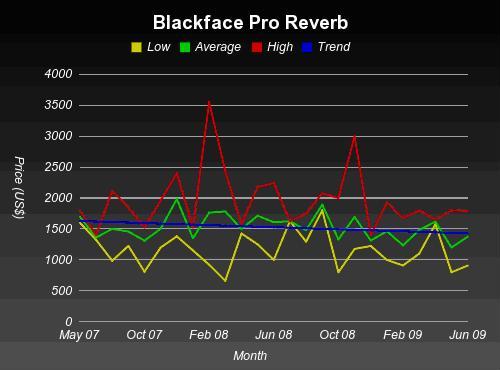
eBay Selling Price History for Blackface Pro Reverb (US Dollars)

Average eBay selling prices for amps in very good or better condition and with no or only common maintenance changes (caps, resistors, speakers, wires/cords).

Blackface.

Avg Model Year Price $

Year

Qty sold

Avg Price $

1964

1

662

1965

33

1,647

1966

40

1,495

1967

28

1,450

4 Years

102

1,524

Avg Monthly Price $

Month

Qty sold

Avg Price $

2009-06

4

1,375

2009-05

3

1,200

2009-04

3

1,620

2009-03

4

1,482

2009-02

8

1,234

2009-01

10

1,463

2008-12

2

1,313

2008-11

5

1,695

2008-10

3

1,330

2008-09

3

1,892

2008-08

4

1,480

2008-07

1

1,625

2008-06

5

1,609

2008-05

2

1,713

2008-04

3

1,499

2008-03

6

1,782

2008-02

7

1,764

2008-01

3

1,350

18 Months

76

1,523

Pro Reverb vintage  price blackface

Pro Reverb vintage price blackface

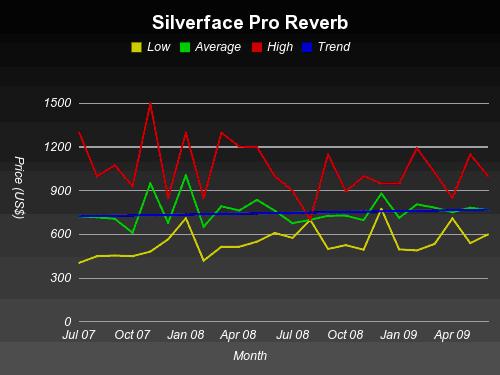
Silverface

Avg Model Year Price $

Year

Qty sold

Avg Price $

1967

1

1,192

1968

24

981

1969

8

936

1970

1

999

1971

6

635

1972

10

710

1973

13

787

1974

10

729

1975

5

673

1976

10

646

1977

3

691

1978

22

579

1979

11

566

13 Years

124

746

Avg Monthly Price $

Month

Qty sold

Avg Price $

2009-06

5

768

2009-05

3

783

2009-04

5

752

2009-03

4

784

2009-02

5

806

2009-01

6

714

2008-12

4

881

2008-11

7

698

2008-10

3

729

2008-09

6

728

2008-08

2

700

2008-07

6

677

2008-06

3

763

2008-05

4

837

2008-04

3

764

2008-03

14

793

2008-02

12

652

2008-01

2

1,006

18 Months

94

752

Pro Reverb vintage  price (silverface)

Pro Reverb vintage price (silverface)

prix vente achat fender pro reverb occassion, ebay, revente ampli fender occasion

Owner Manual Fender Pro Reverb 1972

In Gears on February 26, 2009 at 12:03 pm

Rare! a full copy of the 1972 Owner manual of the Fender Super Reverb and Pro Reverb amplifiers, which is  very light compaired to today’s specs books!

But just good enough to play isn’t it? Click down here:

Fender Pro reverb manual 1972

Fender Pro reverb manual 1972

If you have any other copy of older issue, drop me a mail, Thousand thanks

source: http://www.thevintagesound.com/ffg/

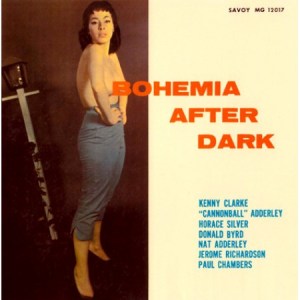
Bohemia after Dark (Album review) Cannonball Adderley (1955)

In Album, Bohemia After Dark on February 25, 2009 at 9:27 am

 Cannonball Adderleybohemiaafterdark

  • Label : Savoy Jazz
  • Orig Year :  1955
  • CD Universe Part number : 5588877
  • Catalog number: 17166
  • Release Date: Feb 11, 2003
  • Studio/Live : Studio
  • Mono/Stereo : Mono
  • Additional Info Bonus Tracks; Remastered


Review

Savoy Jazz reissues are always unpredictable and this CD by Cannonball Adderley is no exception. This music has appeared on earlier CDs, including Discoveries and The Summer of ’55, though the ever-changing total times for each track and mysteriously switching take-numbers make one wonder whether or not to keep earlier editions. In any case, valuable music by Cannonball and brother Nat Adderley (on cornet) is present, including a strong cover of Oscar Pettiford’s “Bohemia After Dark,” a barely disguised reworking of “Sweet Georgia Brown” (“With Apologies to Oscar”) and the leader’s catchy “Caribbean Cutie.” The Adderley brothers, who were making their major league jazz debut in the studio, hit one out of the park with their potent performances. The supporting cast is a good one, with Donald Byrd, Kenny Clarke, Jerome Richardson, Paul Chambers and either Horace Silver or Hank Jones on piano. If one does not already own the double-disc set The Summer of ’55, this CD can be considered essential for any bop fan. ~ Ken Dryden, All Music Guide

Tracks

Track Title Composers Performers Time
Bohemia After Dark Oscar Pettiford Cannonball Adderley, Kenny Clarke (6:05)
Chasm Cannonball Adderley, Nat Adderley Cannonball Adderley, Kenny Clarke (4:22)
Willow Weep for Me Ann Ronell Cannonball Adderley, Kenny Clarke (6:22)
Late Entry Cannonball Adderley, Nat Adderley Cannonball Adderley, Kenny Clarke (3:15)
Hear Me Talkin’ to Ya Cannonball Adderley, Nat Adderley Cannonball Adderley, Kenny Clarke (9:12)
With Apologies to Oscar Cannonball Adderley, Nat Adderley Cannonball Adderley, Kenny Clarke (5:43)
We’ll Be Together Again Frankie Laine, Carl Fischer Cannonball Adderley (6:56)
Caribbean Cutie [Take 1][Alternate Take][*] Cannonball Adderley Cannonball Adderley (5:16)

Credits

Cannonball Adderley (Sax (Alto)), Nat Adderley (Cornet), Hank Jones (Piano), Jerome Richardson (Flute), Jerome Richardson (Sax (Tenor)), Horace Silver (Piano), Steve Backer (Executive Producer), Donald Byrd(Trumpet), Ozzie Cadena (Original Session Producer), Paul Chambers (Bass), Kenny Clarke (Drums), David Alan Kogut (Art Direction), Dan Marx (Series Producer), Paul Reid III (Mastering), Paul Reid III (Reissue Engineer), Lew Herman Smythe (Liner Notes)

Morning Dance (Spyro Gyra/Jay Beckenstein)

In Album, Morning Dance on February 21, 2009 at 3:44 pm

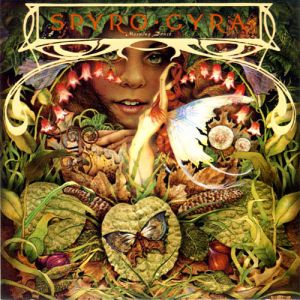
Morning Dance is the title of the second studio album by  Spyro Gyra, released in 1979. The album cover shows an intricate and detailed colour illustration of a woodland scene with dancing fairies and other insects, being spied upon by a young woman.

Morning Dance is Spyro Gyra’s most commercially successful album. The title cut became a major radio hit (Billboard #24 pop, #1 adult contemporary.)

Spyro Gyra is an American jazz fusion band that was originally formed in the mid-1970s in Buffalo, New York, USA. With over 25 albums released and 10 million copies sold, they are among the most prolific as well as commercially successful groups of the scene. Among their most successful hit singles are “Shaker Song” and “Morning Dance”, which received significant play on popular music radio stations, and are still frequently heard nearly 30 years later on jazz and easy listening stations.

Their music, which has been influential in the development of smooth jazz, combines jazz with elements of R&B, funk and pop music. Although generally considered to be more “jazz” than “smooth”, Spyro Gyra have been praised as skilled instrumentalists and for their live performances, which average nearly 100 per year.

With the exception of alto saxophonist, songwriter & founding bandleader Jay Beckenstein and keyboardist Tom Schuman the personnel has changed somewhat over time as well as between the studio and the live stage.


Morning Dance Spyro Gyra

Morning Dance Spyro Gyra


Track listing and personnel

1. “Morning Dance” (Jay Beckenstein) – 4:11

  • Jay Beckenstein: Alto Saxophone
  • Jeremy Wall: Electric Piano
  • John Tropea: Electric and Acoustic Guitar
  • Jim Kurzforder: Bass
  • Ted Reinhardt: Drums
  • Rubens Bassini: Congas and Percussion
  • Dave Samuels: Marimba and Steel Drum

2. “Jubilee” (Jeremy Wall) – 4:31

  • Jay Beckenstein: Alto Saxophone
  • Jeremy Wall: Electric Piano & Synthesizers
  • John Tropea: Electric Guitar
  • Will Lee: Bass
  • Steve Jordan: Drums
  • Rubens Bassini: Congas & Percussion
  • Randy Brecker: Trumpet Solo
  • Dave Samuels : Marimba

3. “Rasul” (Jeremy Wall) – 3:57

  • Jay Beckenstein: Soprano and Tenor Saxophone
  • Jeremy Wall: Acoustic and Electric Piano
  • Rick Strauss: Guitar
  • Jim Kurzdorfer: Bass
  • Ted Reinhardt: Drums
  • John Clark: French Horn

4. “Song for Lorraine” (Jay Beckenstein) – 3:59

  • Jay Beckenstein: Soprano Saxophones
  • Tom Schuman: Electric and Acoustic Pianos
  • Chet Catallo: Guitar
  • Jim Kurzdorfer: Bass
  • Eli Konikoff: Drums
  • Gerardo Velez: Congas, Bongos, and Percussion
  • Suzanne Ciani: Synthesizers
  • Lani Groves, Diva Grey, Gordon Grody: Vocalists

5. “Starburst” (Jeremy Wall) – 4:50

  • Jay Beckenstein: Tenor Saxophone (Intro)
  • Jeremy Wall: Electric Piano & Synthesizers
  • John Tropea: Guitar
  • Will Lee: Bass
  • Steve Jordan: Drums
  • Rubens Bassini: Congas, Timbales & Percussion
  • Michael Brecker: Tenor Saxophone Solo

6. “Heliopolis” (Jay Beckenstein) – 5:34

  • Jay Beckenstein: Tenor Saxophone (Intro)
  • Jeremy Wall: Electric Piano & Synthesizers
  • John Tropea: Guitar
  • Will Lee: Bass
  • Steve Jordan: Drums
  • Rubens Bassini: Congas, Timbales & Percussion
  • Dave Samuels: Marimba
  • Tom Schuman: Rhodes solo

7. “It Doesn’t Matter” (Chet Catallo) – 4:27

  • Jay Beckenstein: Soprano Saxophones
  • Tom Schuman: Electric and Acoustic Pianos
  • Chet Catallo: Guitar
  • Jim Kurzdorfer: Bass
  • Eli Konikoff: Drums
  • Suzanne Ciani: Synthesizer
  • Jeremy Wall: Synthesizer
  • Gerardo Velez: Congas
  • Lani Groves, Diva Grey, Gordon Grody: Vocalists

8. “Little Linda” (Jeremy Wall) – (4:27)

  • Jay Beckenstein: Alto Saxophone
  • Jeremy Wall: Electric Piano, Acoustic Piano and Percussion
  • Rick Strauss: Guitar
  • Jim Kurzdorfer: Bass
  • Ted Reinhardt: Drums
  • Rubens Bassini: Bongos and Percussion
  • Dave Samuels: Vibraphone

9. “End of Romanticism” (Rick Strauss) – 5:00

  • Jay Beckenstein: Soprano Saxophone
  • Jeremy Wall: Electric Piano
  • Rick Strauss: Electric & 12-String Guitar
  • Jim Kurzdorfer: Bass
  • Ted Reinhardt: Drums
  • David Samuels: Marimba
  • Tom Schuman: Synthesizers Solos
  • John Clark: French Horn