funics

Archive for the ‘Partitions’ Category

First release of “Put It Where You Want It”

In Album, Put It Where You Want It on October 19, 2012 at 10:56 am

CRUSADERS 1 
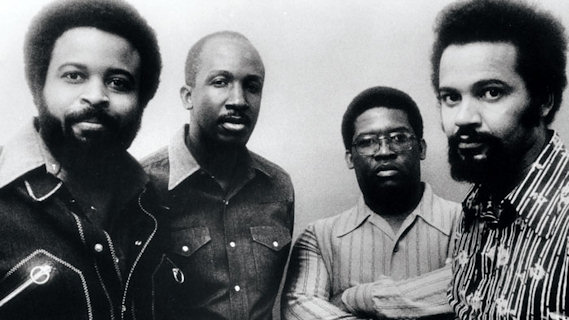
The Crusaders
Los Angeles, California: c. 1971-72


collective personnel inc. Wayne Henderson (tb); Wilton Felder (ts, el-b); Joe Sample (key); Larry Carlton (g solo); Arthur Adams, David T. Walker (g); Chuck Rainey (el-b); “Stix” Hooper (d).

BTS 6001 – Crusaders I – Crusaders [1972] (3-72, #96) (2-LP set)


Put It Where You Want It

Put It Where You Want It

a. That’s How I Feel (Wilton Felder) – 8:20
b. So Far Away (Carole King) – 11:50
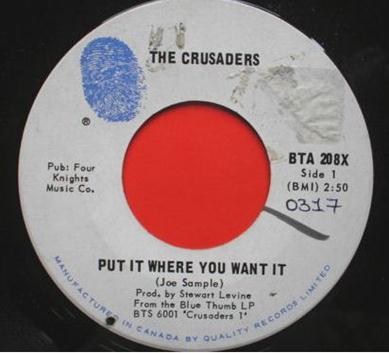
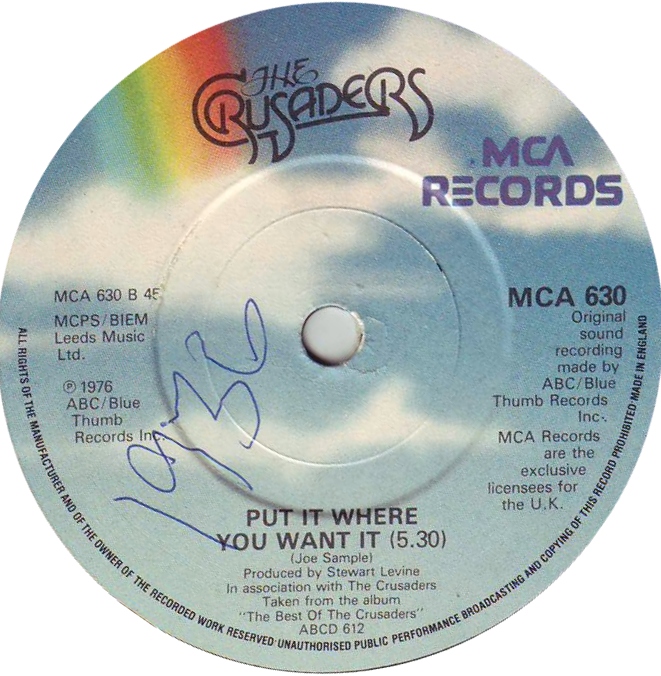
c. Put It Where You Want It (Joe Sample) – 5:30
d. Mystique Blues (Wayne Henderson) – 4:44
e. Full Moon (Wayne Henderson) – 7:20
f. Sweet Revival (Joe Sample) – 4:50
g. Mud Hole (Wayne Henderson) – 6:30
h. It’s Just Gotta Be That Way (Wayne Henderson) – 3:40
i. Georgia Cottonfield (Joe Sample) – 7:02
j. A Shade Of Blues (Joe Sample) – 5:20
k. Three Children (Wilton Felder) – 5:15
l. Mosadi (Woman) (Wayne Henderson) – 7:15

other releases:

  • Issues: a-l on Blue Thumb Chisa BTS 6001
    (issued March 1972), Blue ThumbB0007350-02 [CD], Blue Thumb (Eu) 06025 170 4066 [CD], MCA (Jap) MVCM-20024 [CD], Universal (Jap) UCCU-5365 [CD].
  • Singles: c & l also on Blue Thumb Chisa BTA 208 [45]. b & a on Blue Thumb Chisa BTA 217 [45]. a on Blue Thumb Chisa BTA 232 [45].
  • Samplers: a, b, c, f, j, k & l also on Blue Thumb BTD-4700 [CD] titled WAY BACK HOME. b & c also on Blue Thumb 314 589 944-2 [CD], Blue Thumb UCCR-1032 [CD] titled GROOVE CRUSADE.
    Producer: Stewart Levine, Engineer: Rik Pekkonen


The Crusaders

In Bio, Put It Where You Want It on October 18, 2012 at 11:33 pm

The Crusaders est un groupe américain de jazz. Leur musique, que l’on pourrait qualifier de smooth jazz, est un mélange de jazz, de soul, defunk et de pop. Depuis 1961, le groupe a publié plus d’une quarantaine d’albums mais il a connu deux formations distinctes.

The Crusaders vs The Jazz Crusaders

Au départ, le groupe était connu sous le nom de The Jazz Crusaders et composé du pianiste Joe Sample, du batteur Stix Hooper, du saxophoniste Wilton Felder (son fondateur) et du tromboniste Wayne Henderson et jouait un hard bop aux fortes influences R&B et soul. Le guitariste de blues Roy Gaines les accompagnera régulièrement. Cependant, en 1971, le groupe est renommé The Crusaders avec l’arrivée du guitariste Larry Carlton et opte pour un registre jazz funk plus grand public, qui incorpore des instruments plus électriques. De cette période sera issu le célèbre tube “Street Life” (avec la participation de la chanteuse Randy Crawford), que l’on peut entendre notamment dans la BO de Jackie Brown de Quentin Tarantino. En 1975, Wayne Henderson quitte le groupe pour se lancer dans une carrière de producteur à plein temps. En 1983, c’est au tour de Stix Hooper. Cela marque la fin de la période à succès du groupe. Le groupe va sortir son dernier album en 1991 avant une longue pause, auxquels ne participeront que Joe Sample et Wilton Felder tandis que parallèlement, Wayne Henderson va refonder en 1995 les Jazz Crusaders avec Stix Hooper, Larry Carlton et… ce même Wilton Felder, et ce malgré les objections de Joe Sample qui ne voit pas d’un très bon œil cette version alternative du groupe d’origine. Jusqu’en 2003, seule cette dernière version du groupe perdure et continue de sortir des albums, même si son style est assez éloigné des Jazz Crusaders, première version du groupe d’origine. Eric Clapton a fait une apparition remarquée sur l’album des Jazz Crusaders paru en 2003, “Soul Axess“. Cette même année, la formation “officielle” The Crusaders fait son grand retour avec l’album “Rural Renewal“, celle-ci comptant parmi ses membres Joe Sample, Stix Hooper et Wilton Felder, soit tous les membres fondateurs à l’exception de Wayne Henderson.

Discographie

The Jazz Crusaders

  • Freedom Sound (1961) – Studio, Pacific Jazz
  • Lookin’ Ahead (1962) – Studio, Pacific Jazz
  • The Jazz Crusaders at the Lighthouse (1962) – Live, Pacific Jazz
  • Tough Talk (1963) – Studio, Pacific Jazz
  • Heat Wave (1964) – Studio, Pacific Jazz
  • Stretchin’ Out (1964) – Studio, Pacific Jazz
  • Chile con Soul (1965) – Studio, Pacific Jazz
  • Live at the Lighthouse ’66 (1966) – Live, Pacific Jazz
  • The Festival Album (1966) – Live, Pacific Jazz
  • Talk That Talk (1967) – Studio, Pacific Jazz
  • Uh Huh (1967) – Studio, Pacific Jazz
  • Live Sides (1968) – Live, Blue Note
  • Lighthouse ’68 (1968) – Live, Pacific Jazz
  • Powerhouse (1969) – Studio, Pacific Jazz
  • Lighthouse ’69 (1969) – Live, Pacific Jazz
  • Give Peace a Chance (1970) – Studio, Liberty
  • Old Socks, New Shoes… New Socks, Old Shoes (1970) – Studio, Chisa
  • Happy Again (1995) – Studio, Sin-drome
  • Louisiana Hot Sauce (1996) – Studio, Sin-drome
  • Soul Axess (2003) – Studio, True Life
  • The Pacific Jazz Quintet Studio Sessions (2005) – Compilation, Mosaic
  • Alive in South Africa (2006) – Live, True Life
  • At the Lighthouse (2006) – Live, Blue Note
  • Pass the Plate (1971) – Studio, Chisa
  • 1 (1971) – Studio, Blue Thumb
  • The 2nd Crusade (1972) – Studio, Blue Thumb
  • Unsung Heroes (1973) – Studio, Blue Thumb
  • Hollywood (1973) – Studio, MoWest
  • Scratch (1974) – Live, Blue Thumb
  • Southern Comfort (1974) – Studio, Blue Thumb
  • Chain Reaction (1975) – Studio, Blue Thumb
  • Those Southern Knights (1975) – Studio, Blue Thumb
  • Free as the Wind (1976) – Studio, Blue Thumb
  • Images (1978) – Studio, Blue Thumb
  • Street Life (1979) – Studio, MCA
  • Rhapsody and Blues (1980) – Studio, MCA
  • Standing Tall (1980) – Studio, MCA
  • Royal Jam (1982) – Live, MCA
  • Ongaku Kai: Live In Japan (1981) – Live, Crusaders
  • Vocal Tape (1983) – Studio, MCA
  • Ghetto Blaster (1984) – Studio, MCA
  • The Good And The Bad Times (1986) – Studio, MCA
  • Life in the Modern World (1988) – Studio, MCA
  • Healing the Wounds (1991) – Studio, GRP
  • The Crusaders’ Finest Hour (2000) – Compilation, Verve
  • Rural Renewal (2003) – Studio, PRA/Verve
  • Groove Crusade (2003) – Compilation, Blue Thumb

The Crusaders

  • Pass the Plate (1971) – Studio, Chisa
  • 1 (1971) – Studio, Blue Thumb
  • The 2nd Crusade (1972) – Studio, Blue Thumb
  • Unsung Heroes (1973) – Studio, Blue Thumb
  • Hollywood (1973) – Studio, MoWest
  • Scratch (1974) – Live, Blue Thumb
  • Southern Comfort (1974) – Studio, Blue Thumb
  • Chain Reaction (1975) – Studio, Blue Thumb
  • Those Southern Knights (1975) – Studio, Blue Thumb
  • Free as the Wind (1976) – Studio, Blue Thumb
  • Images (1978) – Studio, Blue Thumb
  • Street Life (1979) – Studio, MCA
  • Rhapsody and Blues (1980) – Studio, MCA
  • Standing Tall (1980) – Studio, MCA
  • Royal Jam (1982) – Live, MCA
  • Ongaku Kai: Live In Japan (1981) – Live, Crusaders
  • Vocal Tape (1983) – Studio, MCA
  • Ghetto Blaster (1984) – Studio, MCA
  • The Good And The Bad Times (1986) – Studio, MCA
  • Life in the Modern World (1988) – Studio, MCA
  • Healing the Wounds (1991) – Studio, GRP
  • The Crusaders’ Finest Hour (2000) – Compilation, Verve
  • Rural Renewal (2003) – Studio, PRA/Verve
  • Groove Crusade (2003) – Compilation, Blue Thumb

Put It Where You Want It (1972) – The Crusaders

In Put It Where You Want It on October 18, 2012 at 11:07 pm

The Crusaders were one of the pioneers of Jazz-Funk music in the seventies and have made a number of visits to Montreux over the years. Founder members Joe Sample and Wilton Felder were joined in the line-up by long-standing friend Ray Parker Jr. on guitar and by the inimitable Randy Crawford on vocals. They delivered a set that spanned their career from early days up to their latest album capped with a stunning nine minute plus performance of their classic “Street Life”.

Larry Carlton – guitar; Rick Jackson – Keyboards; Chris Kent – bass; Moyes Lucas – drums. Plus guests Wilton Felder & Wayne Henderson

Stolen Moments

In Stolen Moments on October 6, 2012 at 1:22 pm

All parts, Score, solo in Concert, Bb and Eb of Stolen moments are in the boxes,

available from the library.

includes also the backing tracks

Stolen Moments – Solo from Oliver Nelson

In Stolen Moments on October 5, 2012 at 12:09 pm

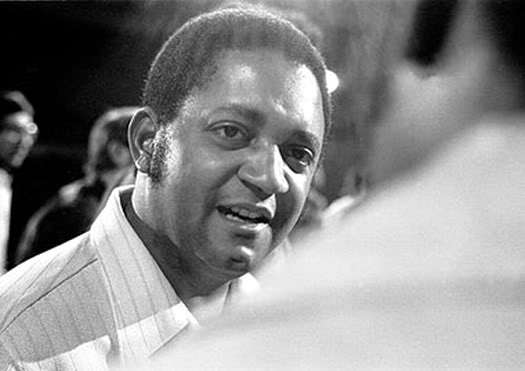
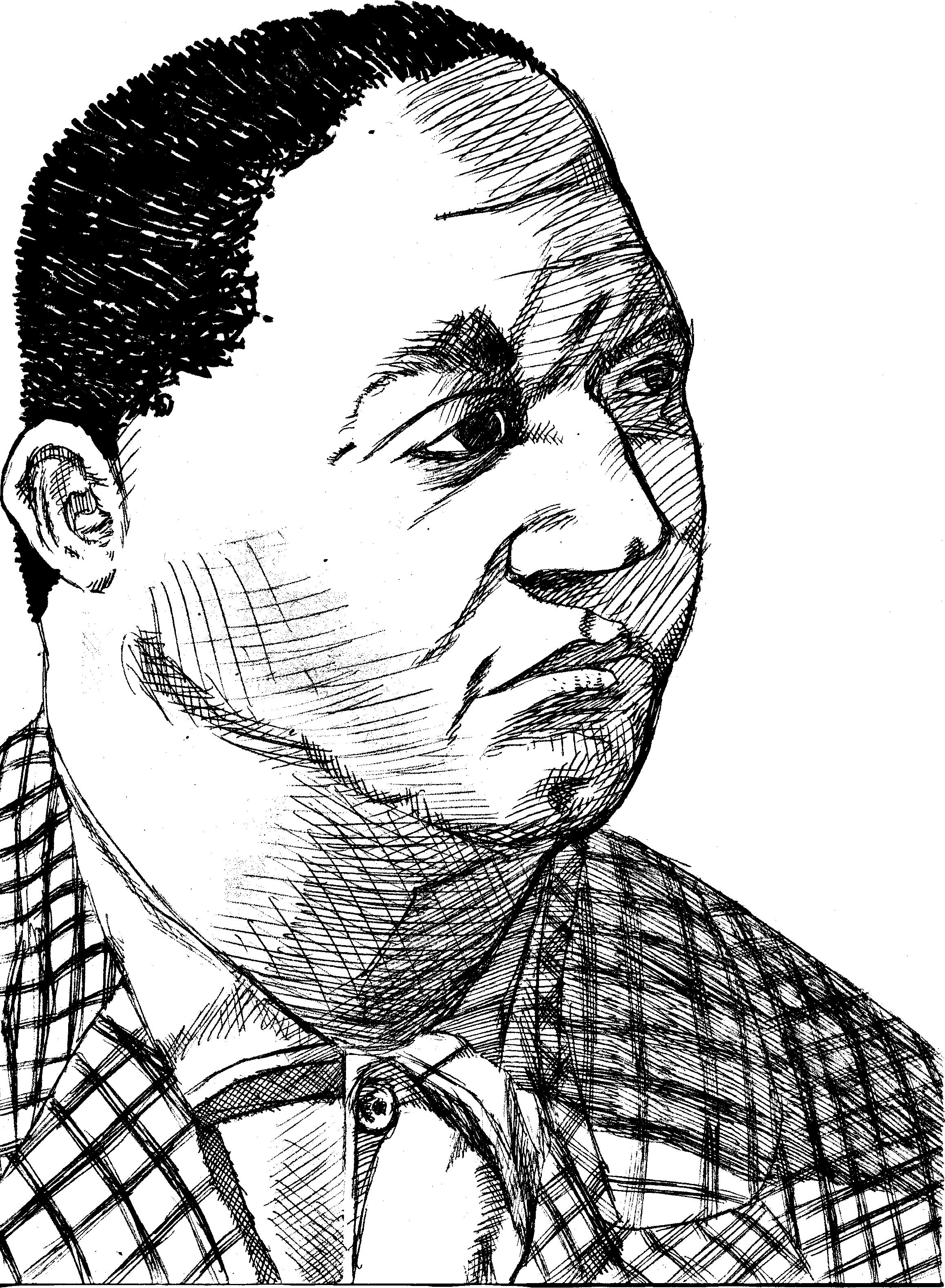
Oliver Nelson Biography

In Bio, Stolen Moments on October 5, 2012 at 9:15 am


Oliver Edward Nelson (June 4, 1932 in St.Louis, Missouri – Ocotober 28.01975) was an American jazz saxophonist, clarinetist, arranger and composer

Early life and career

Oliver Nelson’s family was musical: his brother was also a saxophonist who played with Cootie Williams in the 1940s, and his sister sang and played piano. Nelson began learning to play the piano when he was six, and started on the saxophone at eleven. From 1947 he played in “territory” bands around Saint Louis, before joining the Louis Jordan big band from 1950 to 1951, playing alto saxophone and arranging.

After military service in the Marines, Nelson returned to Missouri to study music composition and theory at Washington and Lincoln Universities, graduating in 1958. While back in his hometown of St. Louis, he met and married Eileen Mitchell; the couple had a son, Oliver Nelson Jr., but soon divorced. After graduation, Nelson married Audrey McEwen, a union which lasted until his death; they had a son, Nyles. Audrey was a native of St. Louis, Missouri.

Nelson moved to New York, playing with Erskine Hawkins and Wild Bill Davis, and working as the house arranger for the Apollo Theater in Harlem. He also played on the West Coast briefly with the Louie Bellson big band in 1959, and in the same year began recording as leader with small groups. From 1960 to 1961 he played tenor saxophone with Quincy Jones, both in the U.S. and on tour in Europe.

Breakthrough and afterwards

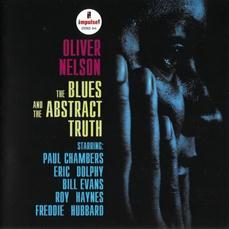
After six albums as leader between 1959 and 1961 for the Prestige label (with such musicians as Kenny Dorham, Johnny Hammond Smith, Eric Dolphy, Roy Haynes, King Curtis and Jimmy Forrest), Nelson’s big breakthrough came with The Blues and the Abstract Truth, on Impulse!, featuring the tune “Stolen Moments,” now considered a standard. This made his name as a composer and arranger, and he went on to record a number of big-band albums, as well as working as an arranger for Cannonball Adderley, Sonny Rollins, Eddie “Lockjaw” Davis, Johnny Hodges,Wes Montgomery, Buddy Rich, Jimmy Smith, Billy Taylor, Stanley Turrentine, Irene Reid, Gene Ammons and many others. He also led all-star big bands in various live performances between 1966 and 1975. Nelson continued to perform as a soloist during this period, though increasingly on soprano saxophone.
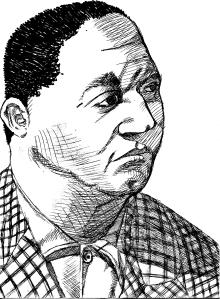
In 1967, Nelson moved to Los Angeles. Apart from his big-band appearances (in Berlin, Montreux, New York, and Los Angeles), he toured West Africa with a small group. He also spent a great deal of time composing music for television (Ironside, Night Gallery, Columbo, The Six Million Dollar Man and Longstreet) and films (Death of a Gunfighter and he arranged Gato Barbieri’s music for Last Tango in Paris). He produced and arranged for pop stars such as Nancy Wilson, James Brown, the Temptations, and Diana Ross. Less well-known is the fact that Nelson composed several symphonic works, and was also deeply involved in jazz education, returning to his alma mater, Washington University, in the summer of 1969 to lead a five-week long clinic that also featured such guest performers as Phil Woods, Mel Lewis, Thad Jones, Sir Roland Hanna, and Ron Carter. Nelson died of a heart attack on 28 October 1975, aged 43.

Discography

Prestige Records

  • 1959: Meet Oliver Nelson
  • 1960: Taking Care of Business
  • 1960: Images
  • 1960: Screamin’ the Blues
  • 1960: Soul Battle
  • 1960: Nocturne
  • 1961: Straight Ahead
  • 1961: Main Stem
  • 1962: Afro/American Sketches

Impulse! Records

  • 1961: The Blues and the Abstract Truth
  • 1964: More Blues and the Abstract Truth
  • 1966: Oliver Nelson Plays Michelle
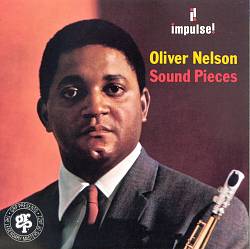
  • 1966: Sound Pieces
  • 1966: Happenings with Hank Jones
  • 1967: The Spirit of ’67 with Pee Wee Russell
  • 1967: The Kennedy Dream
  • 1967: Live from Los Angeles
  • 1968: Soulful Brass with Steve Allen
  • 197_: Three Dimensions (a compilation album)

Flying Dutchman Records

  • 1968: Soulful Brass No. 2
  • 1969: Black Brown and Beautiful
  • 1970: The Mayor and the People
  • 1970: Berlin Dialogue for Orchestra
  • 1970: Leon Thomas In Berlin with Oliver Nelson
  • 1971: Swiss Suite
  • 1974: In London with Oily Rags
  • 1975: Skull Session
  • 1976: A Dream Deferred

Other labels

  • 1962: Full Nelson (Verve)
  • 1962: Impressions of Phaedra (United Artists)
  • 1964: Fantabulous (Argo)
  • 1966: Leonard Feather’s Encyclopedia of Jazz (Verve)
  • 1966: Leonard Feather Presents the Sound of Feeling and the Sound of Oliver Nelson (Verve)
  • 1967: Jazzhattan Suite (Verve)
  • 1973: Fugue and Bossa
  • 1975: Stolen Moments (East Wind Records/Inner City Records)
As arranger

With Air Pocket

  • Fly On (1975, East Wind Records)

With Mel Brown

  • Chicken Fat (Impulse!, 1967)

With Ray Brown and Milt Jackson

  • Ray Brown / Milt Jackson (Verve, 1965)

With Eddie “Lockjaw” Davis

  • Trane Whistle (Prestige, 1960)

With Art Farmer

  • Listen to Art Farmer and the Orchestra (Mercury, 1962)

With Carmen McRae

  • Portrait of Carmen (Atlantic, 1967)

With Shirley Scott

  • For Members Only (Impulse!, 1963)
  • Great Scott!! (Impulse!, 1964)
  • Roll ‘Em: Shirley Scott Plays the Big Bands (Impulse!, 1966)

With Jimmy Smith

  • Bashin’: The Unpredictable Jimmy Smith (Verve, 1962)
  • Hobo Flats (Verve, 1963)
  • Who’s Afraid of Virginia Woolf? (Verve, 1964)
  • Monster (Verve, 1965)
  • Peter and the Wolf (Verve, 1966)

With Wes Montgomery

  • Goin’ Out of My Head (Verve, 1965)

With Count Basie

  • Afrique (Flying Dutchman, 1970)

As sideman

With Manny Albam

  • Jazz Goes to the Movies (Impulse!, 1962)

With Mundell Lowe

  • Satan in High Heels (soundtrack) (Charlie Parker, 1961)

With Quincy Jones

  • The Quintessence (Impulse!, 1961)

From Wikipedia, the free encyclopedia

Stolen Moments (Oliver Nelson)

In Stolen Moments on October 5, 2012 at 8:42 am


“Stolen Moments” is a jazz standard composed by Oliver Nelson. It is a sixteen-bar piece (in an eight-six-two pattern), though the solos are on a conventional minor key 12 bar blues structure.
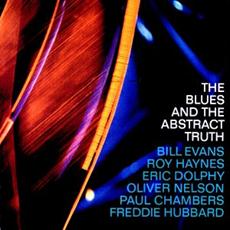
The piece first appeared as “The Stolen Moment” on the 1960 album Trane Whistle by Eddie “Lockjaw” Davis, which was largely written and co-arranged by Oliver Nelson. It was not marked out as anything special, in fact the covernotes only mention that the trumpet solo is by Bob Bryant and that Eric Dolphy’s bass clarinet can be heard briefly on the closing. However, in the liner notes to Eric Dolphy: The Complete Prestige Recordings, Bill Kirchner states that this incorrectly credits Dolphy with playing what’s actually the baritone saxophone of George Barrow, with Dolphy’s contribution to the piece being the 2nd alto behind Nelson. Its first well-known recording was the version on Nelson’s own 1961 album The Blues and the Abstract Truth. Nelson’s solo on this version contains “possibly the most famous” use of the augmented scale in jazz.

Singer Mark Murphy wrote lyrics for his 1978 version.

Ann Fischer later wrote different lyrics to Nelson’s original melody. They were first recorded on the 1987 album The Carmen McRae-Betty Carter Duets. This vocal version of “Stolen Moments” was given the alternate title “You Belong to Her”

Recordings

Oliver Nelson, himself, used the song as an album title (Inner City Records – IC 6008) in 1975. “Stolen Moments” has been recorded numerous times. In 1994 the title was used for a compilation album in the Red Hot AIDS Benefit Series, which helped popularize this and other jazz standards among a wider audience.

Some recorded versions:

  • 1966 by Booker Ervin on the album Structurally Sound
  • 1968 by Phil Woods and his European Rhythm Machine on the album Americans Swinging in Paris
  • 1970 by Ahmad Jamal, album The Awakening
  • 1975 by Oliver Nelson, album Stolen Moments
  • 1978 by Mark Murphy, album Stolen Moments
  • 1979 by Jimmy Raney and Doug Raney, a father and son jazz guitar duo, album Stolen Moments
  • 1988 by Frank Zappa on the album Broadway the Hard Way (trumpet solo by Walt Fowler); after the trumpet solo, Zappa invites Sting to sit in with the band, and he sings a unique, modified version of the Police song “Murder by Numbers” over the “Stolen Moments” vamp. The band finishes by returning to the Nelson melody.
  • 1990 by Lee Ritenour, album Stolen Moments
  • 1991 by Stanley Jordan, album Stolen Moments
  • 1991 by New York Voices on the album Heart of Fire.
  • 1994 by United Future Organization on the compilation album Stolen Moments: Red Hot + Cool
  • 1996 by Jimmy Smith on the album Angel Eyes
  • 2002 by Kenny Burrell, album Stolen Moments
  • 2003 by Gap Mangione, album Stolen Moments
  • 2005 by Telefon Tel Aviv, album Remixes Compiled
  • 2009 by Brownman Electryc Trio, album Juggernaut

Other artists that have recorded the piece: Ray Brown, Caribbean Jazz Project, Betty Carter, Sonny Criss, Joyce DiCamillo, Booker Ervin, Freddie Hubbard, Milt Jackson, J. J. Johnson, Quincy Jones, Oliver Lake, Andy LaVerne, Lorne Lofsky, Herbie Mann, Jon Mayer, Carmen McRae, One for All, Hilton Ruiz, Andy Summers, Bill Taylor, Turtle Island String Quartet, Sadao Watanabe,Grover Washington, Jr., Snakefinger, Avi Lebovich & The Orchestra, Soil & “Pimp” Sessions, Fancie, Brownman Ali.

From Wikipedia, the free encyclopedia

Missing parts added

In Psychedelic Sally on September 24, 2012 at 1:43 pm

Hello, Several missing parts in Eb and Bb, and also

Psychedelic Sally partitions (and more) were added in the Library boxes,

ask for password, if you lost it.

Cheers,

The Horace SILVER Quintet “Psychedelic Sally” (1968)

In Psychedelic Sally on September 21, 2012 at 3:17 pm

From the album ” Serenade to a soul sister”. Horace Silver (piano), Charles Tolliver (tpt), Stanley Turrentine (T sax), Bob Cranshaw (db), Mickey Roker (dr).

Serenade to a Soul Sister (Horace Silver)

In Psychedelic Sally on September 21, 2012 at 2:59 pm

From Wikipedia, the free encyclopedia

Serenade to a Soul Sister is an album by jazz pianist Horace Silver released on the Blue Note label in 1968, featuring performances by Silver with Charles Tolliver, Stanley Turrentine, Bennie Maupin, Bob Cranshaw, John Williams, Mickey Roker and Billy Cobham The Allmusic review by Steve Huey awarded the album 4½ stars and calls it “One of the last great Horace Silver albums for Blue Note, Serenade to a Soul Sister is also one of the pianist’s most infectiously cheerful, good-humored outings.

Track listing

All compositions by Horace Silver

  1. Psychedelic Sally” – 7:14
  2. “Serenade to a Soul Sister” – 6:19
  3. “Rain Dance” – 6:21
  4. “Jungle Juice” – 6:46
  5. “Kindred Spirits” – 5:55
  6. “Next Time I Fall in Love” – 5:19

Recorded February 23 (tracks 1-3) and March 29 (tracks 4-6), 1968.

Personnel

  • Horace Silver – piano
  • Charles Tolliver – trumpet
  • Stanley Turrentine – tenor saxophone (tracks 1-3)
  • Bennie Maupin – tenor saxophone (tracks 4-6)
  • Bob Cranshaw – bass, electric bass (tracks 1-3)
  • John Williams – bass (tracks 4-6)
  • Mickey Roker – drums (tracks 1-3)
  • Billy Cobham – drums (tracks 4-6)

Production

  • Alfred Lion – producer
  • Reid Miles – design
  • Rudy Van Gelder – engineer
  • Billy Cobham (Cover), Francis Wolff (Interior) – photography