funics

Posts Tagged ‘Bio’

Oscar Pettiford Bio

In Bio, Blues In The Closet, Bohemia After Dark on January 25, 2009 at 12:39 pm
  • Born: September 30, 1922, Okmulgee, OK

    Oscar Pettiford

    Oscar Pettiford

  • Died: September 08, 1960, Copenhagen, Denmark
  • Active: ’40s, ’50s
  • Instrument: Bass, Cello
  • Representative Albums: “Deep Passion,” “Vienna Blues: The Complete Sessions,” “The New Oscar Pettiford Sextet”
  • Representative Songs: “Bohemia After Dark,” “Little Niles,” “Laverne Walk”

Biography

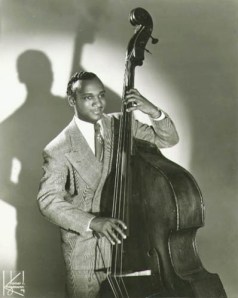
Oscar Pettiford was (along with Charles Mingus) the top bassist of the 1945-1960 period, and the successor to the late Jimmy Blanton. In addition, he was the first major jazz soloist on the cello.

A bop pioneer, it would have been very interesting to hear what Pettiford would have done during the avant-garde ’60s if he had not died unexpectedly in 1960. After starting on piano, Pettiford switched to bass when he was 14 and played in a family band.

He played with Charlie Barnet’s band in 1942 as one of two bassists (the other was Chubby Jackson) and then hit the big time in 1943, participating on Coleman Hawkins’ famous “The Man I Love” session; he also recorded with Earl Hines and Ben Webster during this period. Pettiford co-led an early bop group with Dizzy Gillespie in 1944, and in 1945 went with Coleman Hawkins to the West Coast, appearing on one song in the film The Crimson Canary with Hawkins and Howard McGhee. Pettiford was part of Duke Ellington’s orchestra during much of 1945-1948 (fulfilling his role as the next step beyond Jimmy Blanton), and worked with Woody Hermanin 1949.

Throughout the 1950s, he mostly worked as a leader (on bass and occasional cello), although he appeared on many records both as a sideman and a leader, including with Thelonious Monk in 1955-1956. After going to Europe in 1958, he settled in Copenhagen where he worked with local musicians, plus Stan Getz, Bud Powell, and Kenny Clarke. Among Pettiford’s better-known compositions are “Tricotism,” “Laverne Walk,” “Bohemia After Dark,” and “Swingin’ Till the Girls Come Home.” ~ Scott Yanow.

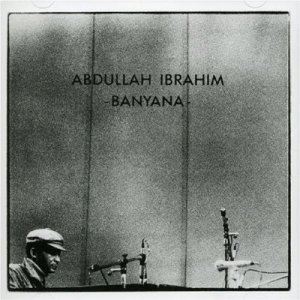
Dollar Brand (Abdullah Ibrahim) Banyana Children of Africa – Ishmael

In Album, Bio, Ishmael on January 20, 2009 at 10:53 pm

Abdullah Ibrahim (born 9 October 1934 in Cape Town, South Africa), formerly known as Adolph Johannes Brand, and as Dollar Brand, is a South African pianist and composer. His music reflects many of the musical influences of his childhood in the multicultural port areas of Cape Town, ranging from traditional African songs to the gospel of the AME Church and ragas, to more modern jazz and other Western styles. Within jazz, his music particularly reflects the influence of Thelonious Monk and Duke Ellington.

He first received piano lessons at the age of seven, was an avid consumer of jazz records brought by American sailors, and was playing jazz professionally by 1949. In 1959 and 1960, he played alongside Kippie Moeketsi with The Jazz Epistles in Sophiatown before joining the European tour of the musical King Kong.

Children of Africa  


Banyana - Children of Africa

Banyana - Children of Africa

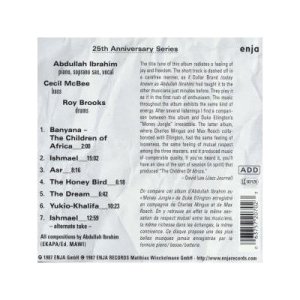
  • Label: Enja Records
  • Catalog#: enja 2070
  • Format: Vinyl, LP
  • Country: US
  • Released: 1976
  • Style: Free Jazz, Soul-Jazz

Credits: 

  • Bass – Cecil McBee 
  • Drums – Roy Brooks 
  • Piano, Saxophone [Soprano], Vocal – Dollar Brand 
  • Producer – Horst Weber , Matthias Winckelmann


Tracklisting:banyanaback

  • Banyana – The Children of Africa (1:59)
  • Asr (8:14)
  • Ishmael (12:14)
  • The Honey-Bird (6:19)
  • The Dream (6:40)
  • Yukio-Khalifa (10:20)

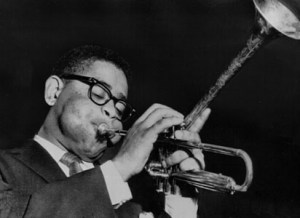
Dizzy Gillespie

In A Night In Tunisia, Bio on January 20, 2009 at 10:22 pm

John Birks « Dizzy » Gillespie, né à Cheraw en Caroline du Sud le 21 octobre 1917, mort le 6 janvier 1993, était un trompettiste, compositeur et chef d’orchestre de jazz américain.

Avec Miles Davis et Louis Armstrong, il est l’un des trois plus importants trompettistes de l’histoire du jazz, ayant participé à la création du style Bebop et contribué à introduire les rythmes latino-américains dans le jazz.

Dizzy Gillespie

Dizzy Gillespie


Dizzy Gillespie se distinguait en particulier par sa trompette au pavillon incliné vers le haut,il bouchait sa trompette d’un bouchon. Ses joues gonflées à bloc comme celles d’un crapaud, ainsi que sa joie de vivre et son humour ravageur qui sont pour beaucoup dans sa popularité auprès du public. En tant que musicien, il avait une technique époustouflante et une vitesse de jeu impressionnante.

Il joue avec Charlie Parker dans des clubs de jazz tels que Minton’s Playhouse et Monroe’s Uptown House ( le berceau du bebop ). Ses compositions (“Groovin’ High”, “Woody n’ You”, “Anthropology”, “Salt Peanuts”, and “A Night in Tunisia”) sonnent radicalement différemment du Swing de l’époque. Un de leurs premiers concerts (au New York’s Town Hall le 22 juin 1945) est seulement sorti en 2005. Gillespie enseigne le nouveau style à de jeunes musiciens de la 52e rue, parmi eux … Miles Davis et Max Roach.

Le groupe se sépare, après un séjour au Billy Berg Club à Los Angeles où le bebop reçoit un accueil mitigé.

Contrairement à Parker, qui aime jouer dans des petites formations et occasionnellement en tant que soliste dans des big bands, Dizzy Gillespie préfère diriger un big band; il tente l’expérience pour la première fois en 1945, mais le succès n’est pas trop au rendez-vous.

Après ses travaux avec Charlie Parker, Gillespie mène d’autres petites formations avec des musiciens tels que Milt Jackson, John Coltrane, Lalo Schifrin. Il apparaît également fréquemment en tant que soliste au Jazz at the Philharmonic sous la direction de Norman Granz.

Le 11 mars 1952, Gillespie quitte les États-Unis pour la France. Il est invité par Charles Delaunay pour jouer au Salon du Jazz. [1] Gillespie qui n’a pas d’autre engagement à Paris en profite pour créer son troisième big band. Grâce à ses succès, il peut enregistrer dans les lieux les plus prisés de Paris (comme au Théâtre des Champs-Élysées). En 1953, il revient aux États-Unis après une série de concerts et d’enregistrements.


Eddie Harris – Bio

In Bio on October 30, 2008 at 10:55 am

Eddie Harris (b. Chicago, 1934 – 1996) was best known for playing tenor saxophone, though he was also fluent on the electric piano and organ. His most well-known composition was “Freedom Jazz Dance”, recorded and popularized by Miles Davis in the 1960s.

After college he was drafted into the United States Army. While serving in Europe he was accepted into the 7th Army Band, which also included Don Ellis, Leo Wright, and Cedar Walton.

After getting out of the army he worked in New York City before returning to Chicago, where he signed a contract with Vee Jay Records. His first album for Vee Jay, Exodus to Jazz included his own jazz arrangement of Ernest Gold’s theme from the movie Exodus. A shortened version of this track, which featured his masterful playing in the upper register of the tenor saxophone, was heavily played on radio and became the first jazz record ever to be certified gold.
Many jazz critics, however, regarded commercial success as a sign that a jazz artist had sold out, and Harris soon stopped playing “Exodus” in concert. He moved to Columbia Records in 1964 and to Atlantic Records in 1965. At Atlantic in 1965 he released The In Sound, a bop album which won back many of his detractors.

Over the next few years he began to perform on electric piano and the electric Varitone saxophone, and to perform a mixture of jazz and funk which sold well in both the jazz and rhythm and blues markets. In 1967 his album The Electrifying Eddie Harris reached second place on the R & B charts.
In 1969 he performed with Les McCann’s group at the Montreux Jazz Festival. Although they had been unable to rehearse, their session was so impressive that a recording of it was released as Swiss Movement, which became one of the best-selling jazz albums ever, also reaching second place on the R & B charts.
Harris also came up with the idea of the reed trumpet, playing one for the first time at The Newport Jazz Festival of 1970 to mostly negative critical feedback. From 1970 to 1975 he experimented with new instruments of his own invention (the reed trumpet was a trumpet with a saxophone mouthpiece, the saxobone was a saxophone with a trombone mouthpiece, and the guitorgan was a combination of guitar and organ), with singing the blues, with jazz-rock (he recorded an album with Steve Winwood, Jeff Beck, Albert Lee, Ric Grech, Zoot Money, and other rockers), and with comic R & B numbers such as “That is Why You’re Overweight.”

In 1975, however, he alienated much of his audience with his album The Reason Why I’m Talkin’ Shit, which consisted mainly of stand-up comedy, and public interest in his subsequent albums declined sharply. He continued to record into the 1990s, but his experimentation ended and he mainly recorded hard bop.

Discography

  • Exodus to Jazz, 1961 VEE JAY Records
  • Swiss Movement; 1969 (CD 1996); with Les McCann
  • Come on Down, 1970 Atlantic Recordings
  • Instant Death,1971
  • In the UK.“ / Is It In; 1973 (CD 1999); with Albert Lee, Jeff Beck, Steve Winwood, Chris Squire, Alan White, Tony Kaye, Rufus Reid, Ronald Muldrow
  • I Need Some Money; 1975; with Ronald Muldrow
  • Bad Luck Is All I Have, 1975 Atlantic Recordings
  • That is why you’re overweight, 1976 Atlantic Recordings
  • How can you live like that; 1977
  • I’m Tired of Driving; 1978
  • The Real Electrifying, 1982 Mutt & JeffRecording Corp.
  • People Get Funny, 1987 Timeless Records
  • Live in Berlin, 1989 Timeless Records
  • Live at the Moonwalker, 1990 Moonwalker Label (Suisa)
  • Listen Here; 1993
  • The Battle of the Tenors; 1994, with Wendell Harrison
  • The Last Concert; CD 1997; with WDR Big Band

Eddie Harris – Bio

In Bio, Listen Here on September 8, 2008 at 12:36 pm

Eddie Harris was born on October 20th, 1934 in Chicago, Illinois. He began his career as a singer in various Baptist churches around Chicago, and started appearing at these churches from the age of five.

Eddie started playing the piano and began playing very well by ear. He was mainly playing just church songs at the time. A few years later, Eddie’s cousin began teaching him how to read musical notation. Eddie Harris went to John Farren Elementary School and to Burke Elementary. He went to Du Sable High School and Hyde Park High School. He continued his education at Illinois University Navy Pier, Roosevelt University and the Paris Conservatoire, where he studied classical saxophone. Eddie first started playing the vibraphone while attending Du Sable High School, under the guidance of the formidable Capt. Walter Dyette, the music teacher who was mentor to many future jazz greats. “Chafing under the strict discipline of Capt. Dyette,” (writes Lloyd Sachs) Eddie transferred to Hyde Park High School. Eddie turned down an athletic scholarship to study music at Roosevelt College, where he met jazz promoter Joe Segal, who hired him to sit in with such immortals as Charlie Parker and Lester Young. Eddie was drafted into the Army, at which time they put him into electronics. He later joined an Airborne unit and soon became disgusted with seeing many of the soldiers being injured, so he auditioned for, and made, the talent-laden 7th Army Jazz Band, which performed and toured extensively. After leaving the Army, Eddie lived in New York, where he worked all the time, from pit bands to jazz bands, to small combos and playing piano in the late afternoon at a dance studio.

Due to an illness in the family, Eddie returned to Chicago in 1960. He married Sarah Elizabeth Turner, and they had two daughters, Lolita Maria and Yvonne Marie. Eddie was signed as a pianist by Vee-Jay Records, but he got to play tenor on his own arrangement of the theme from the movie “Exodus.” The album was called Exodus to Jazz , and the single cut Exodus was released as a 45 RPM. It was the first jazz record to score a “Gold Record” certification, and made the Billboard Top 40 as a pop single. The record sold more than 2 million copies — unheard of from a jazz artiste at that time. “Wounded by accusations of selling out, Eddie didn’t perform ‘Exodus’ for years,” writes Lloyd Sachs.

After two years, Eddie left Vee-Jay Records and began recording for Columbia. In 1965 he released an album called The In Sound which included the song Freedom Jazz Dance, which has been recorded by many other artistes including Miles Davis. In 1967, his album The Electrifying Eddie Harris featured the song Listen Here which also became a hit. In June 1969, Eddie recorded an album at the Montreux Jazz Festival with Les McCann’s group, which included Leroy Vinnegar on bass. It was called Swiss Movement , went to #29 on the Billboard pop album chart, and included the song Compared To What.  

Eddie’s December 1969 album Free Speech is “considered by many jazz aficionados as one of the first, if not THE first, jazz fusion album,” writes Stephen K. Peeples. “He further demonstrated his willingness to stretch the boundaries of jazz” (writes Peter Watrous) when he recorded Eddie Harris in the U.K. which included rock musicians Stevie Winwood and Jeff Beck. From 1969 to 1971, Eddie also wrote the music for “The Bill Cosby Show.” He also invented several unique hybrid instruments, such as the “saxobone,” which was essentially a tenor fitted with a trombone mouthpiece.

He also frequently sang and worked comedy routines into his performances. Eddie even released a comedy album called Why Does This Always Happen To Me? and another one called The Reason Why I’m Talking Shit . Good luck trying to find a copy! Eddie was a tireless performer, composer and innovator.

He published numerous books of interest to jazz students and musicians, including The Eddie Harris Fake Book; Jazz Licks; Skips; Fusionary Jazz Duets and several others. He recorded albums on numerous labels large and small, including MCA, Virgin, Blue Note, Atlantic, Flying Heart, Moonwalker, Enja, Steeplechase, RCA and more. He continued to practice daily and placed great value on it. He held musicians to a rigorous standard, and continued performing until he was disabled by disease. In his obit in the Chicago Tribune, Howard Reich writes: “Though medical treatments in the last year left him thin and weak, Harris played a weeklong engagement in May (1996) at the Jazz Showcase in Chicago. Short on wind and barely able to stand, he nevertheless summoned the strength to produce an extremely moving performance. What he had lost in technical facility he counterbalanced with the urgency and melodic appeal of his work.” Eddie Harris died on November 5th, 1996 at USC/University Hospital in Los Angeles, California. He was 62

Jim Hall

In Bio on September 7, 2008 at 12:20 am

James Stanley Hall, né à Buffalo dans l’état de New York le 4 Décembre 1930, est un guitariste de jazz américain.
Après des études à l’Institut de musique de Cleveland, Jim Hall va à Los Angeles où il commence à se faire connaître à la fin des années 50. Il y étudie la guitare classique avec Vincente Gómez.
Il joue avec Chico Hamilton Quintet, (1955-1956), Jimmy Giuffre Trio (1956-1959), Ella Fitzgerald (1960-1961), Ben Webster, Hampton Hawes, Bob Brookmeyer, John Lewis, Zoot Sims, Paul Desmond, Lee Konitz et Bill Evans.
En 1960 Jim Hall s’installe à New York pour travailler avec divers musiciens dont Sonny Rollins et Art Farmer. Ses concerts et ses enregistrements avec Bill Evans, Paul Desmond Ron Carter sont legendaires. Jim Hall – Écoutez gratuitement sur Last.fm

More on Pat Martino

In Bio, Scales on September 4, 2008 at 10:11 pm

His web site deserves an visit, spend all the time you need to go through the nature of Guitar, which includes theory, transcriptions, and learning technics. Pat’s Web site

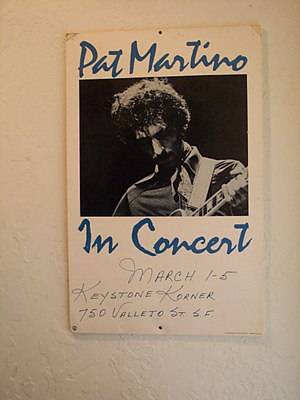
Pat Martino

In Bio on September 4, 2008 at 9:37 pm

When the anesthesia wore off, Pat Martino looked up hazily at his parents and his doctors. and tried to piece together any memory of his life.
One of the greatest guitarists in jazz. Martino had suffered a severe brain aneurysm and underwent surgery after being told that his condition could be terminal. After his operations he could remember almost nothing. He barely recognized his parents. and had no memory of his guitar or his career. He remembers feeling as if he had been “dropped cold, empty, neutral, cleansed…naked.”

In the following months. Martino made a remarkable recovery. Through intensive study of his own historic recordings, and with the help of computer technology, Pat managed to reverse his memory loss and return to form on his instrument. His past recordings eventually became “an old friend, a spiritual experience which remained beautiful and honest.” This recovery fits in perfectly with Pat’s illustrious personal history. Since playing his first notes while still in his pre-teenage years, Martino has been recognized as one of the most exciting and virtuosic guitarists in jazz. With a distinctive, fat sound and gut-wrenching performances, he represents the best not just in jazz, but in music. He embodies thoughtful energy and soul.
Born Pat Azzara in Philadelphia in 1944, ha was first exposed to jazz through his father, Carmen “Mickey” Azzara, who sang in local clubs and briefly studied guitar with Eddie Lang. He took Pat to all the city’s hot-spots to hear and meet Wes Montgomery and other musical giants. “I have always admired my father and have wanted to impress him. As a result, it forced me to get serious with my creative powers.”
He began playing guitar when he was twelve years old. and left school in tenth grade to devote himself to music. During Visits to his music teacher Dennis Sandole, Pat often ran into another gifted student, John Coltrane, who would treat the youngster to hot chocolate as they talked about music.
Besides first-hand encounters with `Trane and Montgomery, whose album Grooveyard had “an enormous influence” on Martino, he also cites Johnny Smith, a Stan Getz associate, as an early inspiration. “He seemed to me, as a child. to understand everything about music,” Pat recalls.
Martino became actively involved with the , early rock scene in Philadelphia, alongside stars like Bobby Rydell, Chubby Checker and Bobby Darin. His first road gig was with jazz organist Charles Earland, a high school friend. His reputation soon spread among other jazz players, and he was recruited by bandleader Lloyd Price to play hits such as Stagger Lee on-stage with musicians like Slide Hampton and Red Holloway.
Martino moved to Harlem to immerse himself in the “soul jazz” played by Earland and others. Previously, he had “heard all of the white man’s jazz. I never heard that other part of the culture,” he remembers. The organ trio concept had a profound influence on Martino’s rhythmic and harmonic approach. and he remained in the idiom as a sideman, gigging with Jack McDuff and Don Patterson. An icon before his eighteenth birthday, Pat was signed as a leader for Prestige Records when he was twenty. His seminal albums from this period include classics like Strings!, Desperado, El Hombre and Baiyina (The Clear Evidence), one of jazz’s first successful ventures into psychedelia.

In 1976, Martino began experiencing the excruciating headaches which were eventually diagnosed as symptoms of his aneurysms. After his surgery and recovery, he resumed his career when he appeared in1987 in New York, a gig that was released on a CD with an appropriate name, The Return. He then took another hiatus when both of his parents became ill, and he didn’t record again until 1994, when he recorded Interchange and then The Maker.

Today, Martino lives in Philadelphia again and continues to grow as a musician. As the New York Times recently noted, “Mr. Martino, at fifty, is back and he is plotting new musical directions, adding more layers to his myth.” His experiments with guitar synthesizers, begun during his rehabilitation, are taking him in the direction of orchestral arrangements and they promise groundbreaking possibilities. Musicians flock to his door for lessons, and he offers not only the benefits of his musical knowledge, but also the philosophical insights of a man who has faced and overcome enormous obstacles. “The guitar is of no great importance to me,” he muses. “The people it brings to me are what matter. They are what I’m extremely grateful for, because they are alive. The guitar is just an apparatus.”

Biography courtesy of DL Media
A Brief Resume

Pat began playing professionally in 1961. He has performed with a wide variety of artists including Sonny Stitt, Gene Ammons, Richard Groove Holmes, John Handy, Bobby Hutcherson, Chick Corea, Jack McDuff, Don Patterson, Stanley Clark, Eric Kloss, Trudy Pitts, Willis Jackson, Lloyd Price, Woody Herman, Chuck Israels, Charles Earland, Barry Miles and Joe Pesci. Since 1967, Pat has been touring as a leader.

He has been a Recording Artist for Vanguard, Prestige, Warner Brothers, Muse, Columbia, King, Paddlewheel, Evidence, Sony, 32 Jazz, High Note, Milestone, Polydor, Concord, Fantasy, House of Blues, Mythos, Mainstream, Cobblestone, Atlantic and, most currently, Blue Note Records.

Pat has given Guitar and Music Therapy Seminars, Clinics and Master Classes throughout the world, at locations including North Texas State University, G.I.T., Berklee College (Boston and Perugia, Italy), Duquesne University, Teatro Rasi (Ravenna, Italy), LeCentre Culturel (D’Athis Mons, France), University of Washington School of Music, Skidmore College, Musicians Institute, National Guitar Workshop, New York University, Pennsylvania University, Stanford University, The University of Missouri, Roosevelt University (Chicago), Patti Summers Jazz Club (Seattle), Music Tech College (St. Paul), The New School (New York City), Southern Illinois University, The Conservatory of Amsterdam (The Netherlands), Cork Festival (Cork, Ireland), Washington University (St. Louis, MO), Wisconsin Conservatory of Music, Musictech College (St. Paul, MN), Nordoff-Robbins Center for Music Therapy at NYU (New York, NY), Greater Hartford Academy of the Arts (Hartford, CT), and the University of Maryland.

Pat is currently on the adjunct faculty at the University of the Arts in Philadelphia, PA.

Since the mid 1990s, Pat has received the following awards:
1995 Mellon Jazz Festival / Dedicated in Honor
1996 Philadelphia Alliance “Walk of Fame Award”
1997 National Academy of Recording Arts & Sciences “Songs from the Heart Award”
2002 Grammy nominations for Best Jazz Instrumental Album, “Live at Yoshi’s”, and Best Jazz Instrumental Solo on ‘All Blues’
2002 National Academy of Recording Arts & Sciences “2nd Annual Heroes Award”
2003 Grammy nominations for Best Jazz Instrumental Album, “Think Tank”, and best Jazz Instrumental Solo on ‘Africa’.
2004 Guitar Player of the Year, Downbeat Magazine’s 2004 Reader’s Poll

Last Update :: 29 January 2005

Biographie de Django Reinhardt

In Bio on September 1, 2008 at 9:03 pm

Jean « Django » Reinhardt (Liberchies, le 23 janvier 1910 – Samois-sur-Seine, le 16 mai 1953) est un guitariste de jazz manouche, issu d’une famille tzigane. Il reste aujourd’hui encore l’un des guitaristes les plus respectés et influents de l’histoire du jazz.

Une jeunesse en roulotte :

Django Reinhardt naît le 23 janvier 1910 dans une roulotte stationnant à Liberchies, en Belgique, où il est déclaré « fils de Jean-Baptiste Reinhardt et de Laurence Reinhardt ». Ce lieu de naissance n’a pas grande signification, car l’enfant fait partie d’une famille de Tziganes nomades habitués à traverser l’Europe de part en part. Il passe donc sa jeunesse à voyager (en France, Italie ou Algérie), avant que sa famille se fixe finalement à Paris, d’abord sur les Fortif’, La Zone mal famée jouxtant la Porte de Choisy, puis à la Porte d’Italie.
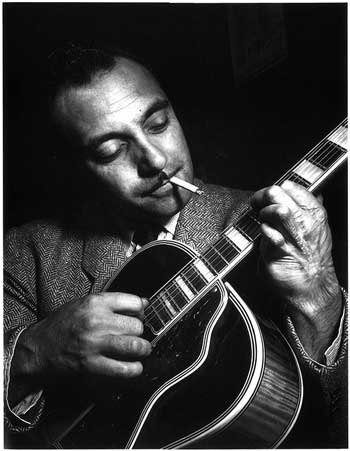
La rencontre avec le banjo de son oncle à l’âge de 10 ans est décisive. Fasciné par l’instrument, le jeune Django n’a dès lors de cesse de s’écorcher les doigts sur ses cordes oxydées. Il fait son apprentissage en observant avec attention les musiciens de passage au campement, et acquiert bientôt une dextérité hors du commun. Il se mettra ensuite, avec le même bonheur, au violon et finalement à la guitare.

À l’âge de 13 ans, il court déjà le cachet dans les bars et bals de Paris, ainsi que dans les demeures des gens aisés, tout en continuant de jouer surtout pour son propre plaisir. La réputation du jeune virtuose se répand chez les amateurs de musique et en 1928, le producteur Jean Vaissade permet à Django d’enregistrer son premier disque. L’adolescent ne sachant ni lire ni écrire, même pas son propre nom, les étiquettes portent la mention « Jiango Renard, banjoiste ».

Un destin capricieux :

La même année, le chef d’orchestre Jack Hylton (Jack Hylton & His Orchestra), impressionné par la virtuosité de Django, lui propose de l’engager dans sa formation de musique populaire, qui doit partir se produire à Londres. Mais le destin contredit ce projet: juste avant le départ du groupe, le 2 novembre 1928, un incendie se déclare dans la roulotte où le musicien vit en compagnie de sa première femme, Bella Baumgartner. Les fleurs en celluloïde — matière très inflammable — que celle-ci vend s’enflamment au contact d’une bougie renversée, détruisant la caravane et blessant assez gravement ses deux occupants. Django surtout est sérieusement atteint à la jambe droite et à la main gauche. Celle-ci cicatrisant très difficilement, il reste près de 18 mois à l’hôpital, où les médecins prédisent qu’il ne pourra plus jamais rejouer de musique. On doit finalement brûler sa main au nitrate d’argent pour provoquer la cicatrisation. Django a perdu l’usage de deux doigts, mais s’obstine néanmoins, et après 6 mois de travail sans relâche il développe une technique nouvelle sur la guitare que son frère Jospeh, alias « Nin-Nin », lui a apportée en guise d’outil de rééducation.

Au printemps 1930, alors que Django est toujours soigné à l’hôpital Saint-Louis, une commission de contrôle militaire vient juger sur place de son état de santé : le musicien, âgé de 20 ans et devant donc accomplir son service militaire, n’a répondu depuis 2 ans à aucune convocation. Mais ses blessures lui permettent d’être rapidement exempté.

Le Hot Club de France – Gloire dans un monde en guerre :

À sa sortie d’hôpital en 1930, Django Reinhardt a développé une toute nouvelle technique guitaristique, d’autant plus exceptionnelle qu’elle n’emploie que deux doigts de la main gauche, plus le pouce. Il découvre qu’entre-temps, la guitare a gagné sa place au sein des orchestres de jazz, cette nouvelle musique venue des États-Unis. Les premiers contacts de Django avec la musique de Duke Ellington, Joe Venuti, Eddie Lang ou Louis Armstrong sont un grand choc, et le jeune guitariste décide de consacrer son existence à la pratique du jazz.

En 1931, il rencontre le violoniste Stéphane Grappelli, avec qui il fonde Le Quintette du Hot Club de France. Le groupe comprend également le frère de Django, Joseph, alias « Nin-Nin », ainsi que Roger Chaput à la guitare et Louis Vola à la contrebasse. Les cinq musiciens inventent une musique innovante, entre jazz et musique tzigane, qui remporte un grand succès. Les années suivantes, ils enregistrent de nombreux disques et jouent dans toute l’Europe aux côtés des plus grands musiciens de l’époque, tels que Coleman Hawkins, Benny Carter ou Rex Stewart. Ces derniers tentent à plusieurs reprises de prendre en défaut la technique instrumentale et les connaissances musicales de Django dans des défis musicaux, tels qu’il s’en pratiquait fréquemment à l’époque, mais le guitariste gagne leur respect en se révélant, malgré son incapacité à lire la musique et son apprentissage quasiment autodidacte, d’une maîtrise à toute épreuve.

Au contact des musiciens américains, Django se familiarise avec une nouvelle musique dont l’influence s’étend dans le milieu du jazz : le be-bop. Il sera sans conteste l’un des premiers musiciens européens à avoir apprécié et compris la musique inventée par des jazzmen tels que Charlie Parker ou Dizzy Gillespie. Il intègre à ses compositions de nombreuses trouvailles du mouvement, tout en restant toujours fidèle à ses propres conceptions musicales.

Lorsque la Seconde Guerre mondiale éclate en 1939, le quintette est en tournée en Angleterre. Tandis que Stéphane Grappelli choisit d’y rester, Django retourne en France, à Toulon, où il est mobilisable dans la Flotte mais est à nouveau réformé à cause de ses brûlures. Il passe la guerre en Zone Libre, voyageant sans cesse de Cannes à Toulon, et parvenant ainsi à survivre au génocide des Tziganes, systématiquement envoyés en camps de concentration par les Nazis. Il épouse même en 1943 Sophie Ziegler, sa seconde femme, dont il aura l’année suivante un fils, Babik Reinhardt, qui deviendra à son tour un grand guitariste. À la libération, il retrouve Grappelli avec lequel il improvise sur une Marseillaise qui restera célèbre.
La déception américaine :

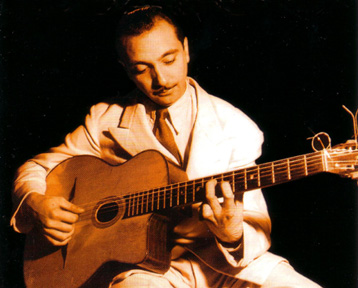
Après la guerre, le Hot Club de France reprend enregistrements et tournées. En 1946, une tournée aux États-Unis donne enfin à Django l’occasion de jouer dans le groupe de Duke Ellington. Les deux musiciens s’étaient rencontrés en 1939 et désiraient depuis lors jouer ensemble, mais cette association n’est pas celle dont Django avait rêvé. Ne parlant pas anglais, habitué à la liberté de sa vie nomade, Django peine à s’habituer à la discipline très stricte des Big Bands. Ces difficultés, alliées au fait qu’Ellington n’avait pas réellement intégré le guitariste à ses arrangements, le faisant toujours intervenir en fin de représentation, faisait de Django une sorte d’attraction et non le concertiste qu’il espérait être durant cette tournée.

Cependant son passage fit toujours sensation. La tournée a emmené le groupe à travers tous les États-Unis (même au Canada) et la présence de Django était évidemment exceptionnelle pour les amateurs : c’était après-tout la seule vedette de jazz (avec Grappelli) non-américaine.

En arrivant à New York, Django chercha à rencontrer Charlie Parker, Dizzy Gillespie, Thelonious Monk, sans résultat, ces derniers étant alors chacun en tournée.

Il gardera de cet épisode une certaine amertume, et s’éloigne peu à peu de la guitare, se consacrant de plus en plus à ses autres passions, la peinture, la pêche et le billard. Cela ne l’empêche pas de récréer à plusieurs occasions sur disque le prestigieux Quintette avec Stéphane Grappelli. Les résultats sont fantastiques de maîtrise et de singularité.

Le renouveau be-bop :

En 1951, il achète une maison et s’installe à Samois-sur-Seine en Seine-et-Marne, près de Fontainebleau. À ce moment commence pour lui un véritable renouveau : l’inspiration revient, son jeu est plus inspiré que jamais et il joue régulièrement avec un orchestre composé des meilleurs be-boppers français : Roger Guérin, Hubert Fol, Raymond Fol, Pierre Michelot, Bernard Peiffer, Jean-Louis Viale… Il est toujours à l’avant-garde du jazz.

En 1953, Norman Granz fait part à Django de son désir de l’engager pour les légendaires tournées du Jazz at the Philharmonic. Le producteur français Eddie Barclay lui fait enregistrer 8 titres, en guise de « carte de visite » pour les amateurs américains. Ces 8 morceaux exceptionnels marqueront irrémédiablement les amateurs de jazz et surtout les guitaristes du monde entier, qui s’inspireront des décennies durant du jeu d’un Django très en avance sur son époque.

Django enregistre son dernier disque le 8 avril 1953, avec Martial Solal au piano (c’est un de ses premiers enregistrements), Pierre Michelot à la contrebasse, Fats Sadi Lallemant au vibraphone et Pierre Lemarchand à la batterie. Son interprétation vibrante de Nuages fera dire à certains que le guitariste s’attendait à disparaître d’ici peu. Il mourra un mois plus tard d’une hémorragie cérébrale. Django Reinhardt repose depuis à Samois sur Seine .

Mémoire et influence :

Considéré avec Charlie Christian et Wes Montgomery comme l’un des meilleurs guitaristes de jazz qui aient jamais existé, Django Reinhardt est aujourd’hui encore une influence majeure pour la plupart des guitaristes à l’instar d’Andrés Segovia ou de Jimi Hendrix dans des styles bien différents. Son style profondément original, entre jazz et musique tzigane, s’est depuis lors développé en un genre musical à part entière, le jazz manouche. Ce style est devenu un véritable folklore pour la communauté Manouche depuis la mort de Django et est aujourd’hui joué partout dans le monde.

Dans le monde des Tziganes, Django Reinhardt est considéré comme un symbole. Comme l’a écrit François Billard : « Django est le héros d’un peuple, celui du peuple Tzigane ». Pour ces gens souvent opprimés, qui ont du faire face à un terrible génocide rarement reconnu et sont aujourd’hui encore victimes de discriminations dans presque tous les pays où ils vivent, Django reste l’ambassadeur d’une culture tzigane bien vivante, entre tradition et modernité.

Parmi les compositions les plus célèbres de Reinhardt, on retient souvent Minor Swing, Nuages, Rhythme Futur, LectureAnouman, Djangology ou encore Douce ambiance.

Ses admirateurs retiendront aussi sa personnalité unique, son insouciance, ses coups de folie et ses coups de génie. Comme l’a déclaré son contrebassiste Louis Vola : « Le génie n’a pas à se justifier : il est ! »

from Last.fm
Stevie Ray Vaughan

In Bio on September 1, 2008 at 8:58 pm

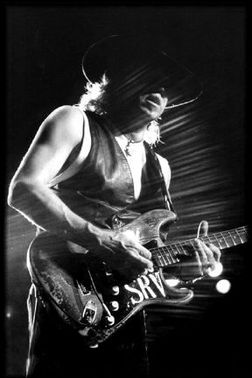
Stevie Ray Vaughan (SRV), né à Dallas, Texas, USA le 3 octobre 1954.

Si son premier album, « Texas Flood », parait en 1983, il commence sa carrière bien avant en tournant avec son frère, lui aussi guitariste, dans de nombreux clubs texans. Son amour pour le blues et sa dextérité lui valent, après la sortie de son premier album, des critiques excellentes. Il est vrai que son jeu de guitare est unique, digne successeur de Jimi Hendrix dont il repris d’ailleurs fort brillamment le morceau « Little Wing ». La vidéo « Live at the Mocambo » illustre bien toute la maitrise de SRV. Il faut voir aussi le « Live from Austin Texas » enregistré entre 83 et 88.

Comme de nombreuses autres rock-star, il a dû faire face à la drogue et l’alcool. Après un dur combat, il était arrivé à s’extirper de ses dépendances. Il décède le 27 aout 1990 dans un accident d’hélicoptère après un concert en compagnie de gloires du blues à Alpine Valley (était présent ce soir là Eric Clapton).

Il faut rendre hommage aussi a ses musiciens: l’ancien bassiste de Johnny Winter,Tommy Shannon et le batteur Chris Layton Thomas sans lesquels il n’aurait pas eu une section rythmique avec un tel son, si caractéristique .

from  Last.fm