Part One.
Part Two
Part One.
Part Two


| 42. | Tremolo units & parts |
| 43. | Tremolo spares |
| 44. | Scratchplates & thumbrests |
| 45. | Transducers – Ashworth & Martin |
| 46. | Transducers – Schaller |
| 47. | Artec transducers |
| 48. | Acoustic pickups |
| 49. | Schaller guitar pickups |
| 50. | Schaller bass guitar pickups |
| 51. | Artec guitar pick ups |
| 51a | More Artec guitar pick ups |
| 52. | Gotoh guitar pickups |
| 53. | Pickup surrounds, screws, jack plates & sockets |
| 54. | Switches, potentiometers, back & control plates |
| 55. | Control knobs |
| 56. | Guitar necks, bodies & fretwire sets |
| 57. | Guitar neck fittings: top nuts, string clamps, guides |
| 58. | Strap locks, endpins, jack socket endpins |
| 59. | Banjo parts & accessories |
| 60. | Banjo & mandolin parts accessories & pickups |
| 61. | Banjo pegs, mandolin machine heads |
| 62. | NEW LINES |

The Soul/Jazz Atelier La Clef Orchestra,
This is all about collecting and sharing informations, songs, music sheets, parts , lyrics, playlists, media, MP3’s & tools… about the Jazz standards we play.
Prochains concerts:
12 juin, à la brasserie des Halles, rue de la paroisse, Versailles

Certaines pages sont protégées, demandez l’accès. You can ask for password when it ‘s protected … Good Jam! Use links, tags… at the bottom of the page to find what you want. 
Une pépite….Rusty Bryant (1929-1991) was one of the funkier saxophonists of the late 1960s/early ’70s when electronic soul-jazz was at the height of its popularity. He was equally skilled on tenor and alto, also utilizing the Varitone sax on a couple of his albums during his peak years.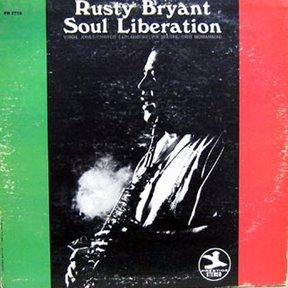
1970’s “Soul Liberation” reconvenes the players from Earland’s classic 1969 release “Black Talk!”, with Bryant taking over the tenor spot from “Black Talk!”‘s Houston Person. Earland does a superb job of building tension and driving dynamics into the mix. Teamed with Muhammad, he unleashes an irresistible juggernaut of jackhammering syncopation. Sparks, always a welcome presence, contributes his earthy yet sophisticated rhythm and bop.
(thanks to Dusty Nuggets)
Le canard est dans la boite! (the music box)
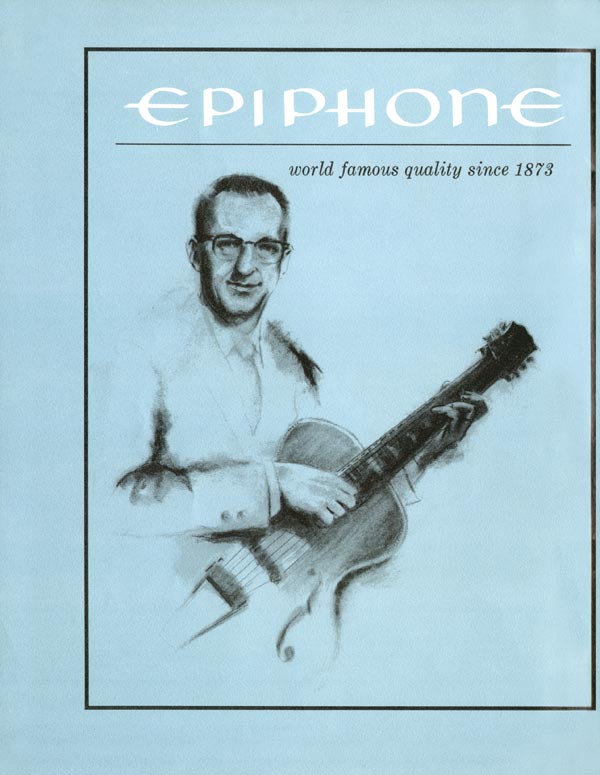
Epiphone catalog 1961
I was really pleased to find originals of the Epiphone catalogs, firstly, the 1961 edition: epiphone61_catalog
Quantities produced
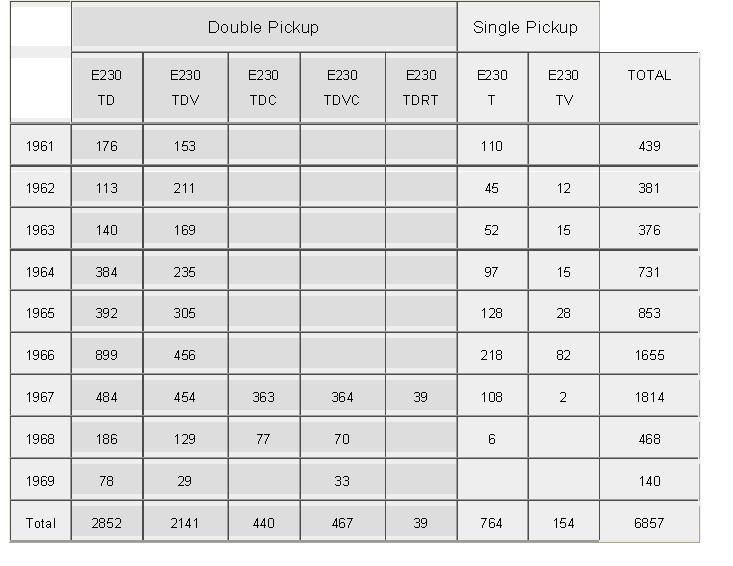
Production Data for the Epiphone Casino
Shipping figures for 1960s Epiphone Casinos The earliest Epiphone catalogue to feature the Casino (1961) lists just the single (E230T) and double (E230TD) pickup models – with vibrola as standard. These shipping figures suggest that non-vibrola models were shipped later in the same year. Early finishes were Royal Tan andShaded (sunburst), and figures do not differentiate between the two. From 1967Cherry became available (C), and Royal Tan was given the designation RT. From ’67 models with no colour code were Shaded
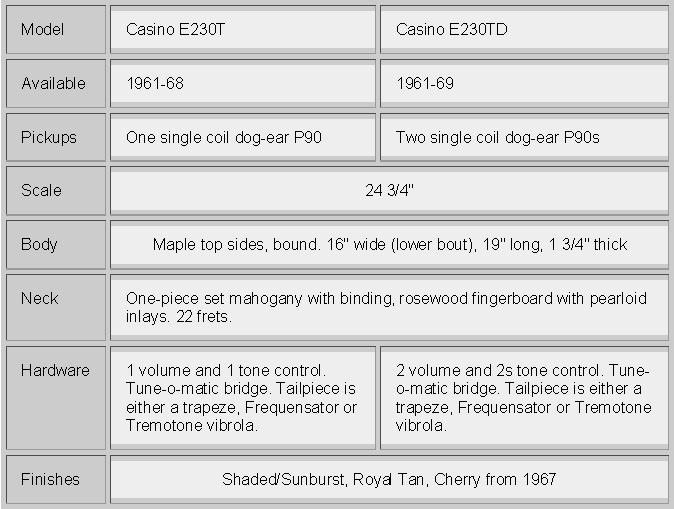
 The most famous Casino users were Keith Richards of the Rolling Stones, and John Lennon and George Harrison of the Beatles, who were given a pair of Casinos in 1965. Both had a sunburst finish, Georges had a Bigsby vibrato, whilst John’s had a stop tailpiece. It was Lennons of course that had the most use; he was widely pictured with it, and used it extensively live and in the studio. He also had it stripped down in 1968. Epiphone make two John Lennon signature Epiphone Casinos – one based on the unstripped 1965 model, and one, the ‘Revolution’ Casino based on the stripped instrument. Epiphone engineers studied the original guitar to get these signature instruments as exact as possible
Une nouvelle box a musique, en bas, à gauche, c’est un peu long a venir, mais on peut y écouter ou télécharger les morceaux mis en boite…
ciao
Voici le lien vers le nouveau morceau travaillé ce soir:
http://www.deezer.com/#music/result/all/Canyon%20Lady
et les parts pour les absents
Pour les autres, Corrigez les accords ils sont mineurs !
(la partition se trouve dans la librairie)
Bonne nuit !
Jacques
It’s here, it’s a wiki
But the ES-335 is here (wiki again)
Cold Duck is the name of a sparkling wine made in the United States.
The wine was invented by Harold Borgman, the owner of Pontchartrain Wine Cellars in Detroit, in 1937. The recipe was based on a traditional German custom of mixing all the dregs of unfinished wine bottles with champagne. The wine he produced was given the name Kaltes Ende (“cold end” in German), until it was humorously altered to the similar sounding term Kalte Ente meaning “cold duck” .
A jazz standard named “Cold Duck Time” by Eddie Harris has been performed by many jazz musicians, including Jeff Golub and Al Jarreau.


| LA Kizer on Bobby Few biographie | |
| Pork Pie Hats: Histo… on Pork Pie Hat | |
 | Heervee on Bobby Few biographie |
 | Doki Doki Finance on i Real b pour smartphones et… |
 | David Sanborn | A Ch… on Chicago Song (A Change of Hear… |
 :>)azZClefs#