La Clef,
46 rue de Mareil, Saint Germain en Layes
 Mulatu Astatké, Yekermo sew, the jody grind, horace silver, this masquerade, george benson, leon russell, jacques de lignières, la clef association, atelier soul jazz, hard bop jazz, concert live
La Clef,
46 rue de Mareil, Saint Germain en Layes
Mulatu Astatké, Yekermo sew, the jody grind, horace silver, this masquerade, george benson, leon russell, jacques de lignières, la clef association, atelier soul jazz, hard bop jazz, concert live
Frankly Jazz was a half-hour television program produced in Los Angeles in the early 1960s. Each program featured one or more prominent West Coast Jazz performer of the day. Frankly Jazz was host…
It is fantastic that someone found these videos hosted by the late, great Frank Evans. Today, Gerald Wilsonis truly a living legend in big band jazz. This brings back wonderful memories of The Lighthouse Cafe in Hermosa Beach and the balmy evenings listening to the Gerald Wilson Band.
Hello tous,
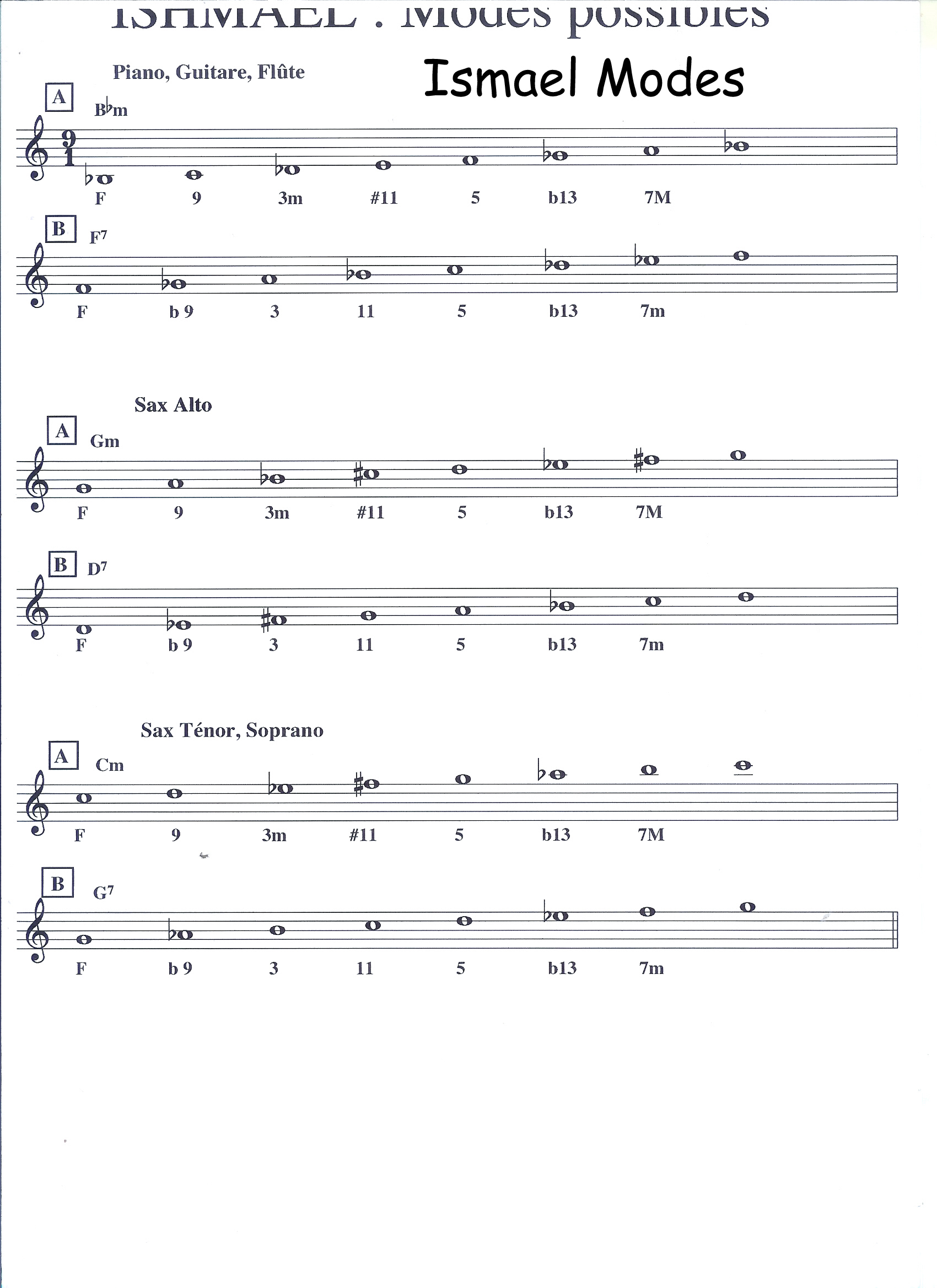
Les partitions, les MP3s et les accompagnements Wikifakebook de:
sont dans la boite (voir Library)
A minor scale can be defined as any scale with a minor scale-tone tonic chord but without a major 3rd (measured from the scale tonic).
The scale must contain:
The minor pentatonic scale and the blues scale are minor scales, but the 8-note dominant scale is not : it contains an ambiguous major 3rd. Neither is the 8-note diminished scale because a minor scale-tone chord can not be formed on its tonic note (it lacks a perfect 5th).
They are (in order of their importance in Jazz):
These minor scales are easiest to recognise by ear by knowing their tetrachord components.
The four component tetrachords are:
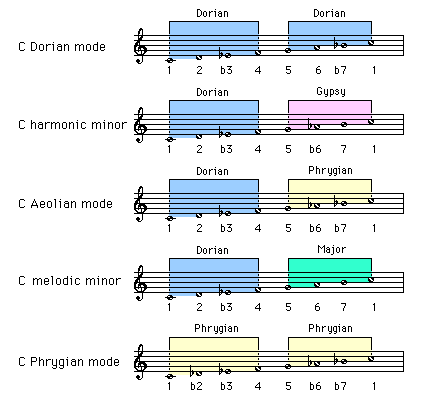
Uses of the minor scales
Below a brief overview of the most common uses for the various minor scales in Jazz improvisation.
1. Dorian mode
This is by far the most commonly used minor scale for Jazz improvisation. Use the Dorian mode over minor chords in these settings.
2. Harmonic minor
This scale is never used over minor 7th chords and only occasionally over minor triads.Use this scale over al IIø – V7 segments in songs.
In the segment Gø – C7 use :
G – Ab – Bb – C – Db – E – F – G (IImode F harmonic minor) over Gø (IIø)
C – Db – E – F – G – Ab – Bb – C (Vmode F harmonic minor) over C7 (V7)
Use the V mode of the harmonic scale over all V7 chords in typically minor songs.
3. Aeolian mode (natural minor scale)
This scale is most commonly used when there are 2 minor 7th chords (which are next to one another on the Circle of Fifths). They then represent two scale-tone chords of a major scale like VIm7 and IIm7, or of a minor scale like Im7 – IVm7.
Use the Dorian mode for the minor 7th chord down stream on the Circle of Fifths.
Use the Aeolian mode for the upstream m7 chord.
Both modes use the same scale tones.
For example for a combination of Cm7 and Fm7 chords use :
C – D – Eb – F – G – Ab – Bb – C (C Aeolian mode) : for Cm7 (VIm7)
F – G – Ab – Bb – C – D – Eb – F (F Dorian mode) : for Fm7 (IIm7)
(Sometimes the C Dorian mode is still preferred over Cm7 to create some additional interest.)
4. Melodic minor
This scale is rarely used for improvisation over minor chords.Its great attraction in Jazz are the modes derived from the melodic minor scale. These are commonly used for altered dominant chords.
5. Phrygian mode
This mode is very prominent in the composition and improvisation over Spanish flamenco music. In Jazz the Phrygian mode is mainly used for scale-tone chord segments that contain three minor 7th chords. They function as : IIIm7 – VIm7 – IIm7. The Phrygian mode is use for the first chord in the row (IIIm7)
In the segment Gm7 – Cm7 – Fm7 use :
G – Ab – Bb – C – D – Eb – F – G (G Phrygian mode) : for Gm7 (IIIm7)
C – D – Eb – F – G – Ab – Bb – C (C Aeolian mode) : for Cm7 (VIm7)
F – G – Ab – Bb – C – D – Eb – F (F Dorian mode) : for Fm7 (IIm7)
Note that all three modes contain the same notes because they are derived from the same major scale. When in doubt as to what scale to use, try out different ones and listen to it.
The ImM7 Chord
Progression: Im – ImM7 – Im7 – VIø – bVImaj7 – V7
The minor Major 7th chord is the scale-tone 7th chord built on the tonic of the harmonic minor scale (and also of the melodic minor scale).
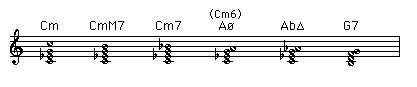
Its main use is as a passing chord between a minor triad and a minor 7th chord.
This chord sequence produces a stepwise (semitone) motion from C –> B –> Bb
The chords produce a continuous line of chord tones that descends stepwise in semitones through the entire progression.
In C minor : C –> B –> Bb –> A –> Ab –> G –> then back to C
This line is most commonly used as a moving bass line
—
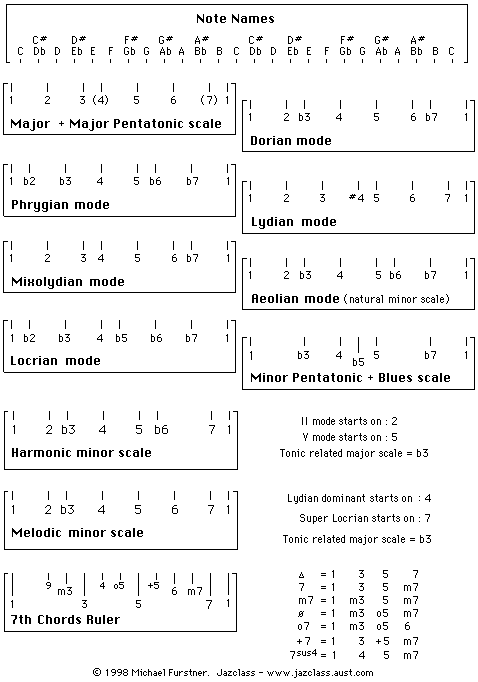

Source: JazClass from Michael Furstner, who developped a very comprehensive Jazz Class course. Thanks to him.

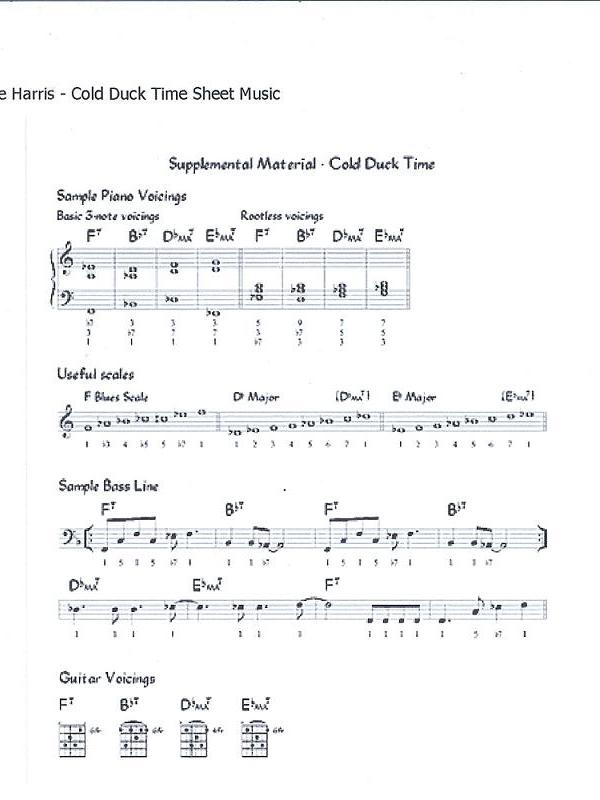
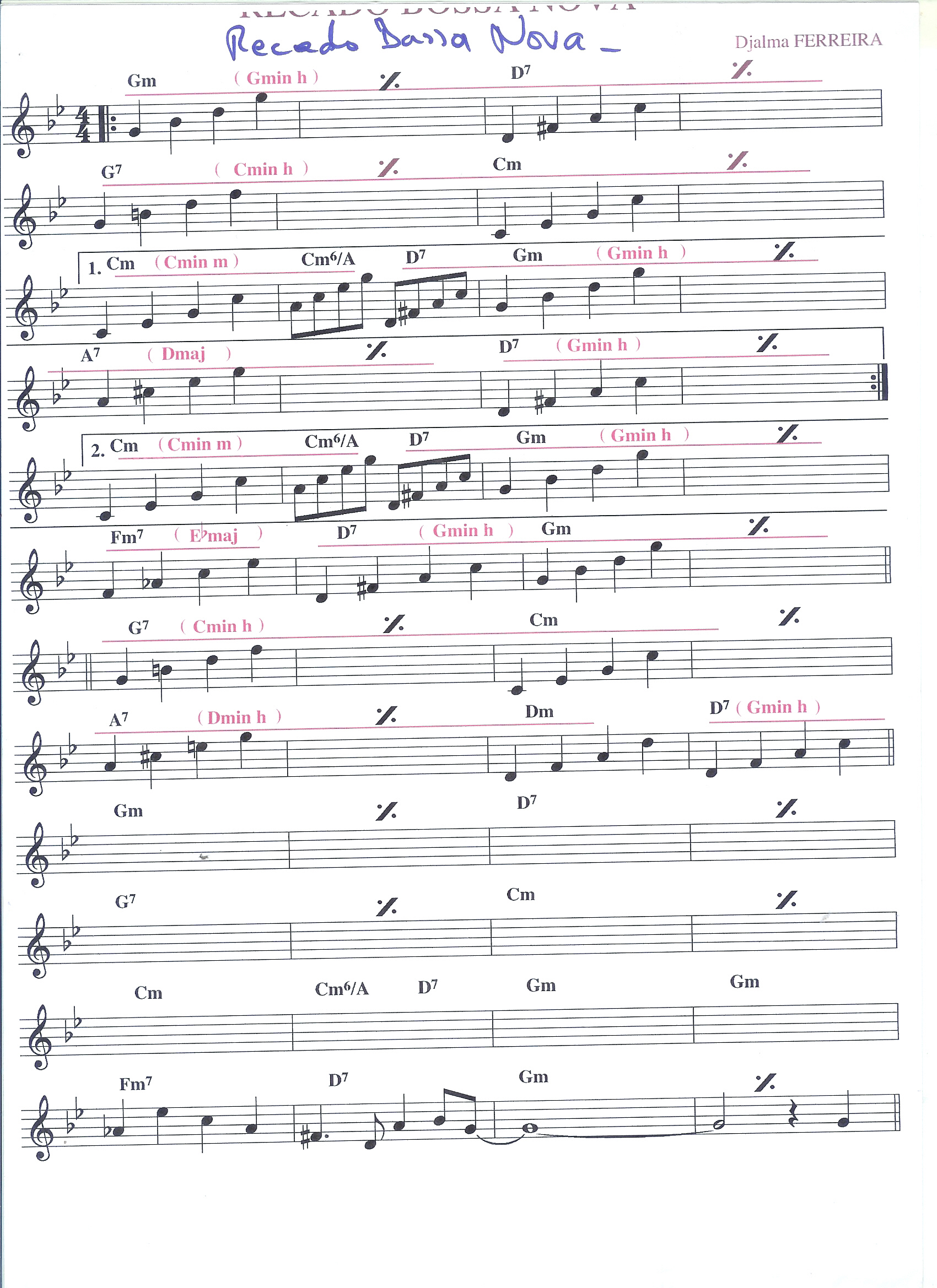
Quelques grilles concernant nos principaux morceaux. (Chords tables for:)
ou directement dans la librairie.
Jacques de Lignières / Boby Few / Serge Lambolet / Hervé Czak , Le JDL Quartet se produit une nouvel fois le 16 Janvier, 22h00 au Club: Autour de Midi, 11 rue Lepic, Paris 18e…. T Monk, Art Pepper…..

Par Danny Luciano

Jazz Crossword Puzzles


 | Listen Here –… on The Electrifying Eddie Harris… |
| LA Kizer on Bobby Few biographie | |
| Pork Pie Hats: Histo… on Pork Pie Hat | |
 | Salainen on Sonorisation d’un Concer… |
 | Heervee on Bobby Few biographie |
 :>)azZClefs#