funics

Author Archive

Moondog – Do your thing

In Bird's Lament, Lyrics on February 15, 2014 at 2:43 pm
et puisque nous reprenons Bird’s lament, en faisant de nouvelles recherches, je suis tombé sur les paroles de: Do your thing :
 
*
Do your thing!
Be fancy-free to call the tune you sing.
Don’t give up!
That’s not the way to win a loving cup.
Do your best,
and opportunity will do the rest.
Don’t give in!
Capitulation is the greatest sin.
Do what’s right,
what’s right for you, to do with all your might.
Don’t regret!
What might have been, you might as well forget.
Stand your ground,
and while you’re standing there, be duty-bound.
Learn to wait,
and while you’re waiting, learn to concentrate.
Make amends!
All enemies I call potential friends,
Calm your fears,
and hope to cope at least a hundred years.
Make your mark!
If need be, even make it in the dark.
Mum’s the word!
My sage advice, pretend you haven’t heard.
*

Pick up the pieces (Average White Band)

In Pick up the pieces on February 14, 2014 at 7:05 pm

une fois n’est pas coutume, je poste quelques liens youtube, on peut pas résister, + de pièces à venir.  😉

18 minutes  de live avec Candy Dulfer.

live at ’30. Leverkusener Jazztage’ 2009/11/12, broadcast by WDR Rockpalast 2010/02/21, written by Roger Ball. With: Candy Dulfer (saxophone / vocals), Jan Van Duikeren (trumpet), Arjen Mooijer (keyboards), Chance Howard (keyboards / vocals), Ulco Bed (guitar), Manuel Hugas (bass), Kirk A. Johnson (drums), Leona Philippo (vocals)
The whole concert now on Vimeo: [https://vimeo.com/84886688]

et l’original de 1974, enregistré par AWB.

Jazz à Auffargis pictures

In Concert, Events on February 10, 2014 at 4:31 pm


This slideshow requires JavaScript.

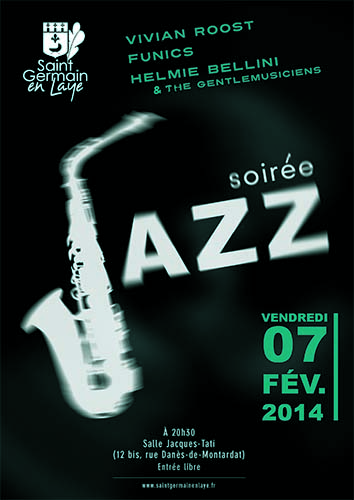
Flyer, salle Jacques Tati

In Concert, Events on January 5, 2014 at 5:27 pm

Soiree_jazzfunics, le 7 janvier 2014


US3 & Cantaloupe Island

In Cantaloupe Island on December 28, 2013 at 7:43 pm

For the 20th anniversary of Us3’s acclaimed, platinum-certified 1993 album, Hand On The Torch and its gold-certified lead single, “Cantaloop (Flip Fantasia).” To celebrate the occasion, the album has been digitally remastered and expanded with four new remixes of “Cantaloop” for a new 2-CD 20th Anniversary Edition on September 17, 2013 by Blue Note/UMe http://smarturl.it/US320thAnniversary

Music video by US3 Featuring Rahsaan And Gerard Presencer performing Cantaloop (Video) (Feat. Rahsaan And Gerard Presencer).

Us3 is a jazz-rap group founded in London in 1992. Their name was inspired by a Horace Parlan recording produced by Alfred Lion, the founder of Blue Note Records. On their debut album, Hand on the Torch, Us3 exclusively used samples from the Blue Note Records catalogue, all originally produced by Lion.

Us3 is the brainchild of London-based producer Geoff Wilkinson. Formed in 1992 alongside production partner Mel Simpson, Us3 had two previous incarnations. The first, a limited edition white label 12″ release in 1990 called “Where Will We Be In The 21st Century”. The release garnered the attention of independent label Ninja Tune, resulting in NW1’s 1991 12″ “The Band Played The Boogie” featuring UK Rapper Born 2 B. It sampled a dancefloor tune of the burgeoning jazz dance scene, Grant Green’s “Sookie Sookie”, originally released on Blue Note Records.

London’s Kiss FM added “The Band Played The Boogie” to its playlist and Wilkinson received a call summoning him to EMI Records’s offices in London. Wilkinson avoided a lawsuit and was granted rights to the archives of Blue Note Records. One of the resulting demos, recorded in March 1992, was “Cantaloop (Flip Fantasia),”featuring UK Trumpeter Gerard Presencer. It sampled Herbie Hancock’s Cantaloupe Island. Two years later, it entered the US top ten and was included on Hand on the Torch, the first Blue Note album to achieve Platinum status (1,000,000 sales) in the USA.

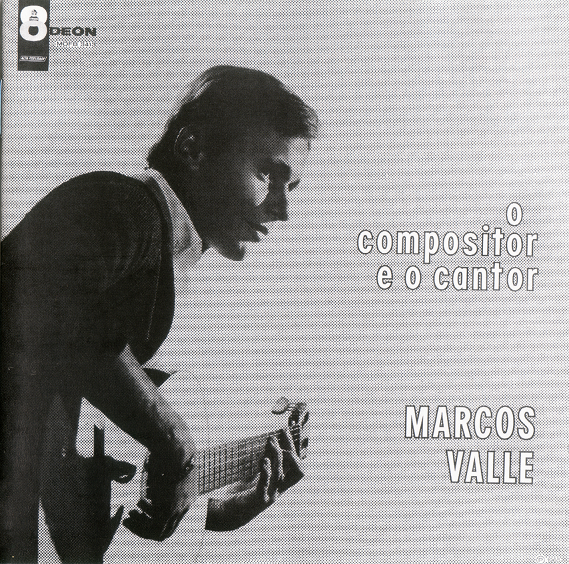
Marcos Valle – O cantor e o compositor (1965)

In Album, Summer Samba on December 28, 2013 at 11:52 am

O Compositor e O Cantorcantor1

1965 on Odeon (SMOFB-3413)
Reissue in 2011 on EMI (026461-2) (SET 026447-2)1 Gente (Paulo Sérgio Valle, Marcos Valle)
2 Preciso aprender a ser só (Paulo Sérgio Valle, Marcos Valle)
3 Seu encanto (Paulo Sérgio Valle, Pingarrilho, Marcos Valle)
4 Passa por mim (Paulo Sérgio Valle, Marcos Valle)
5 Samba de verão (Paulo Sérgio Valle, Marcos Valle)
6 A resposta (Paulo Sérgio Valle, Marcos Valle)
7 Deus brasileiro (Paulo Sérgio Valle, Marcos Valle)
8 Dorme profundo (Pingarrilho, Marcos Valle)
9 Vem (Luiz Fernando Freire, Marcos Valle)
10 Mais amor (Paulo Sérgio Valle, Marcos Valle)
11 Perdão (Paulo Sérgio Valle, Marcos Valle)
12 Não pode ser (Paulo Sérgio Valle, Marcos Valle)
Bonus tracks
13. Vamos pranchar
14. Deus brasileiro (instrumental)
15. Não pode ser (instrumental)Marcos Valle – voice and piano
  • Eumir Deodato – arrangements, orchestrations, piano and organ
  • Sergio Barroso – bass
  • cantor2Wilson das Neves, Dom Um Româo – drums
  • Nelson Ângelo – acoustic guitar
  • Rubens Bassini – percussion
  • Hamilton and Maurílio Santos – trumpet
  • Edson Maciel – trombone
  • Jorginho – alto sax
  • Jt. Meirelles, Walter Rosa – tenor sax
  • Aurino Ferreira – baritone sax
  • Produced by Milton Miranda
  • Musical direction – Lyrio Panicalli

This album is a leap ahead of his first album and situated firmly in jazz-bossa with some traces of innovative pop that would become more prominent in his work later. It also has what is may be the most perfect composition of his entire career: “Preciso aprender a ser só” (I Need To Learn To Be Alone). “Samba de verão is undoubtedly the most reinterpreted song in his catalog, recorded by a bunch of other artists afterwards includes several version of English.. “Deus brasileiro”, “Dorme profundo” lush and shimmery and wonderful. A lot of the same ‘heavy hitters’ from the debut are playing on this album too, with the added bonus of Wilson das Neves and Dom Um Romão on the drums. Also notice a young Nelson Angelo on acoustic guitar. Anybody know who is playing flute on this album (perhaps one of the saxophonists doubling on flute?) — they are not credited in the notes. But kudos to this reissue project for including musician credits in the first place, as these earlier Odeon releases did NOT include ‘backing musicians’ in general, although arrangers usually took pride of place.brazilsamba

Listen to how HARD the ensemble swings on “Seu encanto” and it ought to put to rest any remaining critics (are they any still living?) who thought bossa nova was overly-influenced by or even ‘imitating’ North American jazz: this song is equal to anything recorded elsewhere in its jazz credentials. Goddamn the ruffing is amazing. Just wish I knew who played the flute on it. The tune “Vem” qualifies for this premium category.

The bonus tracks feature the B-side “Vamos prenchar” which was released on the single (compato) for ‘Samba de verão’, and the instrumental takes of “Dues brasileiro” and “Não pode ser”.

Amidst all the greatness on the record, the tune “Dorme profundo” is very special  as the ‘sleeper’ cut that somehow distills the best of what the album has to offer.

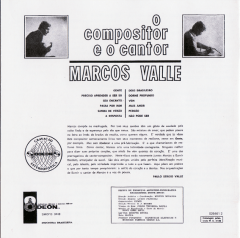
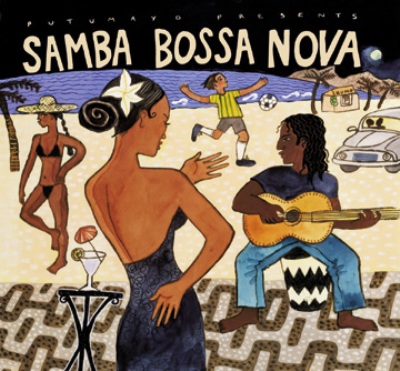
The back of the album jacket had original liner notes by Paulo Sérgio which unfortunately are only reproduced in microscopic form in the CD artwork. But I’ve taken the liberty of translating them here:brazilSambaBossaNova

“”Marcos composes in the middle of the night. For this reason his sambas have the flavor of ‘saudade’ for the end of night, waiting for the day to be born. They are songs of love, that demand poetry in the lyrics in place of shouts of revolution, as some people want. It is true that sometimes this exremely lyrical composer has his moments of realism, like in “Gente”, for example. But without capitulating to some type of pre-fabricated formula. It is what we would like to call “lyrical realism.” As a singer, Marcos creates a contagious intimacy. There is nobody better suited to sing his own songs, that come to us still warm from his heart. It is one of the privleges of the singer-composer. On this album we again have the partnership of Marcos and Eumir Deodator, arranger of choice. They are two friends united by a perfect musical identification, by talent, and by the seriousness engraved on everything they do. Here they put into practice what for so long they have studied: the union of heart and technique. In the orchestration of Eumir and the singing of Marcos is the voice of poetry.” -Paulo Sergio Valle, original liner notes

Marco Valle (bio)

In Bio, Summer Samba on December 28, 2013 at 11:24 am

Marcos Kostenbader Valle (born 14 September 1943 in Rio de Janeiro) is a Brazilian singer, instrumentalist, songwriter and record producer. He has produced works in many musical styles, including bossa nova, samba, and fusions of rock, soul, jazz, and dance music with Brazilian styles.
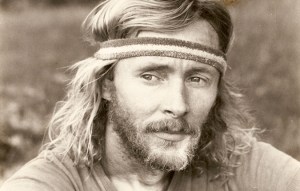
MarcosValle

Valle’s talent was evident from his high school years, which coincided with the explosion of the bossa nova movement in Rio. His classmates included future legends such as Edu Lobo and Dori Caymmi, and his composition “Sonho de Maria” was included on the Avanco album by the influential Tamba Trio in 1963. With his brother Paulo Sergio Valle as his lyricist, he had already built an impressive portfolio of songs, prompting Odeon Records (a subsidiary of EMI) to sign him as a singer. His debut album Samba “Demais”, was released in April 1964. His reputation quickly spread, and his fellow musicians (including Wilson Simonal, Elis Regina, and Nara Leão) lined up to record his songs. A second album, O Compositor e o Cantor, followed in 1965, and featured what would become his most recognisable song, “Samba De Verão” – known in English as “So Nice (Summer Samba)” – along with other hits such as “Deus Brasileiro,” “Gente”, and “A Resposta”.

Nineteen sixty-six brought Valle’s first trip to the United States, where he and his then-wife Anamaria briefly teamed up with Sérgio Mendes in an early version of what would later become Brasil ’66. The threat of being drafted and sent to Vietnam caused Valle to return quickly to Brazil, although the following year saw him back to the United States and enjoying some success, including the release of his U.S. debut album, Braziliance!, on Warner Bros. Records, and several appearances on the Andy Williams TV show. Following session work on Verve Records releases by compatriots Walter Wanderley and Astrud Gilberto, the label released Valle’s Samba ’68 featuring English-language versions of songs from his earlier Brazilian releases.

Shortly thereafter, feeling homesick, Valle returned to Brazil and entered a new creative phase. Viola Enluarada (1968) was more mature and introspective, far removed from the frothy feel of Samba ’68. The title track was a duet with Milton Nascimento and became one of Valle’s signature compositions in Brazil. It also betrayed a political consciousness largely absent from Valle’s previous work – he would become more overtly political in the years to come. The album as a whole pointed to a broader range of musical influences (particularly the Northeastern Brazilian styles he had enjoyed listening to since his childhood days) that moved him out of the “strictly ‘bossa nova artists’ club.”

This process continued on 1969’s Mustang Cor de Sangue ou Corcel Cor de Mel, another leap forward that incorporated rock, soul and pop idioms, all stamped with Valle’s own melodic style. His work on the album reflected the sophisticated pop approach of American songwriters such as Jimmy Webb and Burt Bacharach as well as the inescapable influence of The Beatles.

Around this time, Valle began writing music for TV programs and telenovelas (soap operas), which over the next few years would become one of the main outlets for his work, along with advertising jingles. Marcos Valle (1970) (often referred to as The Bed Album due to its cover shot of Valle in bed) contained his most adventurous as well as his most rock-influenced and psychedelic music up to that point. Backed by Milton Nascimento’s band Som Imaginario, Valle explored a more eccentric approach, with a number of futuristic tracks and an extended instrumental suite not unlike the work of U.S. composer and producer David Axelrod. Garra (1971) was a career highpoint that summed up his music and still stands as one of the finest pop albums of the era, Brazilian or otherwise. Its effervescent pop, jazz, soul, bossa, and film soundtrack stylings were matched by lyrics that attempted to reconcile Valle’s hippie leanings with his status as a wealthy young musician who was also a successful businessman because of his successful novela soundtracks and corporate advertising accounts. Telenovelas he provided some or all of the music for during this period included O CafonaUma Rosa com AmorMinha Doce Namorada,Pigmalião 70Os Ossos do Barão, and, most prominently, Selva de Pedra. He also wrote the score for the film O Fabuloso Fittipaldi (1973).

Vento Sul (1972) found Valle long-haired and bearded, and backed by the progressive rock band O Terço. His most experimental effort to date (he even flirted with heavy metal on the song “Mi Hermoza”), it was a sales flop, although it has acquired admirers over the ensuing decades. The following year’s innovative Previsão do Tempo fared better. It was made in conjunction with the band that initially formed to back Valle at live shows and named itself after one of his songs, Azimuth (soon to change the spelling to Azymuth). This album had a notable jazz fusion feel thanks to Valle’s enthusiasm for the Fender Rhodes piano and Azymuth keyboardist Jose Roberto Bertrami’s expertise on the Hammond organ and assorted synthesizers such as the Mini-Moog and the ARP Soloist. This sound would prove a decisive influence on the acid jazz scene in Europe twenty years later.[1] Another innovation in Previsão do Tempo was the use of vocal percussion on the track “Mentira”, ten years before hip-hop artists introduced beatboxing. Valle emulates a drum kit with his voice to perform a pattern and a fill.

From 1972 to 1974, Valle provided the music for Vila Sésamo, Brazil’s version of Sesame Street. In 1974, he also released his final album for Odeon, again self-titled. This album differed yet again from its predecessors in pursuing a piano-pop sound reminiscent in turns of Elton John, Todd Rundgren and Bread, and replete with elaborate vocal arrangements.

Later careersosamba

At this point, Valle had grown tired of the strictures of living and working under Brazil’s military dictatorship, then in its darkest and bleakest phase. He therefore decided to return to the U.S., where he spent the rest of the decade. Settling in Los Angeles, he entered into collaborations with artists as diverse as Sarah Vaughan, Chicago, and R&B singer and songwriter Leon Ware. Valle and Ware found themselves especially compatible, and wrote many songs together, Valle appearing on several of Ware’s Elektra Records releases.

Valle returned to Brazil in late 1980 and completed two albums, 1981’s Vontade de Rever Você, and 1983’s Marcos Valle. These albums had prominent boogie, soul and funk influences. These had been present in Valle’s work since the beginning of the 1970s and would be permanent influences on his music, also being solidified by his work with Leon Ware and Chicago. His single “Estrelar” (1982), a boogie dance track marketed as “workout music” at the time, proved to be his best-selling record ever with a total of about 90,000 copies sold. In 1984, he released another boogie single, “Bicicleta”, but his recording label (Som Livre) decided to dismiss its entire cast and concentrate on soap opera LPs and Marcos was unable to complete a new album. His final album from the eighties was 1986’s Tempo da Gente, after which he took a break from recording. Nevertheless he kept on playing gigs (something he did not do in his “Estrelar” days) and writing songs for many different artists such as Tim Maia, Roberto Carlos, and Ricky Martin.

In the meantime, many listeners had become acquainted with Valle’s work of the 1960s and 1970s, and his music started to find favour with European and American fans, as well as connoisseurs of dance music. Valle recorded a new album in 1999, Nova Bossa Nova, which reached back to his roots in bossa nova and added contemporary electronic influences to his music. At this point Valle had signed with the London-based Far Out Recordings, which specialised in Brazilian musicians such as Azymuth (his backing band on 1973’sPrevisão do Tempo) and Joyce. In 2001 Valle also produced two other discs, Live in Montreal with guitarist Victor Biglione and a backing band, and Bossa Entre Amigos, a release aimed at the Brazilian market that featured Valle sharing the bill with Braziilian guitarist and songwriter Roberto Menescal and singer-guitarist Wanda Sá.

Escape, and especially its follow-up, Contrasts (released in 2003), showed increased electronic influences, mediated by London-based producer Roc Hunter. Valle showed on these releases that he was able to stay true to the roots of his sound while remaining open to modern influences and integrating them into his style. On 2005, Valle released Jet Samba, an all-instrumental collection featuring reworked compositions from past albums, as well as several new songs.

In 2010, he released Estática, an album which saw him return to a more organic approach, albeit with the use of some analog synthesisers. The record features expansive horn and string arrangements and has been referred to as a “masterpiece” by some. In 2011, he collaborated with the Phenomenal Handclap Band to contribute a version of the song “Tudo o Que Você Podia Ser” to the Red Hot Organization’s fund-raising album Red Hot + Rio 2, proceeds from the sales of which were donated to fight AIDS/HIV. Valle continues to perform in Brazil and throughout Europe.

DiscographyMarcos_Valle
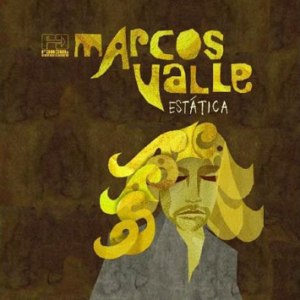
  • 1963: Samba “Demais” (Odeon)
  • 1965: O Compositor e o Cantor (Odeon)
  • 1966: Braziliance! (Warner/Odeon)
  • 1968: Samba ’68 (Verve)
  • 1968: Viola Enluarada (Odeon)
  • 1969: Mustang côr de Sangue (Odeon)
  • 1970: Marcos Valle (Odeon)
  • 1971: Garra (Odeon)
  • 1972: Vento Sul (Odeon)
  • 1973: Previsão do Tempo (Odeon)
  • 1974: Marcos Valle (Odeon)
  • 1981: Vontade de Rever Você (Som Livre)
  • 1983: Marcos Valle (Som Livre)
  • 1986: Tempo da Gente (Arca Som)
  • 1999: Nova Bossa Nova (Far Out)
  • 2001: Escape (Far Out)
  • 2001: Bossa Entre Amigos (with Roberto Menescal and Wanda Sá) (Albatroz) – also on DVD
  • 2003: Live in Montreal (with Victor Biglione) (Rob) – recorded in 2000
  • 2003: Contrasts (Far Out)
  • 2005: Jet Samba (Dubas)
  • 2008: Conecta: Ao Vivo no Cinematheque (live) (EMI) – also on DVD
  • 2009: Página Central (with Celso Fonseca) (Biscoito Fino)
  • 2010: Estática (Far Out)
  • 2011: Valle Tudo (EMI) – 11-CD box set – recorded 1963-1974
  • 2012: Anos 80 (Discobertas) – 3-CD box set – recorded 1981-1986
  • 2012: Ensaio (Warner) – recorded in 2001 – also on DVD
  • 2013: Ao Vivo (with Stacey Kent) (Sony/BMG)

Stolen moments lyrics

In Lyrics, Stolen Moments on December 27, 2013 at 9:48 am

Stolen Moments (Oliver Nelson)

(Text: Edward Fisher)

If I told you I love you pretty baby
Would it make up for what they say?
If I hold you and squeeze you darlin’
Would you linger a while today?
If I hold you and hug you my dear so don’t argue
Then gossip won’t hurt you I’ll never desert you
And someday we’ll find us where people won’t bind us
To the hands of time

I can use more than moments with you baby
And I know where you steal them from
There are so many things I’ll teach you
But they call me a useless bum
They just chatter and patter and nitter and natter
They take it and twist it, until it gets bitter
But we’re here, I steered here it’s weird here those beards dear
Watch the pantomime

 Andy White, April 2008

Stolen moments first recording

In Album, Stolen Moments on December 27, 2013 at 12:02 am

Probably the first known recording of Stolen Moments:

Trane Whistle

Studio album by Eddie “Lockjaw” Davis Big Band
Released 1960
recorded: September 20, 1960, Van Gelder Studio, Englewood Cliffs
label: Prestige PR 7206

Trane Whistle  is an album by saxophonist Eddie “Lockjaw” Davis Big Band with arrangements by Oliver Nelson and Ernie Wilkins recorded in 1960 and released on the Prestige label.

Reception

The Allmusic site awarded the album 4½ stars stating “Most significant is the inclusion of the original version of “Stolen Moments” (here called “The Stolen Moment” and predating the more famous Oliver Nelson recording by several months)”.

Track listing

All compositions and arrangements by Oliver Nelson except as indicated

  1. “Trane Whistle” – 6:19
  2. “Whole Nelson” – 3:35
  3. “You Are Too Beautiful” (Lorenz Hart, Richard Rodgers) – 5:11 (arr. by Ernie Wilkins)
  4. The Stolen Moment” – 7:54    (<- listen here)
  5. “Walk Away” – 5:27
  6. “Jaws” (Eddie “Lockjaw” Davis) – 4:36 (arr. by Ernie Wilkins)

Personnel

  • Eddie “Lockjaw” Davis – tenor saxophone
  • Clark Terry, Richard Williams, Bob Bryant – trumpet
  • Melba Liston, Jimmy Cleveland – trombone
  • Jerome Richardson, George Barrow – tenor saxophone, flute
  • Eric Dolphy, Oliver Nelson – alto saxophone
  • Bob Ashton – baritone saxophone
  • Richard Wyands – piano
  • Wendell Marshall – bass
  • Roy Haynes – drums
  • Oliver Nelson (tracks 1, 2, 4 & 5), Ernie Wilkins (tracks 3 & 6) – arranger

References

  1. Yanow, S.  Allmusic Review accessed July 11, 2012
  2. Payne, D. Oliver Nelson discography accessed July 11, 2012

From Wikipedia, the free encyclopedia

Noël 2013

In Fun, Others on December 24, 2013 at 1:06 pm

xmass2010