funics

Archive for the ‘Partitions’ Category

Stolen moments first recording

In Album, Stolen Moments on December 27, 2013 at 12:02 am

Probably the first known recording of Stolen Moments:

Trane Whistle

Studio album by Eddie “Lockjaw” Davis Big Band
Released 1960
recorded: September 20, 1960, Van Gelder Studio, Englewood Cliffs
label: Prestige PR 7206

Trane Whistle  is an album by saxophonist Eddie “Lockjaw” Davis Big Band with arrangements by Oliver Nelson and Ernie Wilkins recorded in 1960 and released on the Prestige label.

Reception

The Allmusic site awarded the album 4½ stars stating “Most significant is the inclusion of the original version of “Stolen Moments” (here called “The Stolen Moment” and predating the more famous Oliver Nelson recording by several months)”.

Track listing

All compositions and arrangements by Oliver Nelson except as indicated

  1. “Trane Whistle” – 6:19
  2. “Whole Nelson” – 3:35
  3. “You Are Too Beautiful” (Lorenz Hart, Richard Rodgers) – 5:11 (arr. by Ernie Wilkins)
  4. The Stolen Moment” – 7:54    (<- listen here)
  5. “Walk Away” – 5:27
  6. “Jaws” (Eddie “Lockjaw” Davis) – 4:36 (arr. by Ernie Wilkins)

Personnel

  • Eddie “Lockjaw” Davis – tenor saxophone
  • Clark Terry, Richard Williams, Bob Bryant – trumpet
  • Melba Liston, Jimmy Cleveland – trombone
  • Jerome Richardson, George Barrow – tenor saxophone, flute
  • Eric Dolphy, Oliver Nelson – alto saxophone
  • Bob Ashton – baritone saxophone
  • Richard Wyands – piano
  • Wendell Marshall – bass
  • Roy Haynes – drums
  • Oliver Nelson (tracks 1, 2, 4 & 5), Ernie Wilkins (tracks 3 & 6) – arranger

References

  1. Yanow, S.  Allmusic Review accessed July 11, 2012
  2. Payne, D. Oliver Nelson discography accessed July 11, 2012

From Wikipedia, the free encyclopedia

Summer Samba (lyrics)

In Lyrics, Summer Samba on December 24, 2013 at 8:31 am

Summer Samba (So nice)

Words & music by Norman Gimbel, Marco Valle, Paulo Sergio Valle

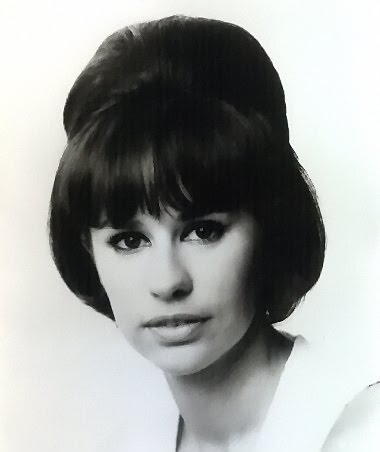
Recorded by Astrud Gilberto, 1965samba guitar


Someone to hold me tight, that would be very nice

Someone to love me right, that would be very nice

Someone to understand each little dream in me

Someone to take my hand and be a team with me

So nice, life would be so nice

If one day I’d find

Someone who would take my hand and samba through life with me

Someone to cling to me, stay with me, right or wrong

Someone to sing to me little samba song

Someone to take my heart and give his heart to me

Someone who’s ready to give love a start with me

Oh yeah, that would be so nice

Should it be you and me, I can see that would be nice

**

pdf here: summer samba

Summer Samba (Marco Valle)

In Summer Samba on December 22, 2013 at 11:32 pm

Summer Samba (also known as So Nice or its original Portuguese title, “Samba de Verão“) is a 1964 bossa nova song by Brazilian composer Marcos Valle, with English-language lyrics by Norman Gimbel; the original Portuguese lyrics came from Paulo Sérgio Valle, brother to the composersummersamba

The song was first popularized by the Walter Wanderley Trio in 1966 — the album Rain Forest on which it was issued reached platinum status in 1970— also reaching the U.S.”Easy Listening” chart in versions by Johnny Mathis, Vikki Carr, and Connie Francis during that same year. In fact, at least one source claims that three different versions were on the Billboard charts at the same time in 1966.  Allmusic has said of Wanderley’s version, “His recording … is regarded as perhaps a more definitive bossa tune than “Girl From Ipanema.”  Wanderley’s version was the biggest seller in the U.S., reaching #26 on the Billboard Hot 100 in 1966, (#3 on the Easy Listening chart) , and is still a favourite on Adult Standards radio stations.

Andy Williams released a version in 1966 on his album, In the Arms of Love. The Angels released a version of the Astrudgilbertosong in 1967 entitled “So Nice” as the B-side to their “Merry Go Round”. Other notable versions include those by Astrud Gilberto and by Bebel Gilberto, both of which have been used in several television programs and in widely broadcast TV advertisements. Some think the very best version was by Brasil ’65 with Wanda de Sah and Sergio Mendes; slower and languid, it imparts the feeling of a lazy day on the beach in a similar way to “Girl from Ipanema”. In 1965 it was the fist to be released As of the year 2000, the song had been recorded by more than 180 different artists worldwide.

The song was covered by Emma Bunton in 2004 and was released as a b-side on the commercial CD single to her single “Crickets Sing For Anamaria” (also written by Marcos Valle), taken from her critically acclaimed second album, Free Me. This song features the Hammond B-3 organ, a staple of the sixties in the recording studio.

From Wikipedia, the free encyclopediaMarcos_Valle

Dat Dere (Bobby Timmons)

In Dat Dere on December 22, 2013 at 10:57 pm

Dat Dere” is a jazz song with music by Bobby Timmons and lyrics by Oscar Brown, Jr.

The song was first recorded by Bobby Timmons in his debut album This Here is Bobby Timmons (January 1960) and shortly after by Art Blakey and The Jazz Messengers on the album The Big Beat (March 1960) with Timmons as the band’s pianist.15-elephant

Oscar Brown Jr. penned the lyrics later for the song’s release on his 1961 début album Sin & Soul…and Then Some, as he did with two other recent jazz instrumentals, Mongo Santamaría’s “Afro Blue,” and Nat Adderley’s “Work Song”. Brown’s lyrics describe a child’s curiosity and excitement on a visit to the zoo with his father, and the parent’s reflections on the child’s growing up.

Musical structure

It features a joint trumpet and tenor saxophone solo from measures 9 through 23. Then the saxophone takes its own solo from measures 34 through 59, sporting a D minor- B minor7 (b5)- E minor7 (b5) chord progression. At measure 59 the whole band joins in for a loud and proud “shout chorus.” It takes the coda back to 18, and once measure 30 is finished, it is open to the whole band to solo individually.

Other versions

  • Sheila Jordan recorded this song on her debut album for Blue Note Records, “Portrait of Sheila” in 1961.
  • Cannonball Adderley recorded/performed a version of this song when Bobby Timmons was a member of the quintet, and so did Art Blakey.
  • Rickie Lee Jones recorded the song for her 1991 Pop Pop album.
  • Mel Tormé performed his version of this song on Ralph J. Gleason’s exemplary Jazz Casual series. Taped on May 2, 1964, it features Mel with Gary Long on piano, Perry Lind on bass, and Benny Barth on drums.

From Wikipedia, the free encyclopedia

Dat Dere lyrics

In Dat Dere, Lyrics on December 20, 2013 at 10:22 am

This re-creation of the wonder of a child (“Dat Dere” = “That There” – you can change all the “th”s to “d”s if you want. You can also change the genders to fit, too.) has been famously covered by Oscar Brown, Jr., Nat “Cannonball” Adderley, May Lou Williams & Rickie Lee Jones. Thanks to correspondent Mark S. for the chords. also, added easier guitar chords. Download pdf for the chords, at bottom page.

Intro vamp

Hey, mama, what’s that there? And what’s that under there?15-elephant
Hey, mama, up here! Mama – hey! – look at that over there!
And what’s that doing there? And where’re they going there?
And, mummy, can I have that big elephant over there?
Who’s that in my chair? And what’s he doing there?
And, mommy, oh, hey, mommy, can I go over there?
Hey mummy, what’s a square? And where do we get air?
And mummy can I have that big elephant over there?

Bridge1

My quizzical kid! She doesn’t want anything here.
Just forever demanding to know who, what, why or where!
Inquisitive child! Sometimes the questions get wild!
Like, mommy, can I have that big elephant over there?
Don’t wanna comb my hair and where’s my teddy bear?Cowboy_Boots
And, mama, hey! Look at the cowboy coming there!
And can I have a pair of boots like that to wear?
And mummy can I have that big elephant over there?

Intro vamp here

Time will march, days will go and little baby’s going to grow.
I gotta tell her what she needs to know.
I’ll help her along, so she’ll know right from wrong & she’ll be strong.
As life’s parade goes marching by, she’s gonna need to know some reasons why.
I don’t have all the answers, but I’ll try the best as I can.
We’ll make a plan. [alt.: I’ll make him a man.]  That’s right!

[back to verse chords]

‘Cause you give the kid your best and hope she passes the test
And finally send her out into the world somewhere.
And though she’s grown up, I bet I never will forget.
Mummy, can I have that big elephant over there?
Hey, why they do that there? And how you put that there?

Hey, mummy, up here! Hey, mummy, what that say up there?
Hey, mummy, what is fair? How come I have to share?
And, mummy can I have that big elephant over there? [last line 3x]

Outro repeat intro vamp & out

lyrics and chords here: DatDere lyrics

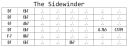
The Sidewinder (Lee Morgan)

In The Sidewinder on December 17, 2013 at 1:07 pm

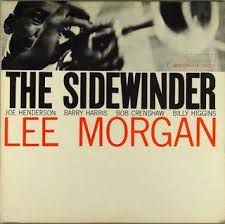
Lee_Morgan-The_SidewinderThe Sidewinder is a 1964 album by jazz trumpeter Lee Morgan, recorded at the Van Gelder Studio, Englewood, New Jersey. It was released on the Blue Note label as BLP 4157 and BST 84157.

The title track “The Sidewinder” was one of the defining recordings of the soul jazz genre, becoming a jazz standard. An edited version was released as a single.

The album became a huge seller, and highly influential – many subsequent Morgan albums, and other Blue Note discs, would duplicate (or approximate) this album’s format, by following a long, funky opening blues with a handful of conventional hard bop tunes. Record producer Michael back sidewinderCuscuna recalls the unexpected success: “the company issued only 4,000 copies upon release. Needless to say, they ran out of stock in three or four days. And ‘The Sidewinder’ became a runaway smash making the pop 100 charts.” By January 1965, the album had reached No. 25 on the Billboard chart.The title track was used as the music in a Chrysler television advertisement and as a theme for television shows.

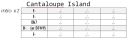
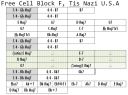
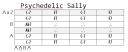
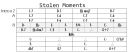
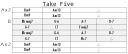
Quelques grilles

In Cantaloupe Island, Free Cell Block, In Walked Bud, Psychedelic Sally, Stolen Moments, Take Five, The Sidewinder on December 17, 2013 at 12:59 pm

Stolen Moments, Take Five, Cantaloupe Island, In Walked Bud, Psychedelic Sally, the Sidewinder, Free Cell Block F, Tis Nazi USA.

Lee Morgan

In Bio, The Sidewinder on December 16, 2013 at 11:06 pm

Edward Lee Morgan (trumpeter) was born on July 10, 1938 in Philadelphia, Pennsylvannia and passed away on February 19, 1972 in New York City.

Lee Morgan was the youngest of Otto Ricardo and Nettie Beatrice Morgan’s four children. Originally interested in the vibraphone, he soon showed a growing enthusiasm for the trumpet. Morgan also knew how to play the alto saxophone. On his thirteenth birthday, his sister Ernestine gave him his first trumpet. His primary stylistic influence was Clifford Brown, who gave the teenager a few lessons before he joined the Dizzy Gillespie Big Band at 18, and remained a member for a year and a half, until the economic situation forced Dizzy to disband the unit in 1958. He began recording for Blue Note Records in 1956, eventually recording 25 albums as a leader for the company, with more than 250 musicians. He also recorded on the Vee-Jaylabel.

He was a featured sideman on several early Hank Mobley records, as well as on John Coltrane’s Blue Train (1957), on which he played a trumpet with an angled bell (given to him by Gillespie) and delivered one of his most celebrated solos on the title track.

Joining Art Blakey’s Jazz Messengers in 1958 further developed his talent as a soloist and composer. He toured with Blakey for a few years, and was featured on numerous albums by the Messengers, including Moanin’, which is one of the band’s best-known recordings. When Benny Golson left the Jazz Messengers, Morgan persuaded Blakey to hire Wayne Shorter, a young tenor saxophonist, to fill the chair. This version of the Jazz Messengers, including pianist Bobby Timmons and bassist Jymie Merritt, recorded the classic The Freedom Rider album. The drug problems of Morgan and Timmons forced them to leave the band in 1961, and the trumpeter returned to Philadelphia, his hometown. According to Tom Perchard, a Morgan biographer, it was Blakey who introduced the trumpeter to heroin, an addictive drug that impeded his career trajectory.
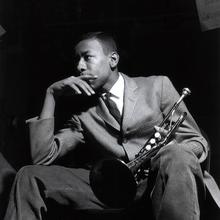
 

Lee_MorganOn returning to New York in 1963, he recorded The Sidewinder (1963), which became his greatest commercial success. The title track cracked the pop charts in 1964, and served as the background theme for Chrysler television commercials during the World Series. The tune was used without Morgan’s or Blue Note’s consent, and intercession by the label’s lawyers led to the commercial being withdrawn. Due to the crossover success of “The Sidewinder” in a rapidly changing pop music market, Blue Note encouraged its other artists to emulate the tune’s “boogaloo” beat. Morgan himself repeated the formula several times with compositions such as “Cornbread” (from the eponymous albumCornbread) and “Yes I Can, No You Can’t” on The Gigolo. According to drummer Billy Hart, Morgan said he had recorded “The Sidewinder” as filler for the album, and was bemused that it had turned into his biggest hit. He felt that his playing was much more advanced on Grachan Moncur III’s essentially avant-garde Evolution album, recorded a month earlier, on November 21, 1963.

After this commercial success, Morgan continued to record prolifically, producing such works as Search for the New Land (1964), which reached the top 20 of the R&B charts. He also briefly rejoined the Jazz Messengers after his successor, Freddie Hubbard, joined another group. Together with John Gilmore, this lineup was filmed by the BBC for seminal jazz television program Jazz 625.

As the 60′s progressed, he recorded some twenty additional albums as a leader, and continued to record as a sideman on the albums of other artists, including Wayne Shorter’s Night Dreamer; Stanley Turrentine’s Mr. Natural; Freddie Hubbard’s The Night of the Cookers; Hank Mobley’s Dippin’A Caddy for DaddyA Slice of the TopStraight No Filter; Jackie McLean’s Jackknife and Consequence; Joe Henderson’s Mode for Joe; McCoy Tyner’s Tender Moments; Lonnie Smith’s Think and Turning Point; Elvin Jones’ The Prime Element; Jack Wilson’s Easterly Winds; Reuben Wilson’s Love Bug; Larry Young’s Mother ShipLee Morgan and Clifford Jordan Live in Baltimore 1968; Andrew Hill’s Grass Roots; as well as on several albums with Art Blakey and the Jazz Messengers.


He became more politically involved in the last two years of his life, becoming one of the leemorganleaders of the Jazz and People’s Movement. The group demonstrated during the taping of talk and variety shows during 1970-71 to protest the lack of jazz artists as guest performers and members of the programs’ bands. His working band during those last years featured reed players Billy Harper or Bennie Maupin, pianist Harold Mabern, bassist Jymie Merritt and drummers Mickey Roker or Freddie Waits. Maupin, Mabern, Merritt and Roker are featured on the well-regarded 3-disc, Live at the Lighthouse, recorded during a two-week engagement at the Hermosa Beach club, California, in July 1970.

Morgan was murdered in the early hours of February 19, 1972, at Slugs’, a jazz club in New York City’s East Village where his band was performing. Following an altercation between sets, Morgan’s common-law wife Helen More (a.k.a. Morgan), shot him in the chest onstage, killing him within moments. He was 33 years old.

We Want Miles

In Album, Jean Pierre on November 27, 2013 at 11:55 pm
 

We Want Miles: Live album by Miles Davis
Released: May 1982
Recorded: June 27, July 5 & October 4, 1981
LabelCBS
ProducerTeo Macero

We Want Miles is a double album recorded by jazz trumpeter Miles Davis in 1981, produced by Teo Macero and released by Columbia Records in 1982. The album features one of the first live appearances by Davis in more than five years, at Boston’s Kix Club, on June 27, 1981. Other tracks are recorded at Avery Fisher Hall, New York, on July 5, and in Tokyo, October 4 of that year. First released on CD in Japan as a two-disc set (CBS/Sony CSCS 5131/5132), subsequent CD releases fit the music onto one disc. Columbia Recordshave never released it on CD in North America. This album won the 1982 Grammy Award for Best Jazz Instrumental Performance by a Soloist. It is the only official worldwide live release of Miles Davis’ band from his final years,  since Miles! Miles! Miles!, documenting the show in Tokyo from which some tracks ended up on We Want Miles, was released exclusively in Japan.

Contents

Track listing

All tracks composed by Miles Davis; except where indicated

Side One

  1. Jean Pierre” – 10:30
  2. “Back Seat Betty” – 8:10

Side Two

  1. “Fast Track” – 15:10
  2. Jean Pierre” – 4:00

Side Three

  1. “My Man’s Gone Now” (DuBose Heyward, George Gershwin) – 20:12

Side Four

  1. “Kix” – 18:45

Personnel

  • Miles Davis – Trumpet
  • Bill Evans – Soprano saxophone
  • Mike Stern – Electric guitar
  • Marcus Miller – Bass guitar
  • Al Foster – Drums
  • Mino Cinelu – Percussion

Production

  • Producer: Teo Macero
  • Series Producer: Henri Renaud
  • Executive Producer: Dr. George Butler
  • Control Engineers: Bud Grahm, Don Puluse
  • Recording Engineers: Hank Altman, Ted Brosnan
  • Remix Engineers: Don Puluse, Ted Brosnan

Caravan lyrics

In Caravan, Lyrics on November 27, 2013 at 10:19 pm

Caravan
Duke Ellington, Wes Montgomery

———

Night and stars above that shine so bright
The myst’ry of their fading light
That shines upon our caravan
Sleep upon my shoulder as we creep
Across the sand so I may keep
The mem’ry of our caravan
This is so exciting You are so inviting Resting in my arms
As I thrill to the magic charms
Of you beside me here beneath the blue
My dream of love is coming true
Within our desert caravan!

(x 2)

—–

by Juan Tizol & Irving Mills