Ci joint un petit programme pour générer toutes les gammes que vous souhaitez avec BIAB, Band In A Box
Scales generator, Bon practices
Ci joint un petit programme pour générer toutes les gammes que vous souhaitez avec BIAB, Band In A Box
Blues Improvisation – it’s all in the wrist – wrong!
Blues Improvisation = pentatonic scale – wrong!
Blues Improvisation = bending notes – wrong!
It’s all about the pause man… THE PAUSE!>
What pause? What this some kind of sex technique?… Well, to tell the truth. maybe.. it’s no secret blues improvisation turns people on.. is there anyone that hasn’t made love to some cool guitar solo?
And like sex, playing the blues is a contact sport.. You have to take off your robe… get in the ring and take your chances.. Like a prize fighter, you got to know when to punch, when to duck and… when you smell blood, how to bring your solo to its climax!!! and get the hell out of there!
The master is, was and always will be B.B. King… listen to the album “Live at the Regal”, the B.B. King’s blues guitar solo throws you off balance, gets you leaning one way and then POW!!! Right in the gut man..
OK, so where does the PAUSE come in? Take a guess… Right at the start of most blues guitar licks… instead of playing a note on the beat.. you leave a rest – an eigth note or sixteenth note rest depending on the tempo… and POW!!! You’re guitar solo’s are going to get noticed!!
It may not seem like such a big deal, but “the pause” separates the men from the boys. It make take you a long time to figure this out.. but once you do, you’re on your way… Once again… the trick is to catch the listener’s ear with a quick note that’s more like a “pick up” than an eighth note.. or to start your blues licks with a rest instead of a note… Just listen to all the greats BB. King, SRV, Eric Clapton, Robert Cray and Albert Collins, my main man..
Good luck and funky blues.. Johnny Mayer.
from BluesforPeace
Learn these blues chords and basic blues progressions to play with any blues band in the world… practice 12 bar blues, “quick’ change, blues turn arounds, 8 bar blues, minor blues, bridge, etc. until you can play them in your sleep… For example, “Sweet Home Chicago”, the 2nd song below… good luck and funky blues…
The name 12 Bar Blues comes from the number of measures or bars in most blues songs – twelve. Here’s the basic 12 bar blues (Chicago blues) in the key of A.
Further On Up the Road – basic 12 bar blues
/ A7 /A7 /A7 /A7 / D7 / D7 /A7 / A7 / E7 / D7 / A7 / E7 /
A quick change is just that, changing chords in the 2nd measure and then back the the first chord.
/ A7 / D7 /A7 /A7 / D7 / D7 /A7 / A7 / E7 / D7 / A7 / E7 /
Blues musicians often refer to chord changes by Roman numerals after the steps of the scale. Below are the scale steps in the key of A and the chords associated with them.
I A (the key of the song)
II Bmi
III C#mi
IV D
V E
VI F#mi
VII G#dim
Many blues songs have just three chords, the I, IV and V chords. In the key of A, that’s A, D and E. Here’s Further On Up the Road by chord name and Roman numerals.
/ A7 / A7 /A7 /A7 / D7 / D7 /A7 / A7 / E7 / D7 / A7 / E7 /
/ I / I / I / I / IV / IV / I / I / V / IV / I / V /
And the quick change in Sweet Home Chicago? It’s to the …. IV chord …. Right!
/ A7 / D7 /A7 /A7 / D7 / D7 /A7 / A7 / E7 / D7 / A7 / E7 /
/ I / IV / I / I / IV / IV / I / I / V / IV / I / V /
1) The last 2 bars of the song are called the turnaround. The basic turnaround is
… / A7 / E7 /
2) There are many varations of the turn around. Here’s a common one
… / A7 D7 / A7 E7 /
Key to the Highway – uses the turnaround variation (#2 above)
/ A7 / E7 / D7 / D7 / A7 / E7 / A7 D7 / A7 E7 /
/ I / V / IV / IV / I / V / I IV / I V /
/ Am / Am / Am / Am / Dm / Dm / Am / Am / Em / Dm / Am / – /
/ I / I / I / I / IV / IV / I / I / V / IV / I / – /
A minor 12 bar blues usually has a repeated rhythm pattern and no chord in the 12 measure.
The chord number system comes in handy on a gig. If the band leader says “take it down from the fifth”, that means start the song from V chord in the 9th measure.
… / E7 / D7 / A7 / E7 /
… / V / IV / I / V /
And if someone points at you and holds up 4 fingers, it means play the IV chord now!
Bridge (B part of song)
Some blues songs have a “B” part or bridge. You’ll find this one in many songs.
/ D7 / A7 / D7 / A7 / D7 / A7 / B7 / E7 /
/ IV / I / IV / I / IV / I / II / V /
The ‘unexpected’ “IV” chord (instead of the I chord) creates tension and interest. Usual format – AABA.
Allman Bros. style layed back triplets
G9 / C9 / G9 G#9 / G9 /
C9 / C9 / G9 Ami7 / Bmi7 A#mi7 /
Ami7 / Cmi7 / G9 C9 / G9 D+ /
The Blues had a baby and they called it Rock N Roll. A comparison of the two styles that may open up your ears and improve your playing.
#1 Tempo / 8th Notes
Blues is usually slower – medium shuffle – played with dotted eight notes
Rock is usually uptempo – played with even eight notes.
#2 Changing Chords / Beat
Blues chords ususally change on the 1st beat of a measure
Rock chords change on the ‘&’ of the 4th beat in the previous measure – gives rock incredible drive.
#1 Rhythm Guitar / 1 Note or 2?
Blues- the rhythm guitar usually plays two notes together.
Rock- the rhythm guitar alternates between playing two notes together and a single ‘bass’ note
The use of a seven-note diatonic musical scale is ancient, though originally it was played in descending order.
In the eleventh century, the music theorist Guido of Arezzo developed a six-note ascending scale that went as follows: ut, re, mi, fa, sol, and la. A seventh note, “si” was added shortly after. The names were taken from the first verse of the Latin hymn Ut queant laxis, where the syllables fall on their corresponding scale degree.
Sheet Music for Ut Queant Laxis
Ut queant laxis resonāre fibris
Mira gestorum famuli tuorum,
Solve polluti labii reatum,
Sancte Iohannes.
The hymn (The Hymn of St. John) was written by Paulus Diaconus in the 8th century. It translates as:
So that these your servants can, with all their voice, sing your wonderful feats, clean the blemish of our spotted lips, O Saint John!
“Ut” was changed much later in Italy to the open syllable Do, and Si was added to complete the diatonic scale. In Anglo-Saxon countries, “si” was changed to “ti” by Sarah Glover in the nineteenth century so that every syllable might begin with a different letter. “Ti” is used in tonic sol-fa and in the song “Do-Re-Mi”.
In the Elizabethan era, England and its related territories used only four of the syllables: mi, fa, sol, and la. “Mi” stood for modern ti, “fa” for modern do or ut, “sol” for modern re, and “la” for modern mi. Then, fa, sol and la would be repeated to also stand for their modern counterparts, resulting in the scale being fa, sol, la, fa, sol, la, mi, fa. This was eventually eliminated by the 19th century, but it was (and still is in a few rare circumstances) used in the shape note system, which gives each solfège syllable a diffferent shape.

From Jamay Aebersold, very valuable booklets to summaryze: chords, scales, tips, II-V-I, Blues & Jazz progressions…. These are the courtesy of Jamay and can be directly downloaded for free at Jamey’s web site.
Click the logo here-above

Aebersold Booklets
or go to The Aebersold Site here
déduite de la considération des nombres relatifs de vibrations
par D. Deloche
Etienne Giraud, Libraire Editeur, 16 Rue Dauphine, Paris , 1857
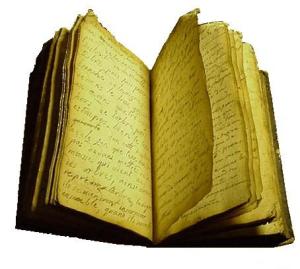
Theorie de la Musique (1857)
… Au dire de Plutarque, les deux plus célèbres musiciens de l’Antiquité, Olympe et Terpandre, ne se servaient jamais que de trois notes…. (p22)
A minor scale can be defined as any scale with a minor scale-tone tonic chord but without a major 3rd (measured from the scale tonic).
The scale must contain:
The minor pentatonic scale and the blues scale are minor scales, but the 8-note dominant scale is not : it contains an ambiguous major 3rd. Neither is the 8-note diminished scale because a minor scale-tone chord can not be formed on its tonic note (it lacks a perfect 5th).
They are (in order of their importance in Jazz):
These minor scales are easiest to recognise by ear by knowing their tetrachord components.
The four component tetrachords are:
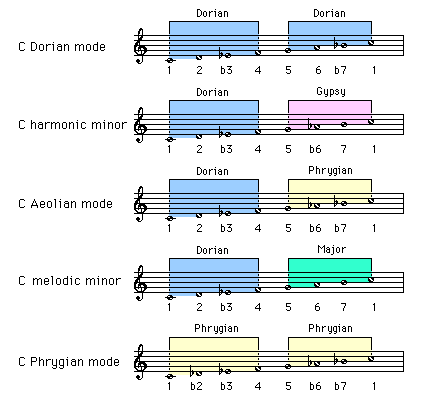
Uses of the minor scales
Below a brief overview of the most common uses for the various minor scales in Jazz improvisation.
1. Dorian mode
This is by far the most commonly used minor scale for Jazz improvisation. Use the Dorian mode over minor chords in these settings.
2. Harmonic minor
This scale is never used over minor 7th chords and only occasionally over minor triads.Use this scale over al IIø – V7 segments in songs.
In the segment Gø – C7 use :
G – Ab – Bb – C – Db – E – F – G (IImode F harmonic minor) over Gø (IIø)
C – Db – E – F – G – Ab – Bb – C (Vmode F harmonic minor) over C7 (V7)
Use the V mode of the harmonic scale over all V7 chords in typically minor songs.
3. Aeolian mode (natural minor scale)
This scale is most commonly used when there are 2 minor 7th chords (which are next to one another on the Circle of Fifths). They then represent two scale-tone chords of a major scale like VIm7 and IIm7, or of a minor scale like Im7 – IVm7.
Use the Dorian mode for the minor 7th chord down stream on the Circle of Fifths.
Use the Aeolian mode for the upstream m7 chord.
Both modes use the same scale tones.
For example for a combination of Cm7 and Fm7 chords use :
C – D – Eb – F – G – Ab – Bb – C (C Aeolian mode) : for Cm7 (VIm7)
F – G – Ab – Bb – C – D – Eb – F (F Dorian mode) : for Fm7 (IIm7)
(Sometimes the C Dorian mode is still preferred over Cm7 to create some additional interest.)
4. Melodic minor
This scale is rarely used for improvisation over minor chords.Its great attraction in Jazz are the modes derived from the melodic minor scale. These are commonly used for altered dominant chords.
5. Phrygian mode
This mode is very prominent in the composition and improvisation over Spanish flamenco music. In Jazz the Phrygian mode is mainly used for scale-tone chord segments that contain three minor 7th chords. They function as : IIIm7 – VIm7 – IIm7. The Phrygian mode is use for the first chord in the row (IIIm7)
In the segment Gm7 – Cm7 – Fm7 use :
G – Ab – Bb – C – D – Eb – F – G (G Phrygian mode) : for Gm7 (IIIm7)
C – D – Eb – F – G – Ab – Bb – C (C Aeolian mode) : for Cm7 (VIm7)
F – G – Ab – Bb – C – D – Eb – F (F Dorian mode) : for Fm7 (IIm7)
Note that all three modes contain the same notes because they are derived from the same major scale. When in doubt as to what scale to use, try out different ones and listen to it.
The ImM7 Chord
Progression: Im – ImM7 – Im7 – VIø – bVImaj7 – V7
The minor Major 7th chord is the scale-tone 7th chord built on the tonic of the harmonic minor scale (and also of the melodic minor scale).
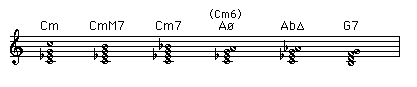
Its main use is as a passing chord between a minor triad and a minor 7th chord.
This chord sequence produces a stepwise (semitone) motion from C –> B –> Bb
The chords produce a continuous line of chord tones that descends stepwise in semitones through the entire progression.
In C minor : C –> B –> Bb –> A –> Ab –> G –> then back to C
This line is most commonly used as a moving bass line
—
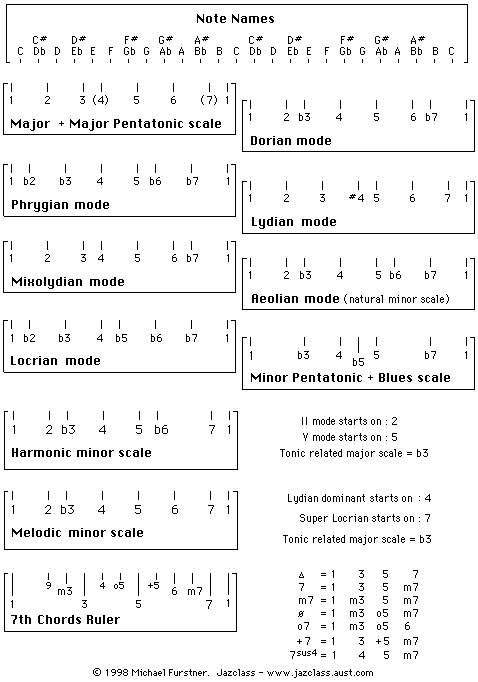

Source: JazClass from Michael Furstner, who developped a very comprehensive Jazz Class course. Thanks to him.

The above association applies to any note of our musical system.
When we play the C for example as a C7 chord it in turn becomes unstable, it assumes to our ear the role of Overtone No.3, and resolves to its Fundamental tone a perfect fifth down, the F.

The F in turn as an F7 chord resolves a fifth down to Bb.
Bb7 resolves a fifth down to Eb, and so on.
Continuing this process from chord to chord we eventually return back to our starting point.
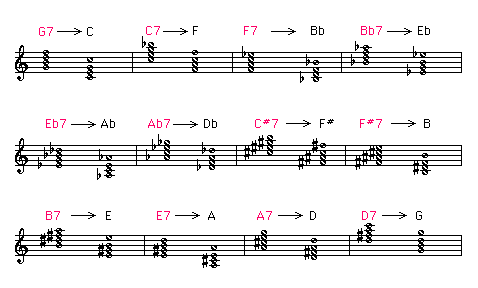
This circle is called the Circle of Fifths.

The Circle of Fifths is sometimes also referred to as the Circle of Fourths.
For moving a perfect 5th downwards (from G down to the C below) is the same as moving a perfect 4th upwards (from G up a 4th to the C above).
Just about every Jazz Standard, exhibits the same principle.
Here a few examples :
Fools Rush In All of Me Heart and Soul
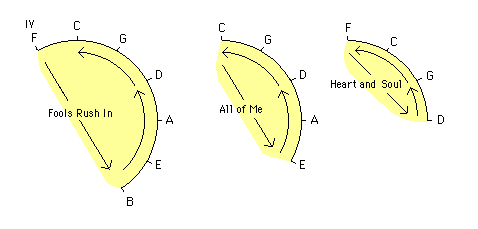
Fmaj7 – Bm7b5 – Em7 – Am7 – Dm7 – G7 – Cmaj7 –
Cmaj7 – E7 – A7 – Dm7 – G7 –
F – Dm – Gm – C – F – Dm – Gm – C –
Blues in F : V = C , I = F , IV = Bb
Blues in A : V = E , I = A , IV = D
etc.
Source: JazClass from Michael Furstner, who developped a very comprehensive Jazz Class course. Thanks to him.

Here the C whole-tone scale.
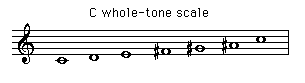 Any of the above notes can form the tonic of the whole-tone scale using the same six notes.
| Scale | Notes |
| C whole-tone scale | C D E F# G# A# C |
| D whole-tone scale | D E F# G# A# C D |
| E whole-tone scale | E F# G# A# C D E |
| F# whole-tone scale | F# G# A# C D E F# |
| G# whole-tone scale | G# A# C D E F# G# |
| A# whole-tone scale | A# C D E F# G# A# |
Jazz improvisers were quick to take up this new sound for improvisation over augmented triads and augmented 7th chords (+7 or 7aug).
Other symmetric scales can be formed by alternating note spacings of tones and semitones. There are two possibilities.
8-note Dominant scale (semitone – tone – semitone – tone -)
This scale starts with a semitone between the tonic and 2nd note, then a tone between the 2nd and 3rd notes, again a semitone between the 3rd and 4th note, and so on.
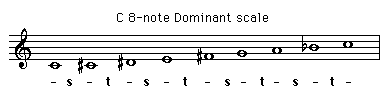
In Jazz this scale is used as an alternative choice for improvisation over dominant 7th and altered dominant 7th chords .
8-note Diminished scale (tone – semitone – tone – semitone – )
This scale starts with a tone between the tonic and 2nd note, then a semitone between the 2nd and 3rd notes, again a tone between the 3rd and 4th note, and so on.
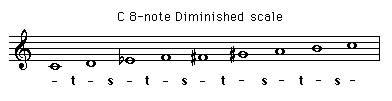
In Jazz this scale is used for improvisation over diminished chords
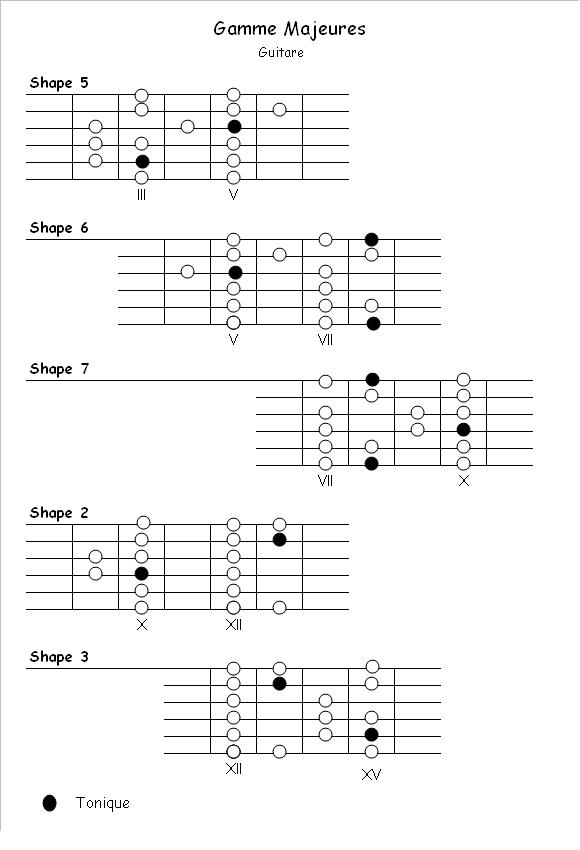
Simple Shapes/patterns to learn and exercise major scales using the five guitar patterns
in C Major
pdf here: The Five Shapes


 :>)azZClefs#