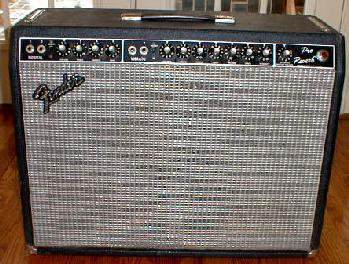
Pro Reverb Fender blackface AA165
Pro Reverb Fender blackface AA165
|
Year: |
1968-1982 |
|
Model: |
Pro Reverb |
|
Circuit: |
AB668, AA1069 |
|
Config: |
Combo |
|
Control Panel: |
Silver, forward facing w/ blue labels |
|
Front Control Layout: |
68-76: Normal: In, In, Bright Sw, Vol, Treb, Bass – Vibrato: In, In, Bright Sw, Vol, Treb, Bass, Rev, Speed, Intensity – Pilot Lamp76-82: Normal: In, In, Bright Sw, Vol, Treb, Mid, Bass – Vibrato: In, In, Bright Sw, Vol, Treb, Mid, Bass, Rev, Speed, Intensity – Master Vol/Boost – Pilot Lamp |
|
Rear Conrol Layout: |
68-76: AC Outlet, Ground Sw, Fuse (2A), Power Sw, Standby Sw, Speaker Jack, Ex. Speaker Jack, Vibrato Jack, Reverb Jack, Reverb Out, Reverb In 76-82: AC Outlet, Ground Sw, Fuse (2½A), Power Sw, Standby Sw, Speaker Jack, Ex. Speaker Jack, Line Out, Tube Matching Adj, Vibrato Jack, Reverb Jack, Reverb Out, Reverb In, Hum Balance |
|
Knobs: |
Black skirted w/ chrome center, numbered 1 – 10 |
|
Cabinet: |
68-69: 19½” x 26½” x 10″ (49.5 x 67.3 x 25.4 cm) 70-82: 19½” x 26″ x 10½” (49.5 x 66 x 25.4 cm) |
|
Cab Covering: |
Black Tolex |
|
Cab Hardware: |
Black strap handle, 5½” Chassis straps, 16″ tilt-back legs, corner protectors, glides (68-71) or casters (72-82) |
|
Grille: |
Blue sparkle grille cloth w/ aluminum frame (68-69) or w/o aluminum frame (70-80) |
|
Logo: |
Grille mounted, raised, chrome & black script “Fender” w/ tail(68-74) or “Fender®” w/o tail (74-82) |
|
Weight: |
58 lbs. (26.3 Kg) |
|
Speakers/Load: |
2 x 12″/4 ohms (8 ohms each in parallel) |
|
Speaker Model: |
Oxford 12L6, Oxford 12T6, Utah 12″, Rola 12″ ceramic |
|
Effects: |
Reverb, Tremolo |
|
Output: |
40 or 70 (late models) Watts |
|
Preamp: |
Normal: 7025 Vibrato: 7025, ½ 7025 |
|
Power: |
2 x 6L6GC |
|
Bias: |
Fixed, adjustment pot (AA668?) or balance pot (AA1069) |
|
Rectifier: |
5U4GB |
|
Phase Inverter: |
12AT7 (long tailed) |
|
Other: |
Reverb Driver: 12AT7 Reverb Recovery: ½ 7025 Tremolo: 12AX7(photoresistor) |
|
Comments: |
|


Serial numbers for the Pro Reverb AA1265, AB668, AA1069, AA270 (silverface)
A10000 to A10500 – 1967
A10500 to A12000 – 1968
A12000 to A13300 – 1969
A13400 to A14500 – 1970
A14500 to A15000 – 1971
A15000 to A15600 – 1972
A15600 to A17200 – 1973
A17200 to A19700 – 1974
A19700 to A20000 – 1975
A20000 to A21500 – 1976
from Greg Galiano
More serial numbers and productions data at 20th Century Guitar Mag
(or here: Dating Fender Amps )
Body size at lower bout: 16″. Scale length: 24.9″ Nut Width: 1 9/16″
S/N 334222 Kalamazoo
Avalaible: 1961 – 1968
Finish: Original sunburst finish, nitrocellulose type
Materials: Solid Honduras mahogany neck; maple top back, and sides; solid Brazilian rosewood fingerboard with pearl parallelogram inlay.
Hardware includes original P-90 pickup with original nickel cover, original nickel trapeze tailpiece, original nickel ABR-1 Tuneamatic bridge with retaining wire; original beveled w/b/w pickguard with nickel support bracket; original nickel-plated Kluson Deluxe tuners; original truss rod cover; original gold reflector cap volume and tone knobs
Notes: John Lennon played one. A true child of the ’60’s, the Epiphone Casino (E230T) debuted in 1961, and came to an early end in 1970. Three decades later, the Casino remains one of Gibson/Epiphone’s most popular reissue guitars, with original examples highly prized by players and collectors alike. The most famous Casino users were Keith Richards of the Rolling Stones, and John Lennon and George Harrison of the Beatles, who were given a pair of Casinos in 1965. Both had a sunburst finish, Georges had a Bigsby vibrato, whilst John’s had a stop tailpiece. It was Lennons of course that had the most use; he was widely pictured with it, and used it extensively live and in the studio. He also had it stripped down in 1968. Epiphone make two John Lennon signature Epiphone Casinos – one based on the unstripped 1965 model, and one, the ‘Revolution’ Casino based on the stripped instrument. Epiphone engineers studied the original guitar to get these signature instruments as exact as possible
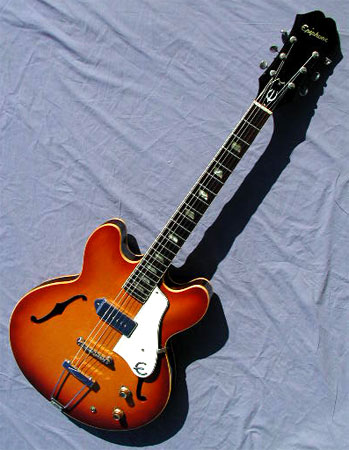 With its fat P-90 pickup and featherweight slimline body, the Casino has surpassed its 60’s counterpart, the Gibson ES-330, in ongoing favor with vintage enthusiasts. The all-hollow thinline profile and absence of superfluous hardware resulted in one of the most lightweight electric guitars ever produced, as well as producing a distictively warm and woody tone. Combined with it’s super fast sixties neck profile, and excellent original jumbo frets, this guitar is incomparably comfortable to hold and just plain fun to play.
Setup: The frets have been precision leveled, recrowned and polished; trussrod tension and neck relief adjusted; bridge height adjusted; bridge compensation set; string slots at nut and bridge inspected and recut as necessary; bridge foot contour inspected and fit to top as necessary; bridge radius inspected and recurved as necessary; bridge wheels and tuners lubricated; fingerboard and bridge oiled; body and neck cleaned and hand polished.
Selmer n°503
(publié par cristof)
C’est une des guitares ayant appartenu à Django. Guitare mythique réalisée dans les ateliers d’Henri Selmer en 1940 après que Maccaferri, parti en 1935, en ait développé le concept. Django décédé en 53, elle a été offerte au musée de la Citée de la musique en 1964. Elle a la particularité de porter son nom sur la tête (comme le modèle 504 de Stochelo) et d’être composée de quatre barrages au lieu de cinq normalement sur les Selmer. Elle est visible (normalement) dans l’exposition permanante située à la Vilette à Paris.
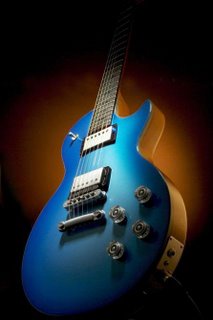 The Gibson HD 6X Pro Electric Guitar sports a traditional Les Paul design so that the musician doesn’t have to compromise on his skills by playing on some weird digital hybrid. The pickups on the HD 6X are a new ‘Hex’ system created by Gibson that uses 6 small humbuckers positioned under each string at the bridge that send 6 individual signals to studio-grade preamps allowing them to be immediately digitized. Gibson HD 6X Pro Electric Guitar ‘Les Paul’ logo These digital signals are then sent to a Breakout Box, known as “BoB,” through a special ethernet port designed by Gibson called ‘MaGIC’ that can carry up to 32 bi-directional channels of audio over a single cable. The BoB can then be connected to a multi-channel sound card where the guitar can be recorded with a piece of professional software such as Cakewalk SONAR which is included with the instrument.
  Playing the Gibson HD 6X Pro Electric Guitar The new Gibson HD 6X-Pro Guitar System comes with all the equipment and music making softwares needed to explore the limitless sonic possibilities it affords today’s guitar players. The Gibson HD 6X Pro Electric Guitar with a Traditional Les Paul design is available for purchase right away and costs around $5,000.

pro reverb silverface
Model/Circuit Number: AB668, AA1069
Years of Production: 1968-1982
Era: Silverface
Configuration: Combo
Controls: Silver, forward facing w/ blue labels
Knobs: Black skirted w/ chrome center, numbered 1 – 10
Faceplate
Cabinet
Covering Material
Logo: Grille mounted, raised, chrome & black script
Weight: 58 lbs. (26.3 Kg)
Speaker
Effects: Reverb, Tremolo
~Watts: 40 or 70 (late models) Watts
Tubes
Bias: Fixed, adjustment pot (AA668?) or balance pot (AA1069)
Rectifier: 5U4GB, Some ’78 and ’79 models had a solid state rectifier.
Comments: * Some of the PRO RVB AA1069 Circuits (Silverface with the Mid control) came with a solid state rectifier. * Fender switched back to the blackface era cosmetics some time in 1980. Pro Reverbs produced between late 1980 and 1982 have a black control panel and silver sparkle grille cloth. * A Boost switch, master volume, and hum balance control was added before Pro Reverb was discontinued.


 :>)azZClefs#